




01. Edit your form online
Type text, add images, blackout confidential details, add comments, highlights and more.

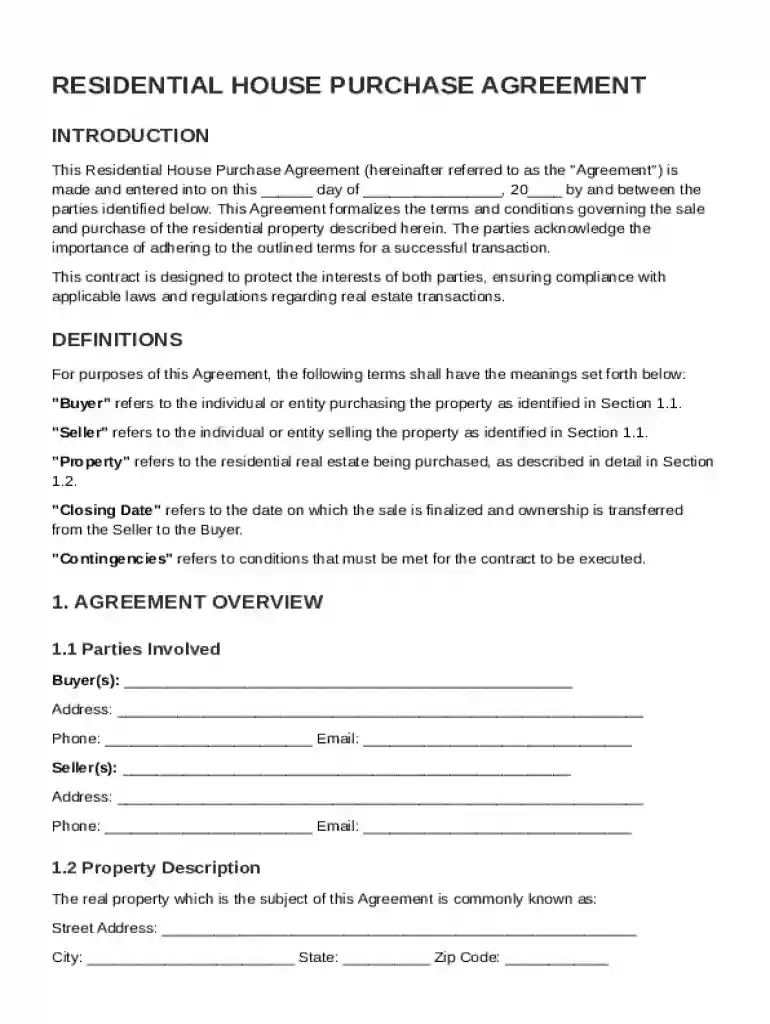
Type text, add images, blackout confidential details, add comments, highlights and more.

Draw your signature, type it, upload its image, or use your mobile device as a signature pad.

Send it via email, link, or fax. You can also download it, export it or print it out.
The House Contract Template is a standardized document used to formalize the terms of a residential property sale between a buyer and a seller. This template sets out the contractual obligations of both parties, providing a clear framework for the transaction. The document typically includes essential clauses covering property details, purchase price, payment arrangements, closing procedures, and more. By employing a template, parties ensure enhanced clarity and compliance with applicable real estate laws, reducing the risk of misunderstandings or disputes.
A House Contract Template comprises several critical sections, each contributing to the document's legal and functional integrity:
These elements ensure both parties have a clear understanding and acceptance of their duties and rights.
Completing a House Contract Template involves several structured steps:
Following these steps helps safeguard both parties' interests and facilitates a smooth transaction.
The legal use of a House Contract Template relies heavily on compliance with state and federal laws governing real estate transactions. The template is designed to align with legal standards, ensuring it meets essential criteria for enforceability. Central to its legality is ensuring that:
Property sales can involve substantial financial and legal repercussions, making the lawful use of such templates imperative.
Real estate laws can vary significantly from one state to another. This variability necessitates careful customization of the House Contract Template based on the governing state:
Understanding and adapting to these state-specific nuances is crucial for the template's successful application.
This template is primarily utilized by individuals and entities engaged in the sale or purchase of residential properties. These can include:
These parties rely on the template to ensure legal accuracy and effective communication.


A few hypothetical scenarios demonstrate the practical utility of the House Contract Template:
These examples illustrate the diverse applications and benefits of this template, ensuring transactions proceed smoothly with reduced risk.
There are distinct considerations when choosing between a digital or paper version of the House Contract Template:
Selecting the appropriate format is crucial and may depend on user preference and jurisdictional requirements.
At DocHub, your data security is our priority. We follow HIPAA, SOC2, GDPR, and other standards, so you can work on your documents with confidence.

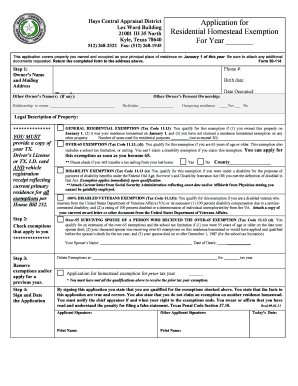
RENT: To pay as rental the sum of $. per month, due and payable in advance from the first day of every month. Failure to pay rent when due will result in the
Nov 17, 2020 Long-term contracts with limited landlord concentration underpinning costs visibility. . Standardised lease contracts across the portfolio.


