






Definition and Purpose of the House Cleaner Contract Template
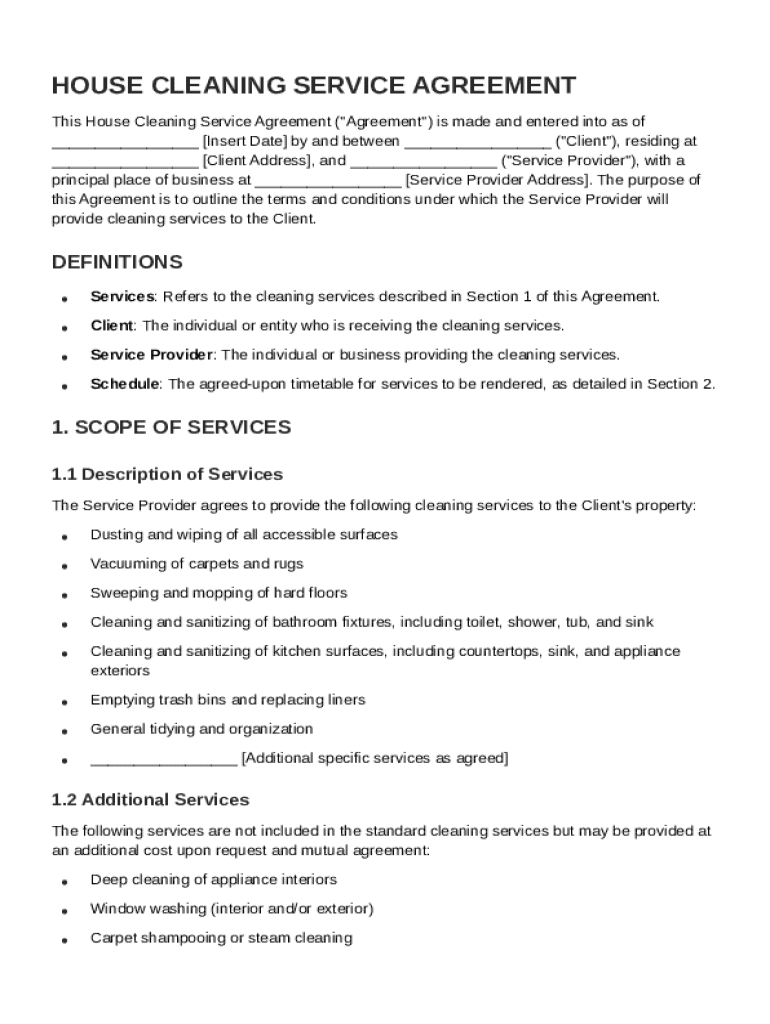
The House Cleaner Contract Template is a critical document that outlines the agreement between a Client and a Service Provider for house cleaning services. It serves as a formal establishment of the terms and conditions, which include the scope of services, payment terms, service schedule, client responsibilities, liability waivers, and confidentiality obligations. This template ensures that both parties have a clear understanding of their roles, responsibilities, and expectations, thereby reducing the likelihood of disputes. Use of this template not only provides a structured framework for service providers and clients but also helps in maintaining professional integrity and transparency in business operations.
Key Elements of the House Cleaner Contract Template
A comprehensive House Cleaner Contract Template includes several crucial sections that articulate the specifics of the cleaning arrangement:
-
Service Scope and Details: This section specifies the cleaning tasks the service provider is expected to perform. It may include regular duties like vacuuming, dusting, and mopping, as well as any special requests or additional services.
-
Payment Terms: Clearly outlines the terms related to compensation, including the agreed-upon rate, payment method, schedule (e.g., weekly, bi-weekly), and any conditions for additional charges.
-
Service Schedule: Defines the days and times the cleaning services will be performed. Flexibility clauses might be included to accommodate changes or cancellations with appropriate notice.
-
Client Responsibilities: Provides a list of client duties, such as providing access to the premises, supplying certain cleaning products, or securing valuable items.
-
Confidentiality and Liability Waivers: Ensures both parties agree on the handling of confidential information and defines liability for potential damages during service.
Steps to Complete the House Cleaner Contract Template
-
Review the Template: Begin by thoroughly reading through the entire document to understand each section.
-
Fill in Personal Details: Enter the name, address, and contact information for both the client and service provider.
-
Specify the Scope of Work: Detail the cleaning tasks and any specific instructions regarding the services.
-
Define Payment and Scheduling Terms: Clearly state the agreed-upon payment terms and service schedule, allowing room for amendments if consensus exists.
-
Outline Responsibilities and Waivers: Record any clauses related to client responsibilities, confidentiality, and liability waivers.
-
Final Review and Signature: Once all information is added, both parties should review the document again, sign, and date it to make it legally binding.
Legal Use of the House Cleaner Contract Template
This contract template is generally used in accordance with state and federal laws governing service agreements. By formalizing the cleaning arrangement, it protects the rights of both parties and helps mitigate legal complications. The template should comply with employment laws, especially if the service provider operates as an independent contractor. To ensure legality, it may be supplemented with necessary disclosures or legal advice, particularly if state-specific regulations apply.
Important Terms Related to the House Cleaner Contract
Understanding the terminology used within a House Cleaner Contract Template can aid in a clearer interpretation of the document:
-
Independent Contractor: Refers to the service provider operating independently, not as an employee, thus affecting tax obligations and labor law applications.
-
Force Majeure: Clauses that address unforeseen events which may cause a delay or hinder the fulfillment of contractual obligations.
-
Termination Clause: Specifies the conditions under which the contract can be terminated by either party.
-
Binding Agreement: Indicates that the contract is enforceable by law once it has been signed by all parties involved.
Who Uses the House Cleaner Contract Template?
Typically, this contract template is used by domestic service providers, cleaning companies, individual cleaners, and homeowners who wish to formalize their cleaning agreements. It is particularly beneficial for self-employed cleaners wishing to validate their business transactions and protect their interests legally. Clients, ranging from busy professionals to large households requiring regular cleaning services, also leverage this template to establish clear expectations and terms.
Examples of Using the House Cleaner Contract Template
Consider a scenario where a homeowner hires a cleaning company for bi-monthly deep cleaning services. Using the contract template, both parties agree on the tasks, such as carpet steam cleaning and window washing, and establish the conditions under which these services will be rendered. Another example might involve an apartment dweller who contracts a freelance cleaner for weekly upkeep. Here, the template helps to define weekly tasks, timeframes, and payment plans, ensuring that expectations are communicated and met.
State-specific Rules for the House Cleaner Contract Template
While the House Cleaner Contract Template serves as a foundational document, variations may exist due to state-specific regulations. Certain states may have unique requirements related to service agreements, independent contractor status, or consumer protection laws. Checking with local regulations, such as those governing labor, privacy, and taxation, is advisable to ensure compliance. For instance, California has specific employment laws that define worker classifications, affecting terms outlined in contracts with house cleaners.
How to Use the House Cleaner Contract Template
To effectively use the House Cleaner Contract Template, it should be tailored to fit the specific needs of the service arrangement. Parties involved should discuss and agree on all essential terms before adding them to the template. Utilizing digital tools like DocHub can streamline this process by allowing users to edit, annotate, and sign the document online, facilitating seamless collaboration between the client and service provider without requiring physical meetings. This not only enhances efficiency but also supports the secure exchange of legally binding agreements.