
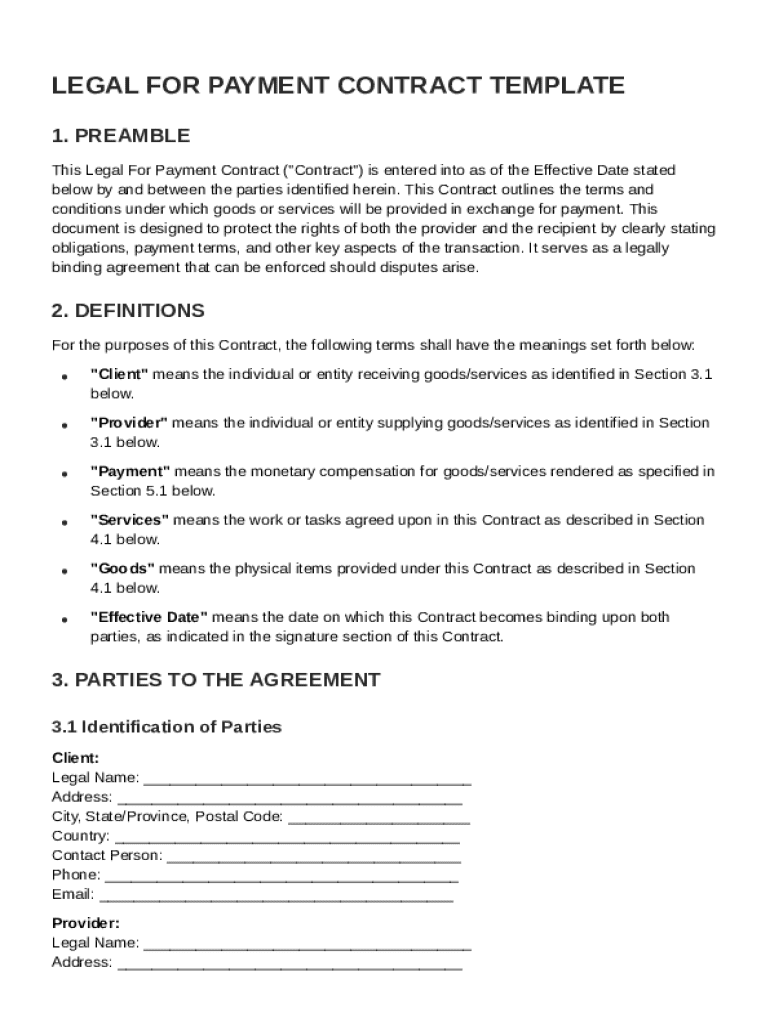







Key Elements of the Legal For Payment Contract Template
The Legal For Payment Contract Template is a comprehensive agreement that sets the foundation for a transaction involving goods or services in exchange for payment. Understanding the key elements within this template is crucial to ensure the document is informative and enforceable.
-
Definitions of Key Terms: This section clarifies specific terms used throughout the contract to prevent ambiguity and misinterpretation. You may find definitions for phrases like "Scope of Work," "Payment Terms," and "Governing Law." By providing precise meanings, the contract ensures all parties have a common understanding of the language used.
-
Identification of Parties: It is essential to accurately identify the parties involved in the contract. This includes providing full legal names, addresses, and contact information for both the provider and the client. Such details are critical for establishing accountability and legal acknowledgment of the agreement.
-
Scope of Work: This component outlines the specific tasks, goods, or services to be provided. It serves as a reference point to measure the contract's performance and delivery. A well-defined scope eliminates discrepancies about what is to be delivered and helps in managing expectations.
-
Payment Terms: Clear payment terms are vital for a successful business relationship. This part should include the payment amount, schedule, method of payment, and any conditions regarding late payments or discounts for early settlement. Understanding these terms ensures smooth financial transactions between parties.
Steps to Complete the Legal For Payment Contract Template
Completing the Legal For Payment Contract Template requires careful attention to detail. Follow these steps to ensure the document is accurately filled out and legally binding.
-
Gather Necessary Information: Before beginning, collect all relevant information about the parties involved and specifics about the work and payment terms. This preparation sets a clear path for filling out the contract accurately.
-
Fill Out Identifying Details: Input the legal names, addresses, and contact numbers of both parties in the designated areas. Ensure that these details match any supporting documentation to avoid any contractual disputes.
-
Outline the Scope of Work: Clearly define the duties, services, or products promised. Specify delivery timelines and quality standards, as ambiguity in this section can lead to misunderstandings and potential conflicts.
-
Draft Payment Terms: Complete this section by detailing payment amounts, schedules, and methods. Include any stipulations for late fees or bonuses for early payments to cover all possible financial scenarios.
-
Include Confidentiality Clauses: If sensitive information is involved, make use of confidentiality clauses to protect data and trade secrets. Specify what information needs protection and the duration of its confidentiality.
Who Typically Uses the Legal For Payment Contract Template
This template is widely utilized across various industries and by different business entities to formalize transactions. Understanding the typical users can provide insights into its applicability and functionality.
-
Small and Medium Enterprises (SMEs): SMEs frequently use such templates to ensure they receive payment for goods or services rendered. It helps protect their interests in the competitive marketplace.
-
Freelancers and Independent Contractors: Freelancers rely on this contract to clearly define payment terms and deliverables, providing them with security and legitimacy in their business dealings.
-
Corporate Entities: Corporations often engage in complex transactions requiring detailed agreements. This template aids in setting professional standards for negotiation and transaction finalization.
-
Service Providers: Businesses offering services like consultancy, design, or repairs implement such contracts to specify the terms of service provision, thereby avoiding potential conflicts with clients.


Important Terms Related to Legal For Payment Contract Template
Understanding important legal terms related to the Legal For Payment Contract Template is fundamental for accurately using and enforcing the contract.
-
Consideration: In contract law, consideration refers to the value exchanged between parties. In this template, it usually comprises the price paid for services or goods received.
-
Breach of Contract: This occurs when one party does not adhere to the agreed terms. The template should specify the consequences and remedies available in the case of a breach.
-
Force Majeure: This clause protects parties from liability due to unforeseeable events that prevent fulfilling the contract obligations. It's crucial to specify what constitutes such events.
-
Indemnification: This provision involves one party agreeing to compensate the other for any loss or damage that arises during the contract's execution. Clarifying indemnity terms can prevent prolonged legal disputes.
Legal Use of the Legal For Payment Contract Template
Ensuring that the Legal For Payment Contract Template is legally sound involves understanding specific legal principles and regulations that govern the use of such documents.
-
Compliance with ESIGN Act: For electronic transactions, the ESIGN Act in the U.S. recognizes electronic signatures and records as legally valid, ensuring enforceability when using platforms like DocHub.
-
State Laws: The template must be aligned with the state laws applicable to the contracting parties. This affects how certain clauses are interpreted and enforced.
-
Confidentiality Agreements: Protecting sensitive information requires carefully worded confidentiality clauses. Legal guidelines ensure these provisions are binding and properly executed.
-
Dispute Resolution: Legal routes such as mediation, arbitration, or litigation should be outlined for resolving disputes. The choice of method influences the contract's legal strategy and resolution speed.
Examples of Using the Legal For Payment Contract Template
Real-world scenarios illustrate the application and advantages of the Legal For Payment Contract Template.
-
Freelance Designer Agreement: A freelance designer uses the template to set terms for project deliverables and payment schedules. This prevents any potential issues related to scope of work or non-payment.
-
Consultancy Services Contract: A consultancy business enters an agreement with a corporate client to formalize the terms of service provision and payment. This provides a transparent framework to base the relationship on.
-
Supplier Agreement for Retail Business: A supplier uses the template to define terms of product delivery and payment in a retail deal, ensuring mutual understanding and enforcing compliance.
-
Joint Venture Agreement: Companies entering a joint venture can use the template to establish the provisions for contributions, distribution of profits, and termination conditions.
State-Specific Rules for the Legal For Payment Contract Template
Certain provisions of the Legal For Payment Contract Template might need customization based on the state where it is executed. Understanding these variations ensures compliance and enforceability.
-
Governing Law Clause: The contract should specify which state laws apply in case of disputes. This choice can significantly impact legal proceedings and the interpretation of the contract.
-
Payment Regulations: Some states have specific regulations concerning payment timelines, interest on late payments, and allowable deductions. Ensuring compliance with these rules avoids legal complications.
-
Licensing Requirements: Depending on the services or goods, parties might need specific licenses to execute the contract legally in certain states. Checking these conditions is crucial for validity.
-
Non-Compete Clauses: The enforceability of non-compete clauses can vary widely across states. Customizing this clause to fit state regulations ensures its legality and effectiveness.
Versions or Alternatives to the Legal For Payment Contract Template
Exploring variations and alternatives to the Legal For Payment Contract Template can introduce different approaches and scope for specific needs.
-
Standard Contract for Services: This version is widely used in situations requiring service provision for an agreed fee. It focuses primarily on performance specifications and payment details.
-
Sales Agreement: For transactions involving goods, a sales agreement template might be more appropriate, detailing the selling price, warranty terms, and delivery conditions.
-
Memorandum of Understanding (MOU): In scenarios requiring flexibility, an MOU outlines the mutual understanding without legally binding terms. It is suitable for preliminary negotiations.
-
Letter of Intent (LOI): This document precedes a detailed contract and states preliminary terms. It indicates a willingness to enter the contract, helping clarify initial intentions.




