




01. Edit your form online
Type text, add images, blackout confidential details, add comments, highlights and more.

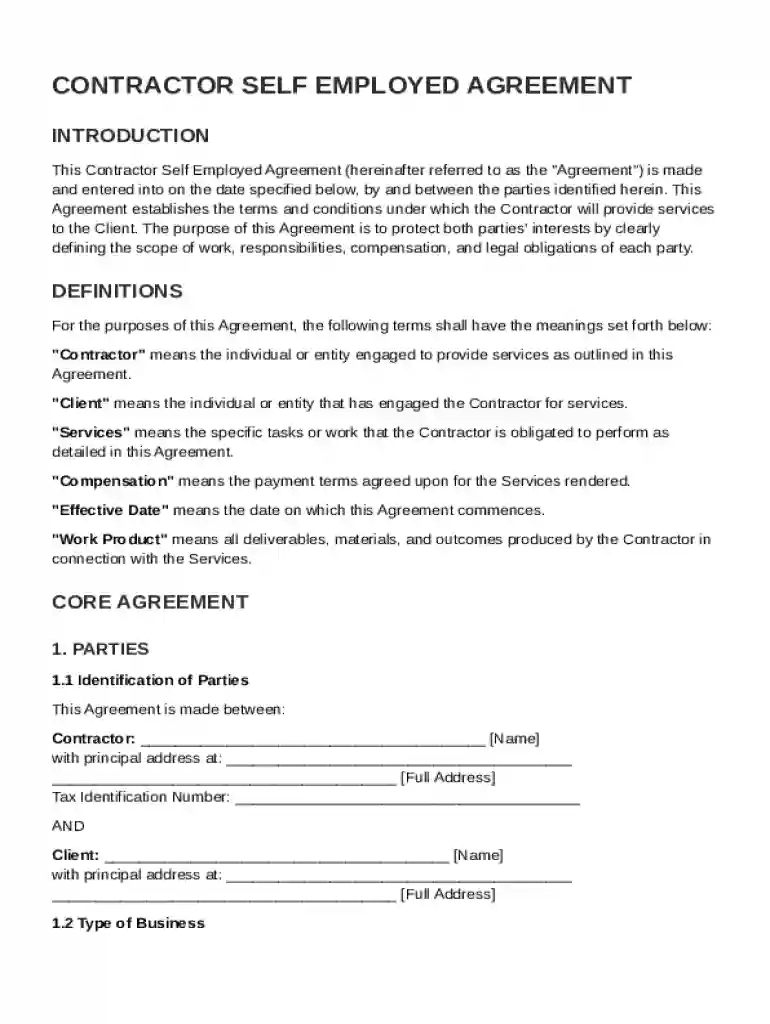
Type text, add images, blackout confidential details, add comments, highlights and more.

Draw your signature, type it, upload its image, or use your mobile device as a signature pad.

Send it via email, link, or fax. You can also download it, export it or print it out.
The Contractor Self Employed Agreement Template outlines the terms established between a contractor and a client when the contractor provides services as an independent entity. This agreement is vital in clarifying the obligations, roles, and responsibilities of both parties. By defining elements such as the scope of work, payment terms, confidentiality, and dispute resolution, the template ensures mutual understanding and reduces potential conflicts. For independent contractors, it serves as a formal document that can help verify their status for tax purposes, protecting both parties from potential IRS misclassifications and providing legal clarity.
The template for a Contractor Self Employed Agreement comprises several fundamental components, each crucial for delineating the parameters of the professional relationship:
Scope of Work: Defines the specific tasks the contractor is expected to complete. It may include deadlines, milestones, and quality standards.
Compensation Terms: Outlines payment details, including the amount, payment schedule, and method of payment.
Confidentiality Obligations: Specifies which information must remain confidential and any consequences for breaches.
Intellectual Property Rights: Clarifies who owns any intellectual property created during the agreement.
Indemnification Clauses: Determines liability protections for both parties if a lawsuit occurs due to performance under the agreement.
Governing Law: Specifies the jurisdiction's laws that will enforce the agreement, often the contractor's or client's home state.
Using the Contractor Self Employed Agreement Template effectively entails several systematic steps to ensure legal compliance and a clear framework for the working relationship:
Customize Template: Tailor the template to reflect specific project details, including precise roles and expectations.
Review Key Terms: Both parties should review terms together to ensure clarity and agreement on all aspects, suggesting edits where necessary.
Legal Review: Consider having a legal professional review the agreement to ensure it adheres to local laws and industry standards.
Signatures: Ensure both parties sign the document, evidencing their consent to the terms outlined.
Through this process, parties can establish a mutual understanding and ensure that the agreement meets legal standards.
Completing the Contractor Self Employed Agreement requires diligence and attention to detail, as follows:
Obtain the Template: Start by downloading a ready-made template that suits your needs from a trusted platform like DocHub.
Fill Out Contractor Details: Include full names, contact information, and business addresses for both the contractor and the client.
Define Project Specifications: Clearly lay out the project scope, deliverables, and deadlines.
Outline Payment Terms: Specify how and when payments will be made, including any invoicing requirements.
Set Confidentiality and IP Terms: Detail the nature of the confidential information, IP ownership, and usage rights.
Review and Edit: Carefully review the completed form and make any necessary edits for clarity.
Following these steps helps ensure accurate documentation and smooth workflow.
Understanding and adhering to legal requirements is essential when utilizing a Contractor Self Employed Agreement:
Compliance with Local Laws: Each state may have different regulations regarding contractor agreements; ensure conformity with local laws.
IRS Classification: Correctly classifying the worker as an independent contractor versus an employee under IRS guidelines helps avoid penalties.
Record Keeping: Maintain a copy of the signed agreement for future reference in case any disputes arise.
These steps protect both parties and promote a legally compliant business relationship.
Real-world scenarios showcase the applicability and utility of the Contractor Self Employed Agreement Template:
Graphic Design Consultant: A designer contracted to create branding materials for a company defines project timelines and ownership of final designs within the agreement.
Software Developer: A freelance developer uses the template to specify deliverables and payment milestones for a custom software project.
Marketing Specialist: A specialist outlines a series of campaigns, performance metrics, and confidentiality requirements about customer data.
Each example highlights how the template protects the interests of both parties and sets clear expectations.
Certain business entities particularly stand to benefit from using a Contractor Self Employed Agreement Template:
Startups: Often hire freelancers for flexibility and require clear agreements to protect intellectual property.
Small Businesses: Use contractors for seasonal work or specialized tasks needing clear terms of engagement.
Agencies: Regularly collaborate with freelancers and must establish consistent frameworks for various projects.
These organizations benefit greatly from the clear, structured expectations the template provides.
The Contractor Self Employed Agreement Template is compatible with various digital tools, simplifying its integration into modern workflows:
Document Editors: The template can be edited using software like Microsoft Word, Google Docs, or DocHub's own editing tool.
Integration with DocHub: Users can take advantage of DocHub's collaborative tools to share and edit the template with stakeholders, ensuring up-to-date versions.
Cloud Storage: Store the completed agreement in cloud services like Google Drive or Dropbox for easy access and sharing.
The technological flexibility enhances efficiency and client satisfaction, supporting seamless contract management.
At DocHub, your data security is our priority. We follow HIPAA, SOC2, GDPR, and other standards, so you can work on your documents with confidence.




Sample Independent Contractor Agreement. This Agreement is made between. (Client) with a principal place of business at
May 12, 2012 COFESA, Contractors, and contracts of employment. Determining the existence of a contract of employment has always been difficult.


