
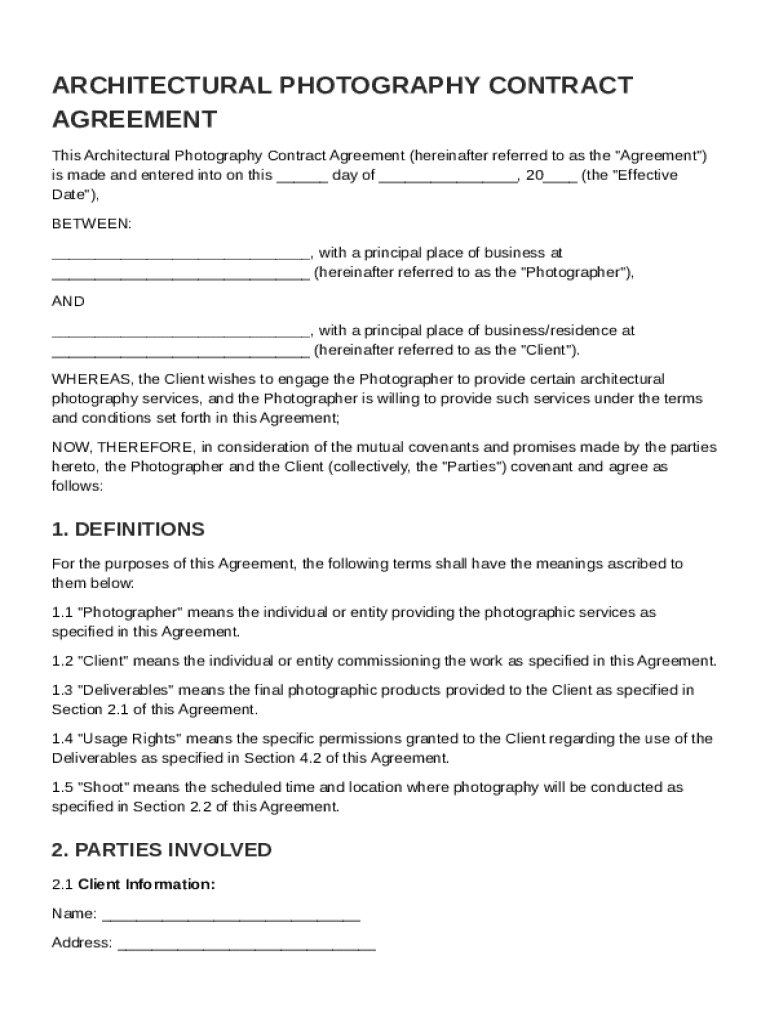







Key Elements of the Architectural Photography Contract Template
The Architectural Photography Contract Template serves as a detailed agreement between a photographer and a client, defining the specifics of an architectural photography engagement. Critical elements include:
-
Scope of Work: Outlines the specific architectural sites or subjects to be photographed, session dates, and expected deliverables. This ensures both parties have a mutual understanding of the project.
-
Payment Terms: Details the agreed fees for services, schedule for payments, and any conditions under which additional charges may occur, such as overtime or additional edits.
-
Copyright and Usage Rights: Specifies who owns the produced images and how the client may use them. Often, the photographer retains copyright, granting limited rights to the client for specified uses.
-
Client Responsibilities: Any obligations the client must fulfill, such as granting site access, ensuring the area is clear for the shoot, and confirming any shoot specifics to prevent misunderstandings.
-
Cancellation Policy: Terms governing the cancellation or rescheduling of the shoot, including any fees applicable for cancellations within a specified timeframe.
-
Liability Limitations: Stipulations around the photographer’s liability concerning delays, missed shots, or unsatisfactory photographs due to unforeseeable circumstances.
How to Use the Architectural Photography Contract Template
Adopting the Architectural Photography Contract Template involves a methodical approach to ensure comprehensive coverage of the agreement terms:
-
Customization: Tailor the template to align with the specifics of the photography project, adjusting fields related to the project scope, pricing, and usage terms.
-
Review and Adjust: Ensure all details accurately reflect mutual agreements. This might involve modifying clauses related to liability, copyright, or other legal stipulations to match specific state laws or personal preferences.
-
Consultation with Legal Counsel: Especially if the template is being used as a standard contract for ongoing business, a legal professional should review it to confirm enforceability and compliance with local regulations.
-
Clarification with Clients: Discuss every section with the client to avoid any misinterpretations and confirm mutual understanding.
-
Final Modifications: Make any final adjustments based on client feedback, ensuring all terms are satisfied before finalizing the contract.
Legal Use of the Architectural Photography Contract Template
The utilization of the Architectural Photography Contract Template must adhere to legal guidelines to ensure enforceability:
-
Compliance with Local Law: Verify that the contract aligns with state laws governing contracts and photography agreements.
-
Valid Consideration: Ensure the contract includes an exchange of value (monetary or otherwise) to support legality.
-
Mutual Assent: Both parties must willingly agree to the contract terms without coercion, guaranteeing a valid agreement.
-
Proper Signatures: Obtain signatures from all involved parties, ensuring an authorized representative for any corporate or business entity signs.
-
Dispute Resolution: Consider incorporating a clause for resolving disputes, which might stipulate mediation or arbitration as a preferred method.
Steps to Complete the Architectural Photography Contract Template
Completing the Architectural Photography Contract Template systematically ensures all necessary components are addressed:
-
Input Basic Information: Add the photographer and client names, contact details, and the date of the contract.
-
Detail Project Specifications: Clearly describe the scope of the architectural photography services, including subjects, locations, and timelines.
-
Set Payment Details: Specify payment amounts, schedules, and conditions, including deposits and final payments upon delivering services or products.
-
Outline Rights and Restrictions: Define who holds the copyright of images and any specific usage rights granted to the client.
-
Draft Terms and Conditions: Complete sections on liability, client obligations, cancellation procedures, and any particular terms warranted by the engagement.
-
Review and Finalize: Check for completeness and accuracy, then print and collate for the involved parties’ signatures to execute the agreement.
-
Secure Signed Copies: Retain copies signed by all parties for record-keeping, confirming the agreement’s validity.
Who Typically Uses the Architectural Photography Contract Template
Various professionals within the photography and design industries utilize this contract to streamline their engagements:
-
Architectural Photographers: Use this template to formalize agreements with architects, real estate developers, and commercial clients who require high-quality images of properties or structures.
-
Real Estate Agencies: Agencies hiring photographers for property marketing use this contract to define expectations and manage deliverables.
-
Architectural Firms: Engage photographers using this template to ensure symmetry between visual content needs and resources offered by photography professionals.
-
Construction Companies: Document and formalize visual project milestones and promotional photo shoots through a structured agreement.
-
Creative Agencies: For agencies managing multiple photographers or projects, the template standardizes contracts and aids in clear communication.


Important Terms Related to the Architectural Photography Contract Template
Familiarity with specific terminology within this contract ensures clarity and alignment between parties:
-
License: Refers to the permissions the photographer grants to the client regarding the use of images, often specifying print, online, or various other rights.
-
Work for Hire: Indicates a scenario where the photographer’s services render outputs directly owned by the commissioning party rather than retaining artist copyright.
-
Indemnification: A clause requiring one party to compensate the other in case of losses or damages, enhancing risk management for the photographer.
-
Force Majeure: A critical inclusion, detailing conditions under which contractual obligations could be rendered void due to uncontrollable circumstances (e.g., natural disasters).
-
Retainer: Advance payment securing the photographer’s services for the agreed period, often non-refundable to ensure minimal financial losses.
State-Specific Rules for the Architectural Photography Contract Template
Photography contracts are subject to variations in state regulations and customary practices:
-
State Licensing Requirements: Certain states require businesses or professional photographers to hold specific licenses, impacting both enforceability and legitimacy.
-
Data Protection Laws: Rules such as the California Consumer Privacy Act influence contracts regarding storage and use of personal data or images containing identifiable individuals.
-
Liability Limitations: States differ on how strictly they interpret liability clauses, which can affect how these are drafted, particularly for negligence.
-
Sales Tax on Services: Applicable in some states, affecting how pricing within contracts accounts for these taxes, requiring clear disclosure in terms.
-
Consumer Rights Regulations: States like New York have specific conditions concerning unsolicited contracts and cancellation rights, markedly affecting contract terms.
Examples of Using the Architectural Photography Contract Template
Understanding practical scenarios can highlight how this contract is employed across various situations:
-
High-End Residential Photography: A photographer might use the contract to provide clarity on the number of images delivered, retouching practices, and expected turnaround times.
-
Commercial Property Development: For large-scale projects, the template facilitates clear communication about progress documentation, deliverable timelines, and associated fees.
-
Historic Building Architecture: Projects requiring specific stylistic treatment, where the contract helps delineate explicit artistic directions and copyright negotiations.
-
Real Estate Marketing Campaigns: The template handles variations in image usage rights, detailing whether images serve for advertising, editorial, or both.
-
Artistic Collaborations: In instances where a photographer collaborates with multiple entities, a clearly defined contract helps allocate rights and responsibilities for each contributor effectively.




