




01. Edit your form online
Type text, add images, blackout confidential details, add comments, highlights and more.

Type text, add images, blackout confidential details, add comments, highlights and more.

Draw your signature, type it, upload its image, or use your mobile device as a signature pad.

Send it via email, link, or fax. You can also download it, export it or print it out.
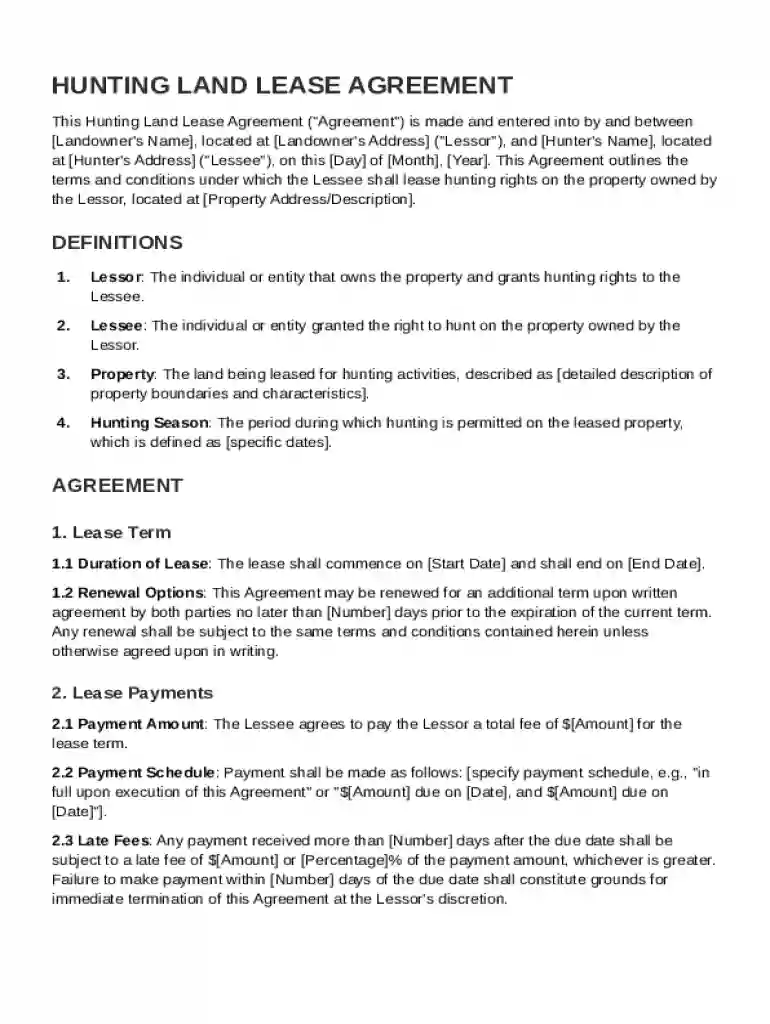
A Hunting Land Lease Agreement is a legal document that establishes the relationship between a landowner (Lessor) and a hunter (Lessee). It formalizes the Lessee's right to access the designated property for hunting. This agreement serves to outline the specific terms, conditions, and responsibilities of both parties involved, ensuring clarity and legal compliance. Key components typically include specifics such as the duration of the lease, payment terms, authorized hunting activities, and liability provisions. By signing this agreement, both parties safeguard their interests and outline mutual expectations, reducing potential disputes.
Understanding the essential elements of the Hunting Land Lease Agreement is crucial for both parties:
These elements provide a structured framework to guide the relationship between the Lessor and Lessee, ensuring both parties understand their rights and obligations.
Completing a Hunting Land Lease Agreement involves several steps to ensure accuracy and comprehensiveness:
Thoroughness in each of these steps helps to create an enforceable and clear agreement tailored to the specific needs of the Lessor and Lessee.
The Hunting Land Lease Agreement must comply with local and federal laws, including property and hunting regulations. Key legal requirements often involve:
Ensuring legal compliance helps to protect the interests of both parties and maintain a lawful hunting environment.
This template is typically used by:
By creating a mutual understanding of rights and responsibilities, the agreement benefits all parties involved.
Familiarity with specific terminology used in the agreement is essential:
Understanding these terms helps in accurately interpreting the agreement and prevents potential misinterpretations.
While a Hunting Land Lease Agreement maintains a standard structure, state laws can affect:
Each state’s unique regulations impact how the agreement is drafted and executed, making local legal consultation advisable.
Real-world scenarios where this template proves beneficial include:
These examples demonstrate the flexibility of the agreement in accommodating diverse needs and facilitating various arrangements.
Acquiring a Hunting Land Lease Agreement Template can be straightforward:
Selecting the right method depends on individual needs and the level of customization required.
At DocHub, your data security is our priority. We follow HIPAA, SOC2, GDPR, and other standards, so you can work on your documents with confidence.


This Hunting Lease Agreement is made by and between (Landowner), hereinafter called LESSOR, and (Hunters), hereinafter called LESSEES. [The
Lessee shall not make any alteration, addition or improvement, including permanent blinds or tree stands, to the Premises, nor raze any improvement, without.
FOREWORD. The concept of Best Available Techniques (BAT) plays a very important role in the assessment of the requirement level of environmental protection


