




01. Edit your scatterplot data sheet online
Type text, add images, blackout confidential details, add comments, highlights and more.

Type text, add images, blackout confidential details, add comments, highlights and more.

Draw your signature, type it, upload its image, or use your mobile device as a signature pad.

Send scatterplot data sheet aba via email, link, or fax. You can also download it, export it or print it out.
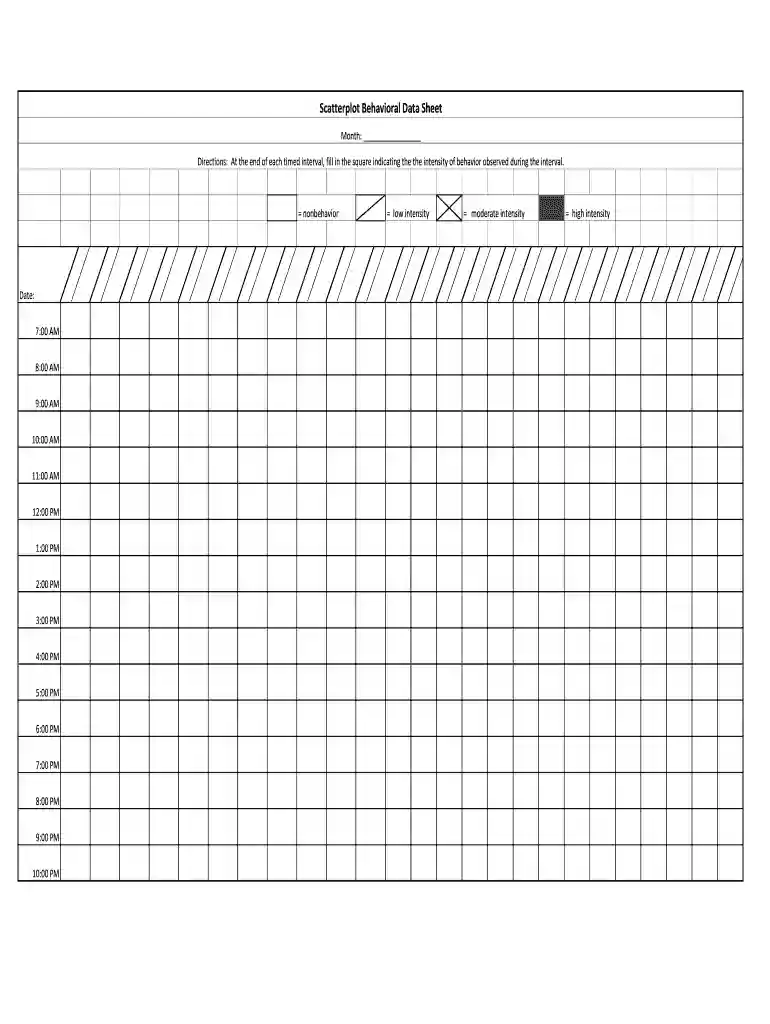
The IA Scatterplot Behavioral Data Sheet is a specialized document designed to systematically track and analyze behavioral patterns over time. By recording specific behaviors at designated hourly intervals throughout a given day, this sheet allows users to identify trends and fluctuations in behavior intensity—high, moderate, low, or nonbehavior. The data collected can be pivotal in behavioral assessments, especially within educational and therapeutic settings, where understanding such patterns can inform intervention strategies.
This data sheet not only aids in recording observed behaviors but also serves as an analytical tool for practitioners. By aggregating data over weeks or months, professionals can derive insights into the effectiveness of treatment plans or educational strategies. For example, an educator might use the sheet to monitor a student's engagement during different subjects, allowing for adjustments tailored to the student’s specific needs.
Utilizing the IA Scatterplot Behavioral Data Sheet involves several critical steps that ensure accurate data gathering and effective analysis.
An exceptional application could be seen in a behavioral therapy setting, where practitioners monitor a client’s anxious behaviors throughout the week. By utilizing this data sheet, they can identify specific triggers or times of day when anxiety peaks, enabling them to create more effective coping strategies.
Providing concrete examples enhances understanding and showcases the practical use of the IA Scatterplot Behavioral Data Sheet.
In an elementary classroom, a teacher can employ the scatterplot data sheet to observe student engagement levels during various activities. By marking behaviors such as participation, distraction, or aggression, the teacher can later analyze the data to ascertain which activities promote positive engagement and which do not.
In a therapy setting, a clinician might document aggressive outbursts in a child. The IA Scatterplot Behavioral Data Sheet enables the clinician to note the frequency and circumstances surrounding these outbursts, facilitating a comprehensive understanding of the child's behavioral triggers.
The effectiveness of the IA Scatterplot Behavioral Data Sheet hinges on several key elements that contribute to its functionality.
Detailed recording on the IA Scatterplot Behavioral Data Sheet provides significant benefits, including:
Understanding specific terminology is essential when utilizing the IA Scatterplot Behavioral Data Sheet effectively.
Incorporating the IA Scatterplot Behavioral Data Sheet into behavioral assessments provides several compelling advantages.
By utilizing the IA Scatterplot Behavioral Data Sheet, individuals—whether they are teachers, therapists, or caregivers—can enhance their ability to understand and support behavioral development and interventions effectively.
Managing your forms with DocHub this way is very straightforward after you have downloaded its extension for Google Chrome. Navigate to the Chrome Web Store and set up DocHub - Sign PDF from Gmail to get it. Give our tool access to your Google account, and then open an email containing scatterplot aba data sheet as an attachment and point to the file with your cursor - the DocHub extension key will automatically show up there. Click on it to open your file in our editor. Make any required modifications, fill out the blanks, and click Sign to create your legally-binding electronic signature.
You need only an internet connection and a web browser to complete your aba scatterplot data sheet by using an iOS phone. Open the DocHub website and authenticate. Then, add your file or choose it from the list in your dashboard. Then use our editing instruments to complete your form and save all your modifications. You can also send it to a dedicated recipient immediately.
At DocHub, your data security is our priority. We follow HIPAA, SOC2, GDPR, and other standards, so you can work on your documents with confidence.
A scatter plot can help to identify the patterns of responding in natural settings. Severe problems often occur in short bursts of responding alternatingRead more
In this tutorial, well learn how to use Meerkat to explore a dataset of images. Well use the imagenette dataset, a small 10-class subset of ImageNet.Read more
Sample Resource: Scatterplot Data Sheet 1. Used to identify patterns and trends in a target behavior over time, to pinpoint when.Read more


