




01. Edit your form online
Type text, add images, blackout confidential details, add comments, highlights and more.

Type text, add images, blackout confidential details, add comments, highlights and more.

Draw your signature, type it, upload its image, or use your mobile device as a signature pad.

Send it via email, link, or fax. You can also download it, export it or print it out.
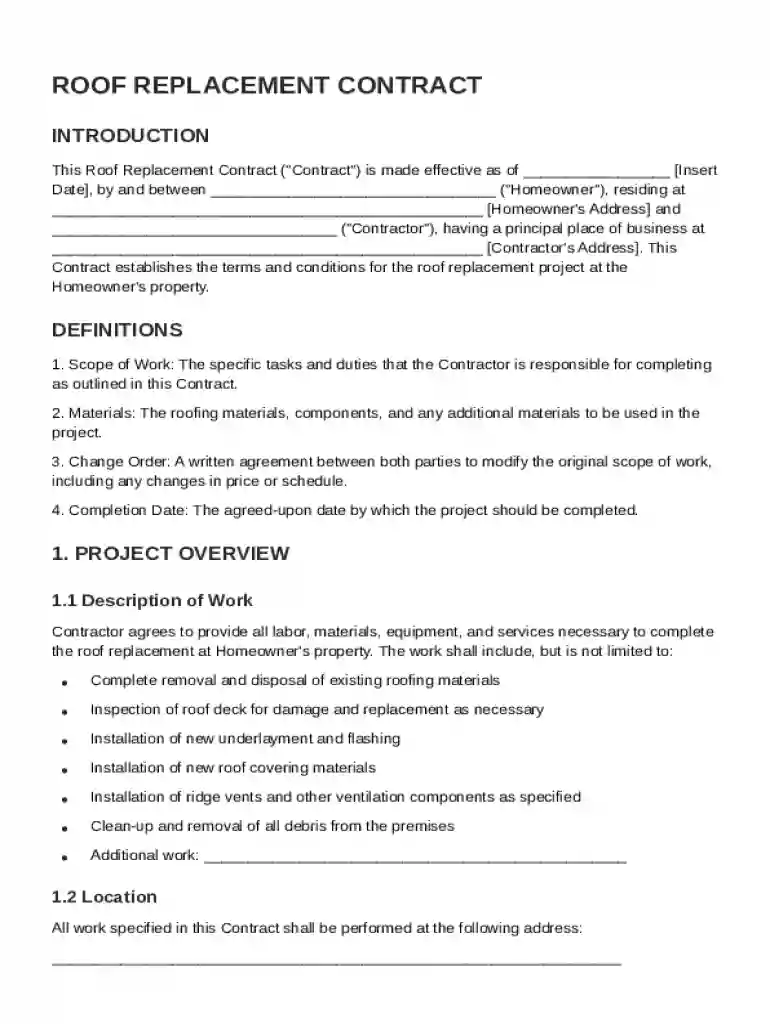
A Roof Replacement Contract Template is a structured document that outlines the agreement between a homeowner and a contractor for a roof replacement project. It serves as a formal record of the terms and conditions agreed upon by both parties. This contract includes essential details such as the scope of work, payment terms, project timeline, and responsibilities, ensuring that there is a clear understanding of each party's obligations. By providing a comprehensive framework, this template helps mitigate misunderstandings and disputes throughout the project lifecycle.
Utilizing a Roof Replacement Contract Template provides assurance and clarity for both homeowners and contractors. It establishes a legal foundation that outlines expectations and responsibilities, minimizing conflict and ensuring smooth project execution. The template helps ensure compliance with relevant laws and regulations, safeguarding both parties' interests.
Using the Roof Replacement Contract Template involves several steps to tailor it to the specific needs of your roofing project. Properly customizing the template ensures all relevant details are covered and aligns the contract with the specific requirements of the project.
For a project involving the replacement of asphalt shingles, clearly specify the type of shingles, installation method, and related costs in the template to ensure complete clarity.
The Roof Replacement Contract Template includes several critical elements that ensure both parties have a mutual understanding of the project details. By including each element, the template provides a comprehensive framework for project execution.
The Roof Replacement Contract Template serves as a legally binding document, ensuring that the project is conducted in accordance with applicable laws. It is vital to understand its legal implications and how it fits into broader legal frameworks governing construction contracts.
This contract template is primarily used by homeowners and roofing contractors. It caters to anyone involved in roof replacement projects who require a clear, formalized agreement outlining both parties' roles and responsibilities.


The Roof Replacement Contract Template is used in various scenarios where roof replacement is needed. Understanding how it can be applied in real-life examples provides insight into its utility and flexibility.
Different states may have varying rules and regulations regarding construction contracts, which can impact how the Roof Replacement Contract Template is drafted and enforced.
By understanding the specific nuances of state regulations, homeowners and contractors can ensure that their contract is both comprehensive and fully compliant.
At DocHub, your data security is our priority. We follow HIPAA, SOC2, GDPR, and other standards, so you can work on your documents with confidence.


Only work order is issued to the contractor for works valued upto Rs. 5 lakhs and it is not necessary to execute agreements in such cases. Standard documents
Sep 1, 2004 2 All replacement roofs shall have a minimum slope of a quarter of an inch (1/4) per foot where feasible, however in no case shall the slope be


