
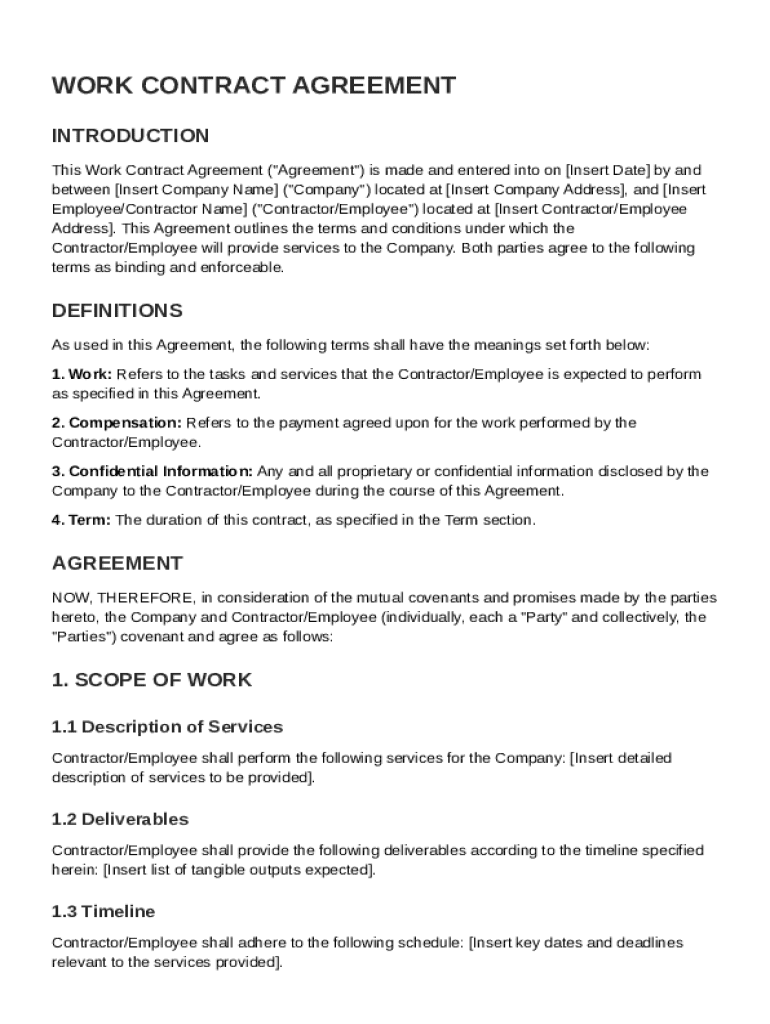







Definition & Meaning
A Work Contract Template is a structured document used to outline the agreement between a company and a contractor or employee. It specifies terms and conditions for services rendered, including responsibilities, payment details, and the scope of work. The template serves as a legally binding document to ensure both parties have a mutual understanding of their commitments and obligations.
This template typically includes key definitions, such as who is considered the "Company" and the "Contractor," the delineation of services provided, and the expected outcomes. By providing clear definitions, the contract prevents misunderstandings and protects the interests of both parties.
Key Elements of the Work Contract Template
The Work Contract Template encompasses various critical components that ensure a comprehensive understanding and enforceability of the agreement. Each element is crafted to cover specific aspects of the working relationship:
-
Scope of Work: Clearly defines what tasks or services will be performed by the contractor or employee, establishing performance expectations.
-
Compensation and Payment Terms: Details how and when payments will be made, including the amount or rate of pay, payment schedule, and any applicable bonuses or commissions.
-
Duration and Termination Conditions: Specifies the contract's start and end dates, renewal terms, and conditions under which either party can terminate the agreement.
-
Confidentiality Obligations: Outlines the necessity for the contractor or employee to maintain confidentiality concerning proprietary information and trade secrets.
-
Intellectual Property Rights: Addresses ownership and rights related to work produced during the contract term, ensuring the company retains control over its intellectual assets.
-
Compliance with Laws: Ensures adherence to relevant local, state, and federal laws and regulations, protecting both parties from legal infractions.
How to Use the Work Contract Template
Utilizing the Work Contract Template efficiently involves several key steps, ensuring that the document is tailored to the specific needs of the business relationship:
-
Customizing the Template: Begin by adapting the template to fit the specific details of the project or employment relationship. Modify sections such as scope, compensation, and dates to match the agreement comprehensively.
-
Consulting Legal Professionals: It is advisable to have the draft reviewed by legal experts to ensure all terms meet legal standards and provide adequate protection.
-
Gathering Necessary Information: Collect all relevant information from both parties, including contact details, tax identification numbers, and any special requirements.
-
Review and Agree: Both parties should review the contract in detail, ensuring mutual understanding of all terms. This step may involve several iterations to address concerns and revisions.
-
Signing the Contract: After agreement on all terms, both parties sign the document, solidifying the legality of the agreement.
Important Terms Related to the Work Contract Template
Understanding the terminologies and clauses within the Work Contract Template is crucial for both parties' clarity and adherence:
-
Force Majeure: Refers to unforeseeable circumstances that prevent one party from fulfilling the contract, such as natural disasters or emergencies.
-
Non-compete Clause: Prevents the contractor or employee from engaging in business activities directly competitive to the company during and after the term of the contract.
-
Indemnification: Protects one party from any legal liability resulting from the other party's actions.
-
Termination Notice: Specifies the required time frame for notifying the other party about the intention to terminate the contract.
Legal Use of the Work Contract Template
The Work Contract Template serves a critical legal function, providing a structured framework that defines the relationship between the parties under the law:
-
Protection of Rights: By clearly outlining terms, the template helps safeguard the rights and obligations of both the company and the contractor/employee.
-
Evidence of Agreement: Serves as concrete evidence of the agreed terms, aiding in dispute resolution should conflicts arise.
-
Enforceability: Ensures that all parties are legally bound to honor their commitments, backed by the governing jurisdiction's legal system.
State-Specific Rules for the Work Contract Template
While a standard Work Contract Template provides a solid foundation, certain elements may require adjustments to adhere to the unique legal requirements of different U.S. states:
-
Employment Laws: Variations exist concerning employment classification, minimum wage, and overtime regulations.
-
Confidentiality Agreements: Specific guidelines might influence how non-disclosure clauses are enforced in various states.
-
Worker Protections: States may have distinct rules on worker protections, impacting clauses related to termination and workplace rights.
Adjusting the template to comply with these state-specific requirements ensures the contract's validity and protects all parties from inadvertent legal infringements.
Steps to Complete the Work Contract Template
Completing the Work Contract Template involves systematic steps to ensure accurate and thorough representation of the agreement terms:
-
Initial Draft: Begin with a comprehensive initial draft, customizing key sections as needed.
-
Legal Review and Revisions: Have a legal professional review the draft for accuracy, legality, and comprehensiveness. Make any necessary revisions.
-
Finalize Contract Details: Confirm both parties' details and agreement specifics, making adjustments until both sides are satisfied.
-
Formal Agreement and Signatures: Both parties should sign the document to signify acceptance and make the contract legally binding.
-
Document Storage: Store the signed contract securely, ensuring all stakeholders have access to the finalized document for reference.
Who Typically Uses the Work Contract Template
The Work Contract Template is versatile and used by diverse parties and industries:
-
Businesses: Small to large enterprises requiring formal agreements with independent contractors and part-time employees.
-
Freelancers and Contractors: Individuals looking to formalize their professional engagements with various companies.
-
Legal Professionals: Lawyers who prepare and review contracts for clients to ensure enforceability and legal soundness.
Utilizing the Work Contract Template enables these parties to formalize agreements efficiently, protecting interests and establishing clear operational expectations.


Examples of Using the Work Contract Template
Real-world scenarios offer insight into how the Work Contract Template can be applied effectively:
-
Marketing Firms: Using the template to engage freelance graphic designers for campaign work, detailing assignments, payment structures, and confidentiality obligations.
-
Tech Startups: Drafting employment contracts for temporary software developers, including performance benchmarks and intellectual property rights.
-
Consulting Agencies: Engaging independent consultants for short-term projects, clarifying roles, project timelines, and submission durations.
Each example illustrates the flexibility and importance of a well-crafted work contract in various professional settings.




