




01. Edit your form online
Type text, add images, blackout confidential details, add comments, highlights and more.

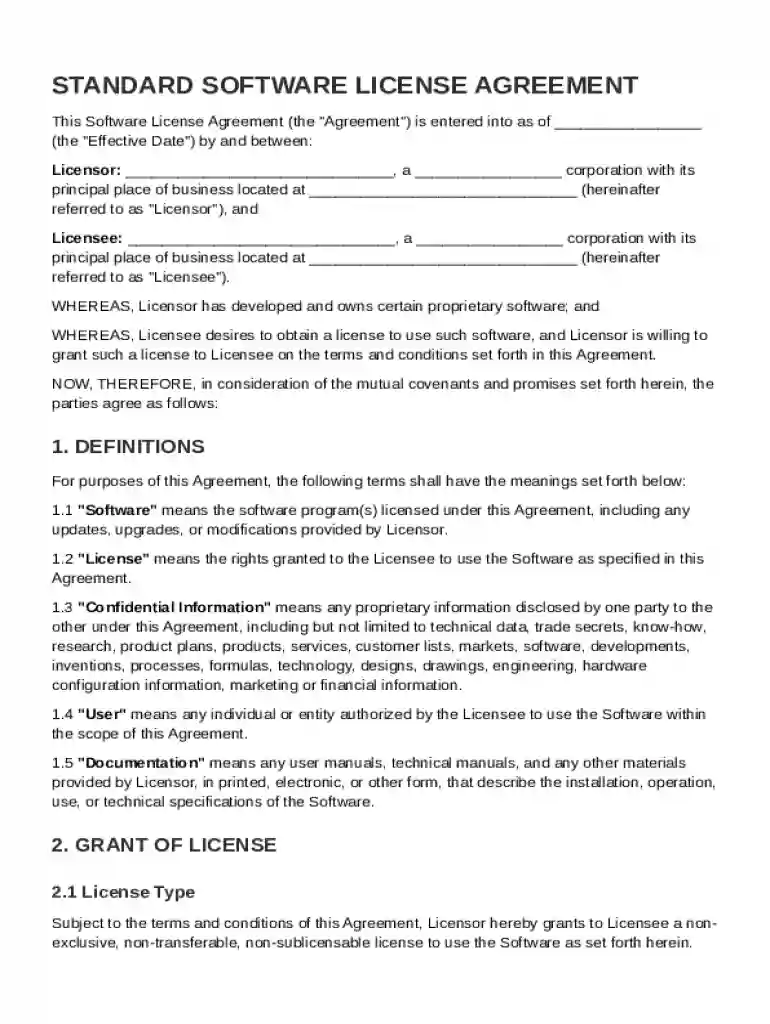
Type text, add images, blackout confidential details, add comments, highlights and more.

Draw your signature, type it, upload its image, or use your mobile device as a signature pad.

Send it via email, link, or fax. You can also download it, export it or print it out.
A Standard Software License Agreement is a legal document used to outline the terms of use for software developed by a licensor and provided to a licensee. This template serves to formalize the relationship between these parties, specifying rights, responsibilities, and restrictions associated with the software use. The agreement highlights critical aspects such as the non-exclusive and non-transferable nature of the license, defining boundaries within which the software can be utilized by the licensee. It seeks to protect the intellectual property rights of the licensor while granting the licensee the necessary permissions to use the software under stipulated conditions.
The agreement starts by defining essential terms to ensure both parties have a clear understanding of the language used throughout the document. This section covers terms such as "software," "licensee," "licensor," "intellectual property rights," and other terms relevant to the agreement. Establishing these definitions upfront helps prevent ambiguities and misunderstandings, providing a foundation for the remaining sections of the agreement.
This section delineates the specific rights granted to the licensee by the licensor. It typically covers the scope of usage, highlighting whether the license is perpetual or limited, and whether it includes any restrictions on the number of installations, locations, or users. The licensee is informed about any geographical limitations or required acknowledgments when using the software. The section also elaborates on whether any sublicensing rights are extended to the licensee or if the license can be transferred.
Payment terms are clearly outlined in this section, detailing how and when the licensee must compensate the licensor for the software usage rights. Payment structures can vary, including one-time fees, recurring subscriptions, or usage-based charges. This section may also discuss penalties for late payments, accepted payment methods, and any taxes or additional charges that the licensee is responsible for.
Review and Understand the Template: Begin by carefully reading through the entire template to grasp all stipulated terms and conditions.
Fill in the Parties' Information: Enter the full legal names and contact details of the licensor and licensee. Ensure accuracy to avoid any potential legal complications.
Define the Scope of License: Specify the software covered by the agreement, including version numbers or identifiable features. Clarify the rights being granted to the licensee.
Specify Payment Details: Outline the agreed-upon payment terms, including amounts, schedules, and acceptable payment methods.
Include Confidentiality Obligations: Identify any sections of the software or documentation considered confidential, outlining restrictions on disclosure and use.
Finalize and Sign: Both parties should review the completed agreement, making any necessary adjustments. Once satisfied, the agreement can be signed, either electronically or in written form, to formalize the arrangement.
This template is commonly used by software developers, technology companies, and businesses that produce proprietary software seeking to legally protect and license their products to other businesses or individuals. It is also utilized by companies seeking third-party software to incorporate into their operations, ensuring they comply with legal requirements while benefiting from the software. Both small startup enterprises and large corporations rely on such agreements to structure their software distribution and usage terms effectively.


A critical aspect of this agreement is its compliance with legal standards and requirements. It includes stipulations consistent with laws governing software use and intellectual property rights within the United States. The agreement must adhere to relevant legislation such as the Digital Millennium Copyright Act (DMCA) and intellectual property laws to ensure enforceability and protection against unauthorized use or distribution of the software. Understanding these legal fundamentals is crucial when drafting or engaging in a software license agreement.
Companies in the tech industry, particularly those involved in software development, find significant value in using a software license agreement template. It helps these firms protect their intellectual property by legally binding users to specific terms of usage.
Businesses that offer software-as-a-service (SaaS) or manage IT solutions capitalize on these agreements to maintain control over software distribution and usage, ensuring compliance and consistent service delivery to customers.
Smaller entities looking to develop proprietary software for niche markets can utilize these agreements to create clear terms with their customers, protecting their innovations while securing revenue through licensing. This template suits their need for scalability and adaptability as their client base grows.
While the basic structure of a software license agreement remains consistent across states, nuances can exist based on jurisdictional laws. For example, specific clauses on warranty disclaimers or limitation of liability might be influenced by state-specific consumer protection laws. Understanding these disparities is vital for ensuring the agreement's enforceability. In certain states, additional language or modifications may be necessary to comply with local legal standards. Legal counsel familiar with state requirements can provide invaluable guidance in adapting the template accordingly.
At DocHub, your data security is our priority. We follow HIPAA, SOC2, GDPR, and other standards, so you can work on your documents with confidence.

Harvard offers sample agreements for exclusive patent, nonexclusive patent, royalty-based and flat-fee materials licenses, and option agreements.
Preamble. This End User License Agreement (hereinafter referred to as EULA) applies to all standard Software Prod- ucts of Vector, Austria GmbH


