




Definition and Meaning of the Source Data Agreement Template
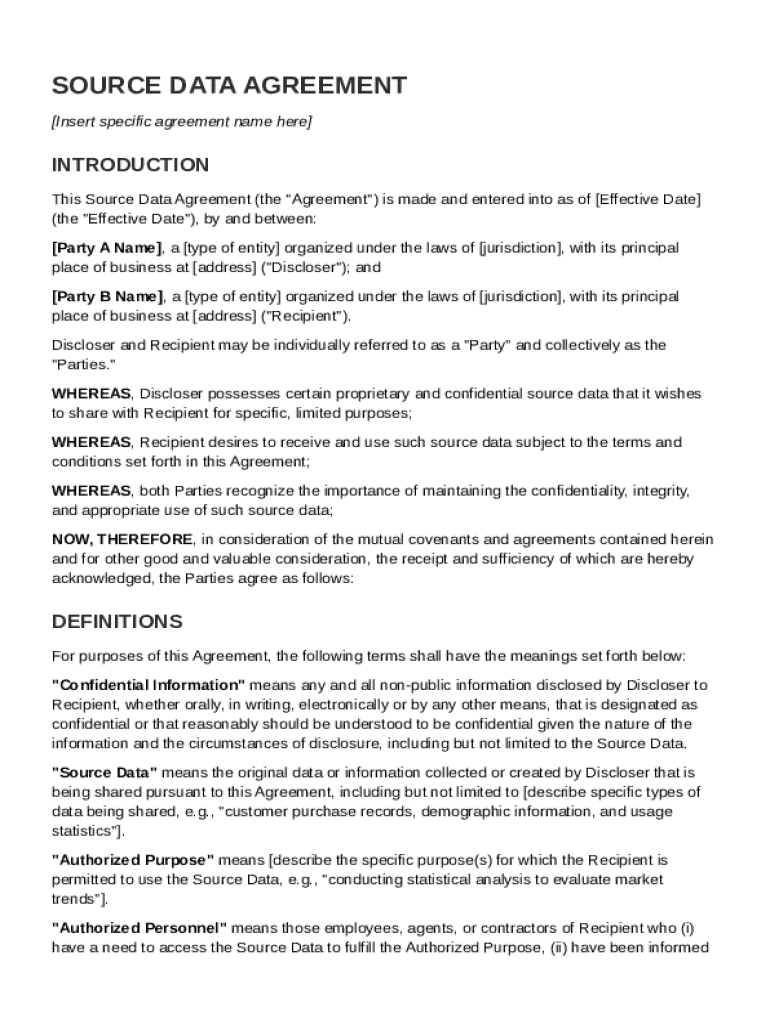
The Source Data Agreement Template is a structured document that outlines the terms under which one party, known as the Discloser, shares proprietary and confidential source data with another party, referred to as the Recipient. The agreement is designed to protect the confidentiality and integrity of the data being shared, ensuring that it is used only for specific authorized purposes. By establishing definitions, confidentiality obligations, and data management protocols, this document becomes a cornerstone of secure and compliant data sharing.
- Proprietary and Confidential Data: Details what constitutes proprietary and confidential information under the agreement.
- Authorized Purposes: Explains the specific uses that are permitted under the terms of the agreement, ensuring data is used as intended.
Practical Examples
- Software Licensing: A company sharing source code with a third-party developer.
- Pharmaceutical Research: Collaboration between two companies sharing research data for drug development.
How to Use the Source Data Agreement Template
Utilizing the Source Data Agreement Template involves a structured approach to drafting the agreement to meet specific needs. It serves as a foundation that parties can customize to address their unique requirements.
- Identify Parties: Clearly define the Discloser and Recipient.
- Define Data: Specify the data to be shared, including descriptions and categories.
- Detail Purposes: List intended uses, ensuring alignment with business objectives.
- Set Obligations: Establish measures for confidentiality, data handling, and security.
Real-World Scenario
An IT firm drafts a Source Data Agreement with a subcontractor to ensure data integrity while allowing the subcontractor to develop certain software components.
Who Typically Uses the Source Data Agreement Template
This agreement is commonly used by organizations involved in collaborative projects requiring data exchange. Industries that frequently employ this template include technology, healthcare, and finance, where data sharing is crucial to business operations.
- Technology Firms: Sharing software and source code.
- Healthcare Organizations: Collaborating on patient data for research.
- Financial Institutions: Exchanging financial models and analyses.

Case Study
A healthcare provider shares anonymized patient data with a university for research purposes, utilizing the Source Data Agreement Template to govern the use and protection of the data shared.
Key Elements of the Source Data Agreement Template
The Source Data Agreement Template comprises several key components that ensure comprehensive coverage of all aspects related to data sharing.
- Definitions: Establishes clear terminology to avoid ambiguity.
- Confidentiality Obligations: Specifies measures required to protect the data.
- Term and Termination: Details the duration of the agreement and conditions for termination.
- Compliance: Outlines legal requirements and adherence to relevant laws and regulations.
Practical Application
Ensuring that each element is explicitly addressed during the creation of the agreement helps prevent legal disputes and misunderstandings between parties.
Legal Use of the Source Data Agreement Template
Legal compliance is integral when using the Source Data Agreement Template. It is critical to ensure that the agreement aligns with applicable laws, such as data protection regulations in the U.S.
Key Considerations
- Regulatory Compliance: Ensures adherence to data protection laws like the GDPR or CCPA.
- Legal Safeguards: Incorporates mechanisms for legal protection of both parties should disputes arise.
Steps to Complete the Source Data Agreement Template
Completing the Source Data Agreement Template involves meticulous attention to detail and collaboration between the parties involved.
- Draft the Initial Agreement: Use the template as a starting point.
- Review and Customize: Modify sections to meet specific project requirements.
- Consult with Legal Experts: Ensure all legal standards and industry regulations are met.
- Finalize and Sign: Obtain signatures from all parties involved to solidify the agreement.
Example of Steps
An organization sharing data with a contractor would follow these steps to ensure that the agreement accurately reflects their partnership and obligations.
Important Terms Related to the Source Data Agreement Template
Understanding significant terminology within the Source Data Agreement Template is essential for ensuring clarity and effectiveness of the document.
- Confidentiality: Protection of sensitive information from unauthorized access or disclosure.
- Data Integrity: Maintaining the accuracy and reliability of data throughout its lifecycle.
- Discloser and Recipient Roles: Definitions of the parties involved under the agreement.
Examples and Definitions
- Non-Disclosure Agreement (NDA): Often used in conjunction with the Source Data Agreement to bolster confidentiality measures.
Examples of Using the Source Data Agreement Template
Various industries employ the Source Data Agreement Template to facilitate efficient and secure data sharing.
- Pharmaceutical Companies: Share clinical trial data with research institutions.
- Financial Analysts: Exchange market data for collaborative analysis.
- Manufacturing Firms: Share proprietary designs for production collaboration.
Real-World Example
A tech startup partners with a larger corporation to develop an innovative product, using the Source Data Agreement to protect its intellectual property while benefitting from shared resources.