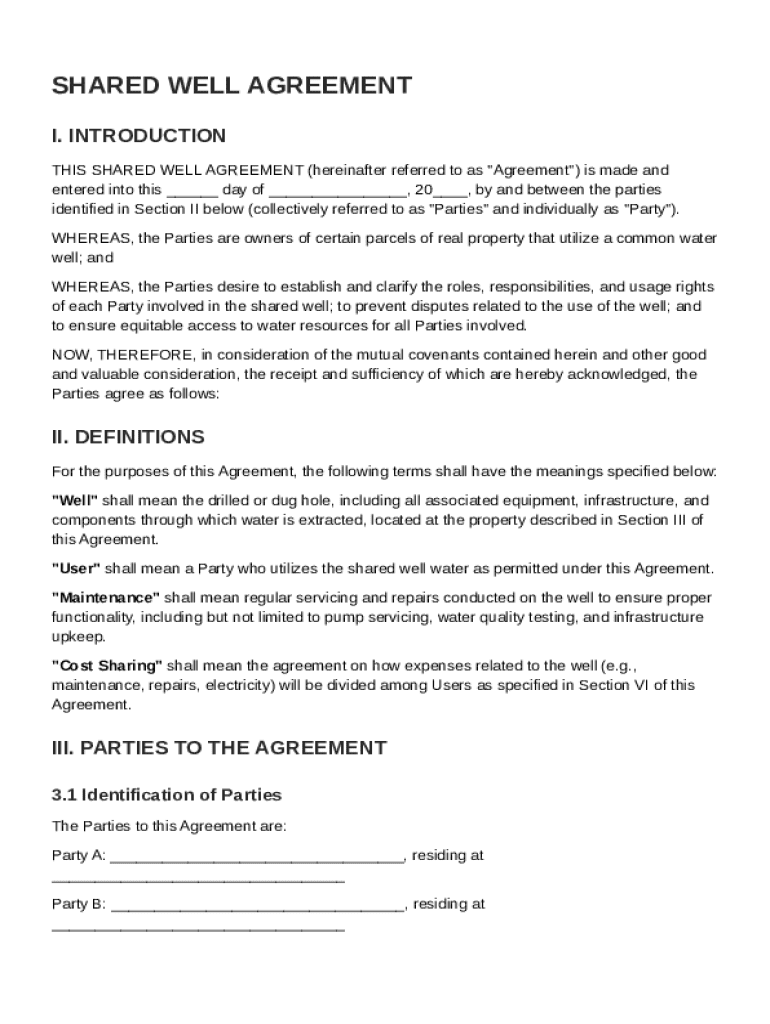







Definition & Meaning
The Shared Well Agreement Template is a legal document that establishes the terms under which property owners share access to a common water well. This agreement typically includes specifications about roles and responsibilities, access rights, maintenance obligations, cost-sharing arrangements, and dispute resolution processes. The primary purpose of the template is to ensure equitable access to water resources and prevent conflicts among parties. By defining these aspects clearly, the agreement serves as a reference point for resolving any disputes that may arise, thus preserving good relations among property owners.
- Roles and responsibilities: The document outlines each party's duties, ensuring that all involved understand their obligations.
- Access rights: Details each owner's legal right to use the shared water resource.
- Cost-sharing arrangements: Specifies how the cost of maintaining and operating the well is distributed among users.
- Dispute resolution: Includes procedures for addressing disagreements, potentially involving third-party mediation.
Key Elements of the Shared Well Agreement Template
A Shared Well Agreement Template typically contains several essential components aimed at safeguarding the interests of all parties involved. These components help in clarifying expectations and reducing the potential for conflicts.
- Identification of parties: Clearly lists all parties involved, with names and contact information.
- Description of the property: Includes legal descriptions of the properties sharing the well.
- Maintenance schedules: Specifies how often the well will be maintained and inspected.
- Financial provisions: Outlines how costs are divided, including initial contributions and ongoing maintenance fees.
- Amendment procedures: Describes the procedure for making changes to the agreement.
Steps to Complete the Shared Well Agreement Template
Completing a Shared Well Agreement Template requires careful attention to detail to ensure that all aspects of well sharing are adequately addressed. Here is a step-by-step guide to finishing the template:
- Collect participant information: Gather names, addresses, and contact details of all parties involved.
- Describe the well: Provide detailed information about the well, including its location and any unique characteristics.
- Establish access protocols: Define how, and when each party can access the well.
- Draft financial arrangements: Clearly articulate the cost-sharing system, including how expenses will be tracked and paid.
- Set maintenance and repair schedules: Agree on a timeline and responsibilities for upkeep.
- Include legal clauses: Ensure that relevant legal statements are incorporated, including consent to jurisdiction and procedures for conflict resolution.
- Revise and finalize: Review the agreement with all parties, making necessary adjustments before each party signs.
Who Typically Uses the Shared Well Agreement Template
The Shared Well Agreement Template can apply to a variety of situations, most commonly when multiple residential properties share a single water resource. Typical users include:
- Homeowners: Those who share a privately owned well.
- Landlords: Property owners who lease land or homes with shared water resources.
- Land developers: Those involved in projects where shared wells are part of the infrastructure.
- Rural communities: Neighborhoods or small groupings of homes in areas where water network expansion is impractical.


Legal Use of the Shared Well Agreement Template
The Shared Well Agreement Template has specific legal applications, serving as a legally binding document that can help avoid disputes and facilitate cooperation. Key legal aspects include:
- Enforcement: The agreement is enforceable in court, providing a legal avenue to resolve any disputes.
- Compliance with regulations: Local and state water laws must be considered when drafting and executing the agreement.
- Record-keeping: Official filing may be required to ensure the agreement is recognized as part of the property records.
State-Specific Rules for the Shared Well Agreement Template
Legal requirements for shared well agreements can vary significantly from state to state. Considering these variations is critical:
- Water rights: Some states may have specific statutes governing water rights and usage that must be adhered to.
- Local zoning laws: Agreements must comply with any local zoning regulations about well-sharing.
- Registration: Certain states may require that such agreements be registered with a state agency.
Examples of Using the Shared Well Agreement Template
Real-world examples of Shared Well Agreement Template applications can provide insight into its practical use:
- Residential neighborhoods: In small rural communities, boundaries are set for water use and costs are shared proportionally based on property size.
- Recreational vehicle parks: Agreements ensure that all RV users have access to water and share in maintenance costs.
- Agricultural areas: Farmers with neighboring lands share a well to irrigate crops, defining specific irrigation times and cost responsibilities.
Important Terms Related to Shared Well Agreement Template
Understanding specific terms is crucial for properly drafting or reviewing a Shared Well Agreement Template. Some common terms include:
- Easement: The right granted to use the well located on another’s property.
- Pro-rata share: A term used for dividing costs proportionally among all users.
- Potable water: Indicates that water from the well is safe for consumption.
- Wellhead protection area: Identifies zones where certain activities are restricted to protect water quality.