
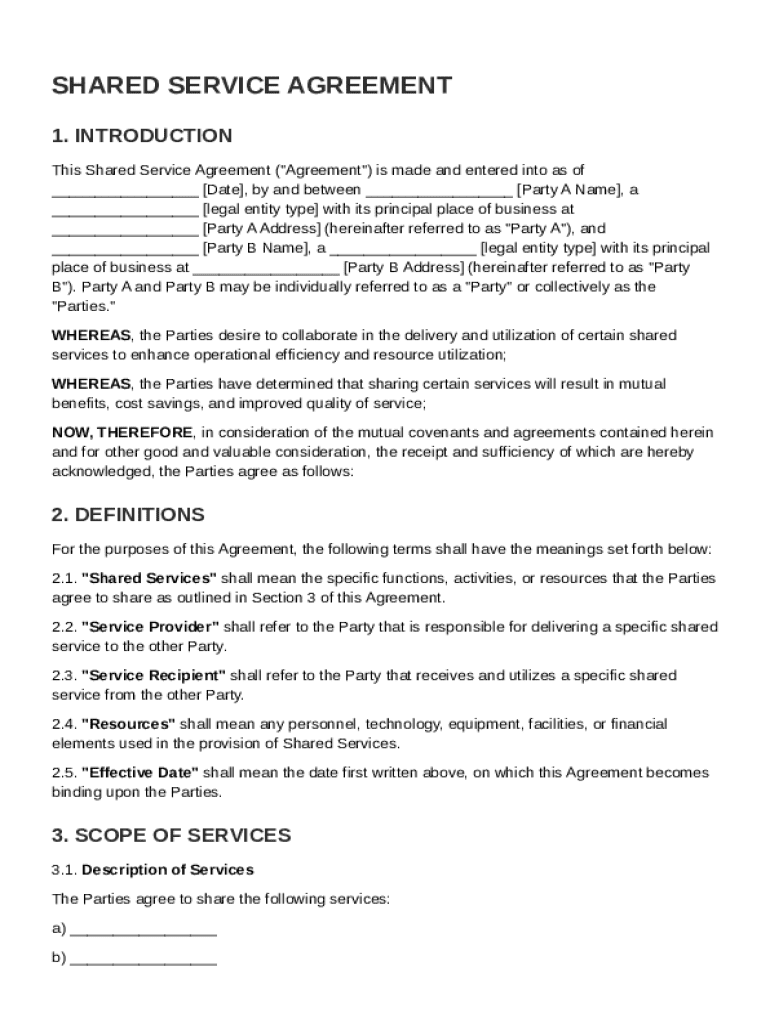







Definition & Meaning
A Shared Service Agreement Template is a structured document that outlines the collaborative arrangement between two or more parties to share specific services. This template is designed to help organizations streamline their operations, enhance resource utilization, and achieve cost efficiencies. It delineates the responsibilities and roles of each party involved, defines the scope of the shared services, and establishes the framework for financial arrangements, confidentiality agreements, and dispute resolution processes. The primary goal is to articulate the terms clearly to ensure mutual understanding and agreement, fostering a mutually beneficial partnership.
Key Elements of the Shared Service Agreement Template
The template includes several critical components that form its backbone. These elements are not only essential for defining the operational boundaries and responsibilities but also serve as a guideline for the legal and financial aspects of the agreement:
- Parties Involved: Clearly identifies all parties to the agreement, typically referred to as Party A and Party B.
- Scope of Services: Details the specific services to be shared, ensuring all involved understand their contributions and expectations.
- Financial Arrangements: Outlines the cost-sharing mechanics, including payment terms and financial responsibilities.
- Confidentiality Obligations: Provides for the protection of sensitive information, ensuring that proprietary data remains secure.
- Dispute Resolution: Sets out the process for resolving disagreements between parties, often involving mediation or arbitration as alternatives to litigation.
- Term and Termination: Describes the duration of the agreement and conditions under which the agreement may be terminated or renewed.
Steps to Complete the Shared Service Agreement Template
Completing the Shared Service Agreement Template requires careful consideration and mutual agreement on all aspects. Here is a step-by-step guide to accomplishing this:
-
Identify Parties: Clearly state the organizations or individuals entering the agreement.
-
Define Services: Document the specific services that will be shared. Be precise to avoid future conflicts.
-
Agree on Financial Terms: Work out the financial arrangements, ensuring each party agrees to their share of costs.
-
Set Confidentiality Terms: Develop confidentiality clauses that protect all parties involved.
-
Establish Dispute Resolution Procedures: Agree on mechanisms to resolve potential disputes.
-
Determine Duration and Termination Clauses: Specify the length of the agreement and termination procedures.
-
Finalize and Sign: Review the completed document thoroughly, ensuring all parties understand and agree before signatures are obtained.
Why Use a Shared Service Agreement Template
Utilizing a Shared Service Agreement Template can significantly enhance the operational efficiency of organizations. By clearly defining roles, responsibilities, and expectations, this document reduces the likelihood of misunderstandings and disputes. It also offers a standardized framework that can be tailored to specific needs and circumstances, saving time and resources. Additionally, having a pre-defined agreement ensures compliance with legal standards and fosters trust between parties, essential for successful and long-term cooperation.
Legal Use of the Shared Service Agreement Template
In the United States, using a Shared Service Agreement Template is legally recognized as a formal contract. It must comply with federal and state laws to ensure enforceability. Key legal considerations include ensuring that the agreement is signed by authorized representatives of each party and adheres to relevant regulatory requirements, such as antitrust laws and fair competition standards. Legal advice is often recommended to address complex issues and to tailor the agreement to specific jurisdictional requirements.
Examples of Using the Shared Service Agreement Template
Shared Service Agreements are employed across various sectors. For example, two municipal governments may enter into such an agreement to share waste management services. By doing so, they can reduce costs while optimizing service delivery. In the corporate sector, manufacturing companies may share research and development facilities, enabling them to leverage shared expertise and technological advancements. Educational institutions might also use these agreements to share staffing resources or technology infrastructures.
Who Typically Uses the Shared Service Agreement Template
The Shared Service Agreement Template is utilized by a broad range of entities, including:
- Government Agencies: To collaborate on services such as public safety, health services, and infrastructure maintenance.
- Corporations: Large companies often use these agreements to share functions like IT support, procurement, and marketing resources.
- Non-Profit Organizations: To share administrative services or facilities, helping them reduce overhead and concentrate resources on mission-critical activities.
- Educational Institutions: Schools and universities may collaborate to share libraries, research facilities, or online learning platforms.


Software Compatibility
When considering integration with digital platforms, the Shared Service Agreement Template is often compatible with various document management systems. Platforms like DocHub enable users to edit, sign, and manage these documents seamlessly online. This compatibility extends to common file formats, including PDF, DOC, and others supported by cloud storage services like Google Drive and Dropbox. The utility of these platforms allows for efficient management and modification of agreements, enhancing collaboration and ensuring all parties have access to the most recent version of the document.
State-by-State Differences
The specific legal requirements for Shared Service Agreements can vary by state. Factors such as the regulation of shared services, tax implications, and other statutory obligations may differ. For example, some states may have more stringent requirements regarding public sector shared services agreements due to transparency laws. It is crucial to research these variances or consult with legal experts to ensure that each agreement complies with relevant state laws and regulations.




