
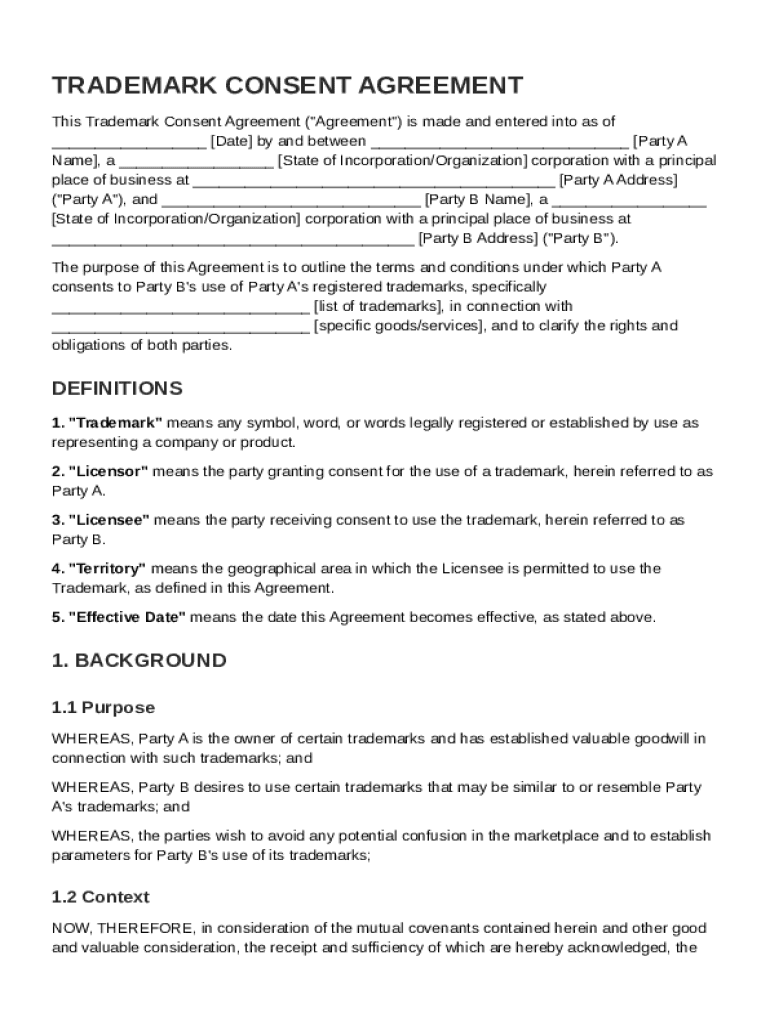







Definition & Meaning
A Trademark Consent Agreement is a legal document allowing one party (Party A) to grant another party (Party B) permission to use its registered trademark. This agreement outlines specific terms and conditions that aim to ensure the trademark is used in a manner that maintains the owner's control over its quality and reputation. By defining a non-exclusive license, it establishes the contexts in which Party B can use the trademark and includes provisions for quality control, usage restrictions, and the agreement's duration.
Key Aspects
- Non-Exclusive License: Grants limited rights to Party B, ensuring the owner retains primary control over the trademark.
- Quality Control: Imposes standards to maintain the trademark's reputation.
- Usage Restrictions: Dictates specific contexts and geographic areas for permissible use.
Key Elements of the Trademark Consent Agreement Template
Main Components
- Identification of Parties: Details about Party A (the trademark owner) and Party B (the licensee).
- Trademark Description: Includes registration numbers and descriptions of the trademarks involved.
- Terms of Use: Specifies what constitutes acceptable use and defines any limitations.
- Quality Assurance: Requirements for maintaining the standards associated with the trademark.
- Duration and Termination: Duration of the agreement and conditions for termination by either party.
Additional Provisions
- Indemnification: Protection for Party A against any claims resulting from Party B's use of the trademark.
- Fees and Compensation: Any monetary exchange or terms regarding financial obligations.
How to Use the Trademark Consent Agreement Template
Step-by-Step Guide
- Identify Parties: Clearly state the full legal names and addresses of both Party A and Party B.
- Define Trademark Scope: Describe the specific trademarks and their registered uses.
- Set Terms of Use: Outline how and where the trademarks can be used by Party B.
- Quality Control Measures: Establish standards Party B must adhere to in using the trademark.
- Finalize Duration and Termination Clauses: Specify the agreement's duration and how it can be ended.
Practical Considerations
- Customization: Adjust the template to reflect any unique terms agreed upon by both parties.
- Legal Review: Consult with a trademark attorney to ensure all aspects are legally sound.
Who Typically Uses the Trademark Consent Agreement Template


Common Users
- Businesses: Companies looking to expand partnerships or collaborations using a trademark.
- Legal Firms: Attorneys drafting agreements for clients needing trademark permissions.
- Startups: New ventures entering markets requiring trademark access.

Use Case Scenarios
- Co-branding Ventures: Two companies collaborating on a product needing dual-branded trademarks.
- Licensing Agreements: Expanding a franchise or product line while maintaining brand standards.
Legal Use of the Trademark Consent Agreement Template
Compliance and Legality
- ESIGN Act Compliance: Ensure electronic signatures are legally binding.
- Governing Law: Specify which state's laws will govern the agreement.
Protective Measures
- Indemnity Clauses: Protects the trademark owner from liabilities associated with the licensee's use.
- Confidentiality Agreements: Safeguarding proprietary information during the agreement's execution.
Important Terms Related to Trademark Consent Agreement Template
Legal Terminology
- Licensor/Licensee: The trademark owner and the party granted permission.
- Non-Exclusive Rights: Limited permission, allowing the trademark owner to issue similar licenses to others.
- Indemnification: Legal protection against third-party claims.
Trademark-Specific Terms
- Trademark Dilution: Misusing a mark could weaken its uniqueness, thus the need for control clauses.
- Infringement Prevention: Ensuring unauthorized uses are legally addressed.
Steps to Complete the Trademark Consent Agreement Template
Completion Process
- Draft Agreement: Use the template to outline initial terms.
- Review by Parties: Both parties examine the document for accuracy and agreement.
- Negotiate Terms: Discuss any clauses that need amendment or further definition.
- Finalize Document: Reach a consensus and prepare for signing.
- Sign and Execute: Both parties legally formalize the agreement.
Recommendations for Execution
- Professional Consultation: Engage a trademark lawyer for legal validation.
- Electronic Validation: Use DocHub to ensure the agreement is securely signed and stored.
State-Specific Rules for the Trademark Consent Agreement Template
Variations by State
- Local Regulations: Some states may have specific requirements for trademark agreements beyond federal laws.
- Enforcement Protocols: Differences in how agreements are executed and enforced.
Why State Differences Matter
- Legal Compliance: Ensures that the agreement will be enforceable in specific jurisdictions.
- Cultural Considerations: Different regions may have varying perceptions of trademark usage.




