




01. Edit your form online
Type text, add images, blackout confidential details, add comments, highlights and more.

Type text, add images, blackout confidential details, add comments, highlights and more.

Draw your signature, type it, upload its image, or use your mobile device as a signature pad.

Send it via email, link, or fax. You can also download it, export it or print it out.
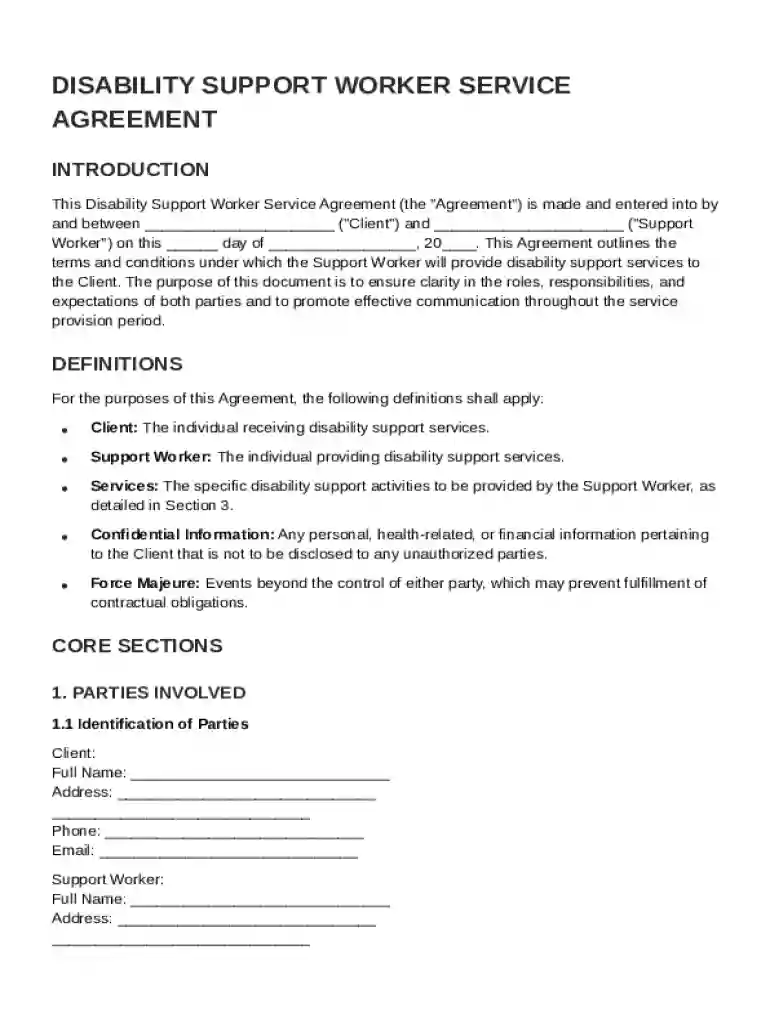
The Disability Support Worker Service Agreement Template is a formal document that outlines the arrangement between a client and a disability support worker. It specifies the roles, responsibilities, and terms under which the support services are provided. This document serves as a contractual agreement designed to enhance the quality of life for individuals with disabilities by clearly defining expectations and obligations.
Utilizing the template efficiently requires understanding its structure and purpose. Proper usage ensures that both parties have a clear record of agreed terms.
Review the Template: Begin by going through the entire document to familiarize yourself with the sections it covers.
Customize the Agreement: Modify the template fields to fit the specific client-worker relationship, including personal details, service descriptions, and compensation rates.
Discuss Terms: Engage in a discussion with the other party to agree on terms not initially included in the template. Make sure that all expectations are documented.
Fill in the Details: Complete all required fields, ensuring that no section is left blank unless intentionally omitted following mutual agreement.
Seek Professional Advice: Consider consulting a legal professional to review the agreement to ensure compliance with local laws and regulations.
Sign the Document: Both parties should sign the agreement to make it legally binding. Electronic signatures are permissible if all parties consent.
Completing the template involves several key steps, each ensuring that the agreement is comprehensive and legally sound.
Gather Information: Collect necessary details about the client and the support worker, including names, addresses, and contact information.
Define the Services: Clearly describe the types of services to be provided, the schedule, and any limitations or conditions.
Outline Compensation: Specify payment terms, including rates, frequency, method, and any reimbursement for expenses.
Confidentiality and Privacy: Include terms that protect private information, making sure all parties understand their obligations regarding client confidentiality.
Dispute Resolution: Decide on a process for resolving disagreements, including mediation or arbitration clauses if necessary.
Final Review and Signature: After inputting all information and reviewing for accuracy and completeness, both parties should sign the document.
Ensuring that the agreement complies with local and federal laws is critical.
A comprehensive agreement includes several key components:
Understanding specific terminology ensures all parties are on the same page.
Real-world examples provide context on how the template can be applied:
At DocHub, your data security is our priority. We follow HIPAA, SOC2, GDPR, and other standards, so you can work on your documents with confidence.




This form must be completed by a Personal Care Attendant (PCA) working with a Montclair. State University student approved for such service by the Disability
Examples of contract management and administrative services that would be reported on line 12 include department directors, administrators, managers, ward
This written agreement lays out the agreed-upon terms of employment and home care services between. (Employer) and. (Employee). 1. Employer name: a.


