01. Edit your form online
Type text, add images, blackout confidential details, add comments, highlights and more.

Type text, add images, blackout confidential details, add comments, highlights and more.

Draw your signature, type it, upload its image, or use your mobile device as a signature pad.

Send it via email, link, or fax. You can also download it, export it or print it out.
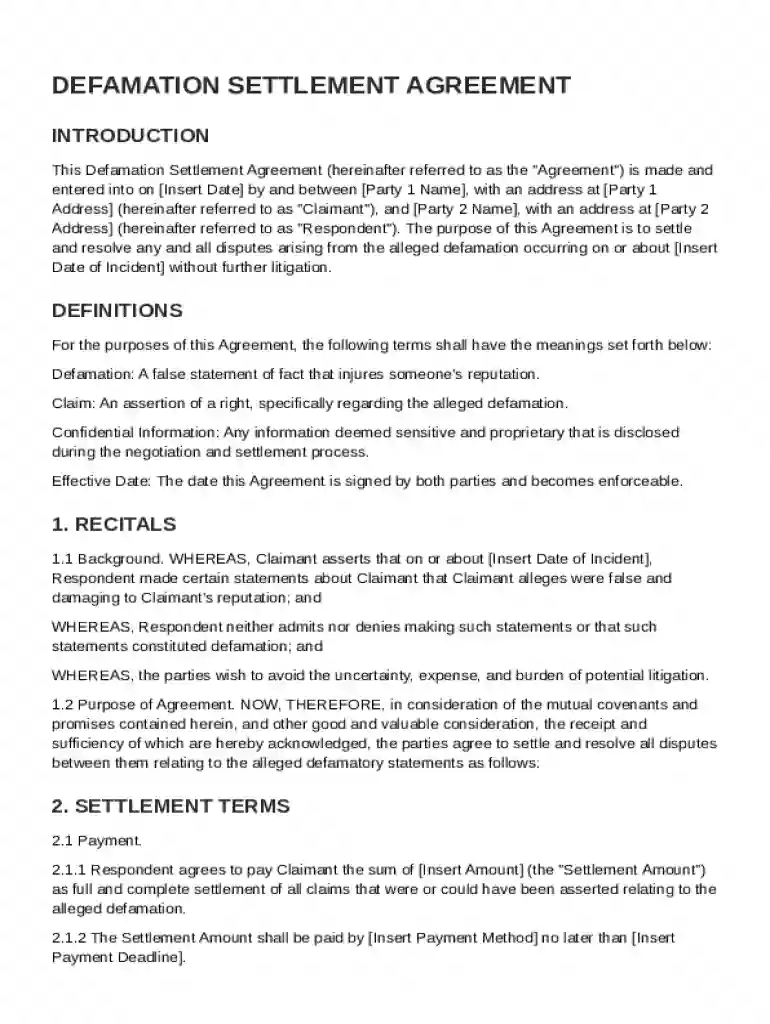
A "Defamation Settlement Agreement Template" is a legal document primarily intended to resolve disputes arising from allegations of defamatory statements. Such allegations occur when one party, typically identified as the Claimant, accuses another, known as the Respondent, of making false statements that harm the Claimant's reputation. The agreement template outlines how these parties can achieve a settlement without further litigation or courtroom procedures. Key components usually included are settlement payments, confidentiality clauses, non-disparagement agreements, and mutual release of claims, all serving to establish a formal resolution.
The Defamation Settlement Agreement Template is comprehensive, covering various crucial elements that ensure clarity and enforceability.
Settlement Payment: Specifies the financial resolution agreed upon by the parties. This can include lump-sum payments or structured payments over time.
Confidentiality Clause: Ensures that the terms of the settlement, as well as the details of the dispute, are not disclosed to external parties.
Non-Disparagement Agreement: Both parties agree not to make or endorse any further defamatory statements about each other.
Mutual Release of Claims: This provision ensures that once the settlement is executed, neither party can pursue further legal action on the same issues.
Non-Admission of Liability: Clarifies that the settlement does not imply any admission of guilt or wrongdoing by the Respondent.
Governing Law: Defines which jurisdiction's laws will interpret and enforce the agreement.
Completing the Defamation Settlement Agreement Template involves several critical steps to ensure it's both accurate and enforceable.
Identification of Parties: Clearly identify the Claimant and Respondent, including their addresses and contact information.
Articulating the Dispute: Concisely outline the nature and context of the defamatory allegations.
Drafting Settlement Terms: Define the payment and non-monetary compensation terms, ensuring clarity and mutual understanding.
Adding Legal Provisions: Incorporate clauses like confidentiality, non-disparagement, and the release of claims to protect both parties.
Review by Legal Professionals: Have the agreement reviewed by attorneys to ensure it complies with applicable legal standards and is fair to both parties.
Finalizing and Signing: Obtain signatures from both parties and any witnesses, completing the execution of the agreement.
The legal use of a Defamation Settlement Agreement Template is central to its purpose, offering a structured means for parties to resolve disputes without resorting to costly and time-consuming litigation.
Contractual Binding: These agreements are legally binding, provided they are drafted and executed correctly, thereby offering both protection and finality for involved parties.
Dispute Resolution: They facilitate the peaceful resolution of defamation disputes by ensuring that both parties acknowledge and accept the agreed terms.
Judicial Review: While mainly agreed between parties, the agreement can be referenced in court should future disputes about the same matter arise.
Understanding the terminology used within the Defamation Settlement Agreement Template is crucial for all parties.
Several real-world scenarios illustrate the practical application of a Defamation Settlement Agreement Template.
Business Disputes: A company accused of defaming a competitor reaches a settlement to avoid public trials that could harm both parties' reputations.
Media and Publications: A journalist accused of libel by a public figure settles to prevent prolonged litigation and media scrutiny.
Online Platforms: Remarks made on social media lead to an agreement between an influencer and an affected party to remove content and compensate for reputational damage.
While the agreement template serves as a standardized starting point, it must be tailored to comply with state-specific defamation laws and enforceability requirements.
Jurisdictional Variances: States may have different definitions and thresholds for what constitutes defamation, affecting how agreements are structured.
Statutes of Limitations: Each state determines the period during which a defamation claim can be filed, influencing settlement timelines and urgency.
Enforceability Clauses: Certain states might have unique requirements for making confidentiality or non-disparagement agreements more enforceable.
Using DocHub to manage defamation settlement documentation offers several advantages through its compatibility and integration features.
Document Management: Easily import the template for completion from your local files or cloud storage services like Google Drive.
Security Features: Ensure confidentiality and secure signatures within the platform, utilizing 256-bit SSL encryption for data transfer.
Collaboration Tools: Facilitate real-time editing and sharing, allowing attorneys or parties to modify documents efficiently and observe updates instantly.
Integration Convenience: Directly work with documents from Google Workspace, enabling smooth editing and exporting back to cloud storage.
The variety of use cases for a Defamation Settlement Agreement Template spans numerous industries and individuals.
Legal Professionals: Attorneys drafting settlements to minimize client exposure in defamation lawsuits.
Public Figures: Celebrities and influencers seeking to resolve privacy and reputation issues without protracted public disclosures.
Corporate Entities: Businesses involved in disputes over false claims that might affect their market value or public image.
Media Organizations: Networks and publishers using these agreements to settle out of court with individuals who have been allegedly defamed in reports or articles.


At DocHub, your data security is our priority. We follow HIPAA, SOC2, GDPR, and other standards, so you can work on your documents with confidence.