






Definition & Meaning
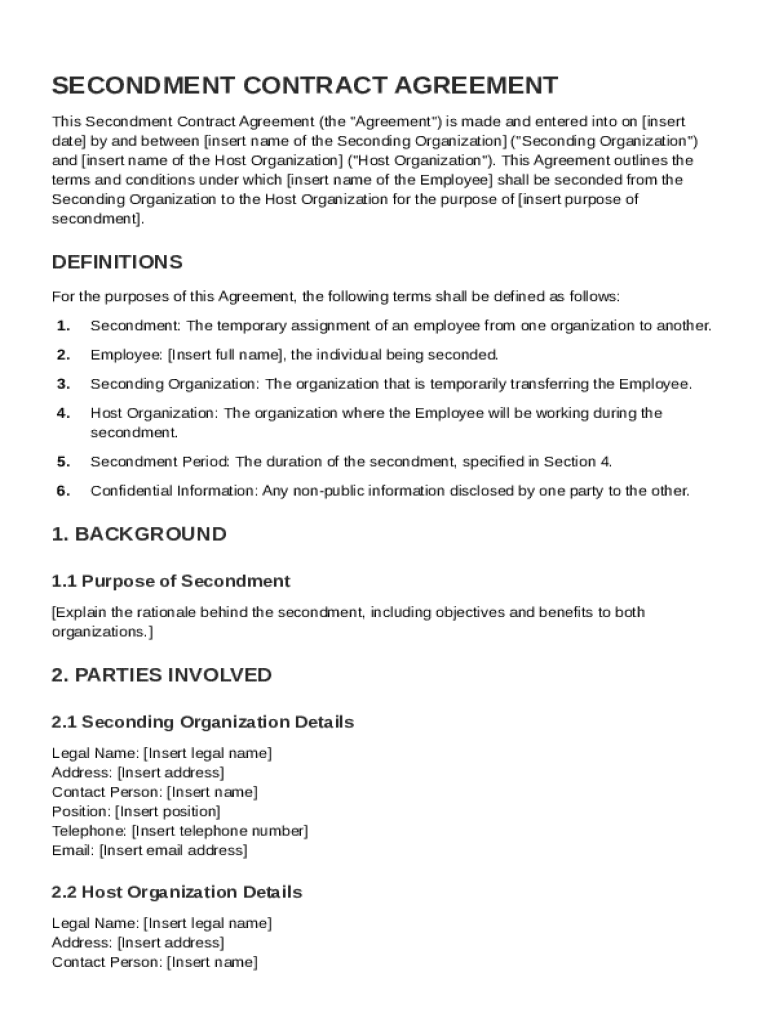
A secondment contract is an agreement between two organizations and an employee wherein the employee is temporarily assigned to another organization, known as the host organization, while maintaining ongoing employment with the original employer, referred to as the seconding organization. The primary purpose of a secondment contract is to outline the terms of this temporary transfer, detailing the roles and responsibilities of each party involved. Such agreements are common in professional services sectors where knowledge sharing and skill development are crucial.
Key Components
- Seconding Organization: This is the employee's original employer, responsible for the employee's benefits and potentially involved in determining the scope and duration of the secondment.
- Host Organization: This is the entity where the employee will be temporarily working. The host often covers the day-to-day responsibilities of the employee during the secondment period.
- Employee: The individual being seconded must understand their roles and responsibilities, clearly defined within this document.
Key Elements of the Secondment Contract Template
The secondment contract template is a comprehensive document that ensures all parties are aligned with the terms of the secondment. Each section serves a specific purpose in maintaining professional standards and legal compliance.
Main Sections
- Definitions and Background: This section defines key terms used throughout the contract and provides context about why the secondment is taking place.
- Roles and Responsibilities: Clearly delineates what is expected of the seconding organization, host organization, and the employee.
- Employment Terms: Outlines the conditions of employment during the secondment, such as salary, benefits, and duration.
Steps to Complete the Secondment Contract Template
Completing a secondment contract involves several detailed steps to ensure clarity and agreement among all parties.
- Fill in the Basic Information: This includes the names and addresses of the seconding and host organizations and the employee.
- Outline the Purpose and Duration: Clearly state the reason for the secondment and define the time frame.
- Detail Roles and Responsibilities: Specify the duties and expectations for all parties involved.
- Define Financial Terms: Include the employee's salary, any benefits adjustments, and financial obligations of each organization.
- Set Terms for Termination and Dispute Resolution: Outline the procedures for ending the secondment and resolving any potential conflicts.
Legal Use of the Secondment Contract Template
Utilizing a secondment contract ensures that all parties are legally protected and that there is a mutual understanding regarding the terms of the secondment.
Compliance and Protections
- The contract should comply with labor laws and standards in the United States, protecting both the employee and the organizations involved.
- Clauses related to confidentiality and intellectual property rights are crucial, especially if the employee will have access to sensitive information at the host organization.
Software Compatibility
DocHub offers compatibility with various software and file formats, streamlining the process of completing and managing secondment contracts.
Integrated Tools
- Platform Integration: Easily import documents from Google Drive, Dropbox, and OneDrive for seamless editing.
- Document Editing: Modify documents directly in formats like PDF, DOC, and more, with tools for annotations, text edits, and image insertions.
- Electronic Signatures: Collect legally binding e-signatures to expedite the contract finalization process.
Business Types That Benefit Most from Secondment Contract Template
Certain business sectors, particularly those emphasizing professional development and cross-company collaboration, benefit significantly from secondment agreements.
Examples of Beneficial Industries
- Consulting Firms: Use secondments to provide employees with varied client experiences and develop specialized skills.
- Technology Companies: Engage in secondments to foster innovation and share cutting-edge practices across teams.
- Financial Services: Implement secondments for talent development and to strengthen professional networks.
State-Specific Rules for the Secondment Contract Template
While the template offers a standardized framework, it is vital to consider state-specific regulations that may influence secondment arrangements.
Considerations by State
- Employment Laws: Ensure compliance with the specific labor laws of the state where the employee is seconded.
- Tax Implications: Understand any tax obligations that may arise from a secondment, which can differ by state.
Important Terms Related to Secondment Contract Template
Several critical terms need to be understood when drafting or reviewing a secondment contract.
Glossary of Terms
- Secondment Period: The duration for which the employee will be placed with the host organization.
- Confidentiality Clause: Legal protectors of sensitive company information.
- Governing Law: The jurisdiction whose laws will apply to disputes arising under the contract.
Why Should You Use a Secondment Contract Template?
Employers and employees benefit from having a clear and formalized understanding of the secondment process. It defines expectations, reduces conflicts, and protects the rights of all parties involved.
Strategic Benefits
- Clarity: Provides clear guidelines and expectations about roles, responsibilities, and objectives.
- Legal Protection: Ensures that the secondment complies with legal standards, reducing the risk of disputes or legal issues.
- Professional Development: Encourages skills transfer and growth opportunities for the seconded employee.
These sections extensively cover the essential elements of the secondment contract template, ensuring that users are well-informed and adequately prepared for successful contract completion and execution.