






Definition and Purpose of a Service Delivery Contract Template
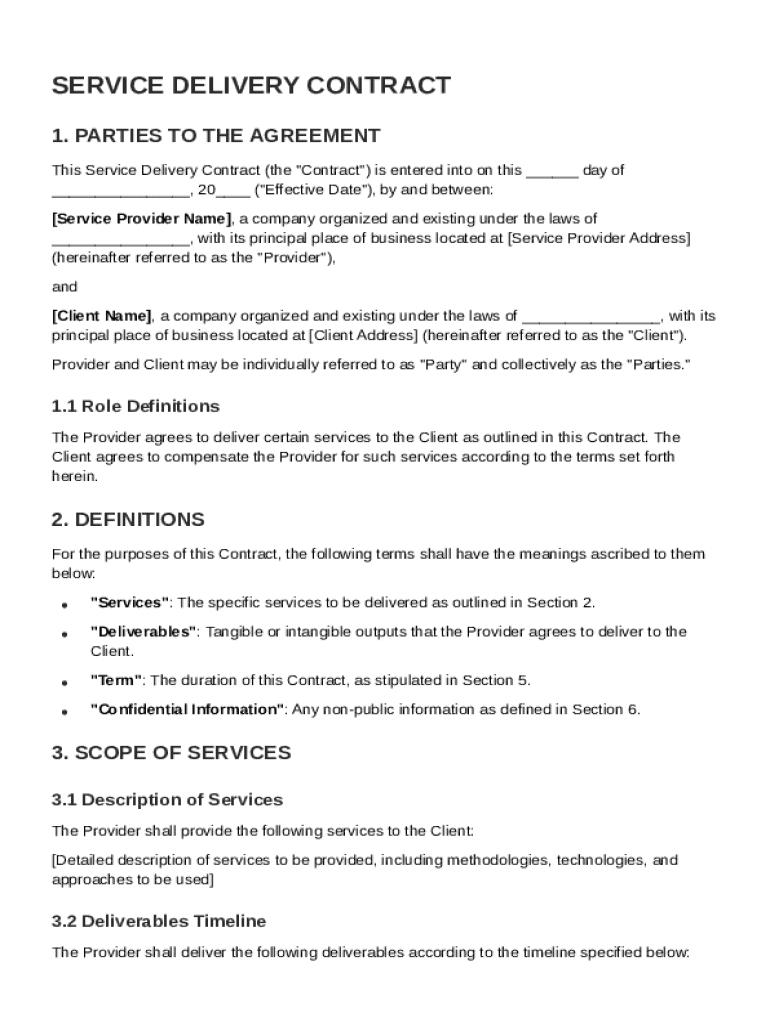
A Service Delivery Contract Template is a structured document that outlines the terms and conditions between a service provider and a client. The main purpose of this template is to detail the scope of services, set performance standards, and establish the responsibilities of both parties involved. This contract ensures that both the client and the service provider have a clear understanding of their roles and expectations. It typically includes sections on payment terms, confidentiality, liability limitations, and dispute resolution, ensuring comprehensive coverage of all relevant aspects of the service relationship.
Key Sections in a Service Delivery Contract
A typical Service Delivery Contract Template includes several critical sections. These sections provide clarity and prevent misunderstandings, which are crucial for maintaining a professional relationship:
- Roles and Definitions: Clarifies the parties involved and their respective responsibilities.
- Scope of Services: Details what services will be provided, including any limitations or exclusions.
- Performance Standards: Sets the benchmarks for measuring the quality and quantity of services rendered.
How to Use the Service Delivery Contract Template
Using the Service Delivery Contract Template effectively involves several straightforward steps, each integral to the process of documenting and securing the service agreement. Here is a detailed guide:
-
Customizing the Template: Begin by entering the specific details of both the service provider and the client. This includes names, contact information, and any special terms that may apply to the service relationship.
-
Defining the Services: Elaborate on the scope of services to be delivered. Clearly outline what will be included and excluded in the service offering to eliminate any potential ambiguity.
-
Setting Payment Terms: Specify the agreed-upon payment structure, including the amount, frequency, and method of payment. This section should also address penalties for late payments.
-
Addressing Confidentiality and Liability: Describe the measures both parties will take to maintain confidentiality, and outline the limitations of liability in case of disputes or claims.
-
Finalizing and Signing: Once completed, both parties should review the contract for accuracy. The final step involves signing the contract to signify mutual agreement and understanding.
Importance of the Service Delivery Contract Template
Employing a Service Delivery Contract Template is essential for several reasons:
-
Clarity and Precision: It ensures that all parties involved have a clear and concise understanding of what the service entails, thus minimizing misunderstandings.
-
Legal Protection: The template acts as a formal agreement that can be referenced in a legal setting, providing protection for both the service provider and the client.
-
Professionalism: Using a formal contract enhances the professionalism of the service arrangement, fostering trust and reliability between the parties.
Key Elements of the Service Delivery Contract Template
Several critical elements should be meticulously addressed within a Service Delivery Contract Template to ensure its effectiveness:
-
Contract Duration: Clearly states the timeline over which the services will be rendered, including start and end dates.
-
Termination Conditions: Outlines the terms under which the contract can be terminated by either party. This section should specify notice periods and any repercussions or penalties.
-
Amendments: Provides guidelines on how changes to the contract can be made and documented, ensuring flexibility while maintaining legal integrity.
Who Typically Uses the Service Delivery Contract Template
This template is widely utilized across various industries and by numerous professionals:
-
Consultants and Freelancers: Individuals offering specialized services often rely on this template to define client engagements.
-
Business Enterprises: Companies, ranging from startups to established firms, use such contracts to formalize service agreements with vendors or third-party providers.
-
Non-Profit Organizations: To ensure accountability and clarity in service provision, many non-profits engage with service delivery templates in their collaborations.


Legally Binding Aspects of the Service Delivery Contract Template
The Service Delivery Contract Template is fashioned to be legally binding:
-
Compliance with Legal Standards: The template includes provisions that align with legal requirements, such as adherence to regulations governing service delivery and consumer protection.
-
Enforceability: Once signed by both parties, the contract becomes enforceable in a court of law, providing a legal framework for dispute resolution.
-
Electronic Signatures: Utilizing platforms like DocHub, parties can sign electronically, ensuring legality and convenience while maintaining compliance with standards like the ESIGN Act.
State-Specific Rules for Service Delivery Contracts
While the template is broadly applicable across the United States, it is important to consider state-specific regulations which may affect contract enforcement and content:
-
Regulatory Variations: Different states may have unique laws regarding service contracts, such as specific notice requirements or clauses that must be included for the contract to be valid.
-
Adaptation for Local Compliance: Parties should review state laws or consult with a legal professional to adapt the template as necessary for compliance with local legal standards.
Examples of Using the Service Delivery Contract Template
Here are several real-world scenarios illustrating how the Service Delivery Contract Template can be used:
-
Information Technology Services: An IT firm uses the template to solidify agreements for managed services, ensuring clarity in response times and service delivery standards.
-
Marketing Agencies: A marketing agency employs the contract template to establish terms with clients for advertising campaigns, detailing deliverables and payment milestones.
-
Maintenance Services: Facilities management providers use this template to define scopes of work with clients for ongoing maintenance and repairs, ensuring both parties are aligned on expectations.