Jv 296 2026

Get Form
jv 296 Preview on Page 1

Here's how it works

01. Edit your jv 296 online
Type text, add images, blackout confidential details, add comments, highlights and more.
02. Sign it in a few clicks
Draw your signature, type it, upload its image, or use your mobile device as a signature pad.
03. Share your form with others
Send jv 296 form via email, link, or fax. You can also download it, export it or print it out.

How to use or fill out jv 296 with our platform

Form edit decoration
9.5
Ease of Setup
DocHub User Ratings on G2
9.0
Ease of Use
DocHub User Ratings on G2
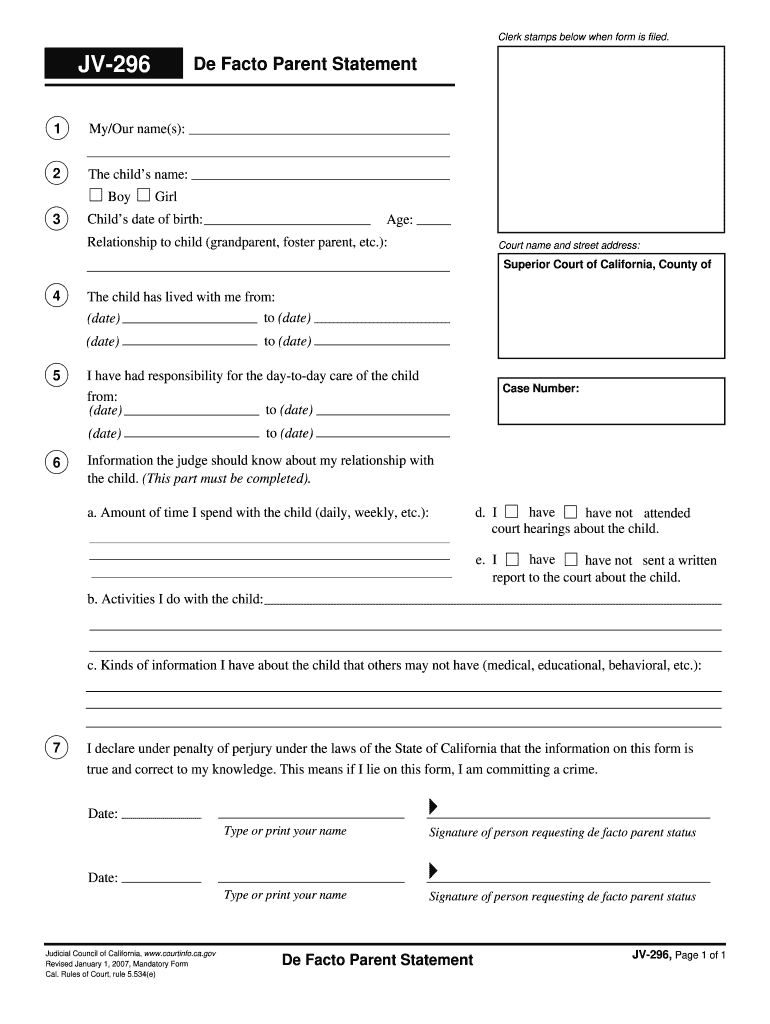
  1. Click ‘Get Form’ to open the JV-296 in the editor.
  2. Begin by entering your name(s) in the first field. This identifies you as the applicant.
  3. Next, fill in the child's name and select their gender by checking either 'Boy' or 'Girl'.
  4. Provide the child's date of birth and age in the designated fields.
  5. Indicate your relationship to the child (e.g., grandparent, foster parent) in the appropriate section.
  6. Fill out the court name and street address where you are filing this form.
  7. Document the dates during which the child has lived with you, ensuring to specify start and end dates.
  8. Detail your responsibility for day-to-day care of the child, including relevant dates.
  9. Enter your case number for reference.
  10. In the final section, provide information about your relationship with the child, including time spent together and any unique insights you have about their needs.
  11. Finally, declare under penalty of perjury that all information is accurate by signing and dating where indicated.

Start filling out your JV-296 form online for free today!

See more jv 296 versions

We've got more versions of the jv 296 form. Select the right jv 296 version from the list and start editing it straight away!
Versions Form popularity Fillable & printable
2007 4.8 Satisfied (196 Votes)
be ready to get more

Complete this form in 5 minutes or less

Get form

Got questions?

We have answers to the most popular questions from our customers. If you can't find an answer to your question, please contact us.
Contact us
In politics, a de facto leader of a country or region is one who has assumed authority, regardless of whether by lawful, constitutional, or legitimate means; very frequently, the term is reserved for those whose power is thought by some faction to be held by unlawful, unconstitutional, or otherwise illegitimate means,
De facto comes from a Latin phrase meaning in reality or as a matter of fact. In legal contexts, de facto describes what really happens, in contrast with de jure, which explains what the law says should happen.
States a courts decision on the request to change a court order, without holding a hearing on the request.
De Facto is a legal term meaning in fact or in reality, which is used to qualify many legal concepts, even when the formal legal requirements have not been met. De facto law refers to a legal practice or formality that is not specifically enumerated by law.
De facto parent rights If the judge finds you are a de facto parent, you have the right: To be present at dependency proceedings. To be represented by a lawyer if you hire one, or, in some cases, the court may appoint a lawyer at no cost to you if the judge thinks that is necessary. To present evidence.

Security and compliance

At DocHub, your data security is our priority. We follow HIPAA, SOC2, GDPR, and other standards, so you can work on your documents with confidence.

Learn more
ccpa2
pci-dss
gdpr-compliance
hipaa
soc-compliance

People also ask

In jurisprudence, a de facto law (also known as a de facto regulation) is a law or regulation that is followed but is not specifically enumerated by a law. By definition, de facto contrasts de jure which means as defined by law or as a matter of law.
The Caregiver Information Form, also called form JV-290, is intended to provide an easily accessible way for foster parents, relative caregivers, preadoptive parents, nonrelative extended family members, legal guardians, community care facilities, and foster family agencies (or any other individual or agency currently
The Property (Relationships) Act 1976 (the Act) defines this as a relationship between any two persons who are both aged 18 years or older, who live together as a couple, and who are not married to, or in a civil union with, one another.

Related links