
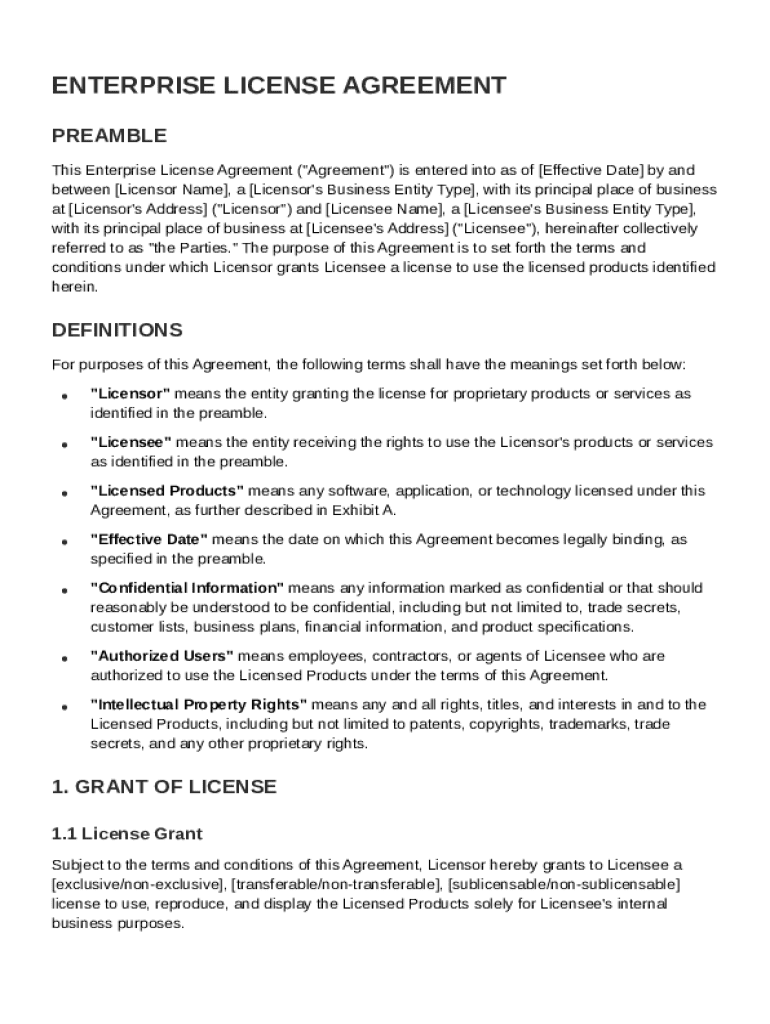







Definition and Meaning
An Enterprise License Agreement (ELA) Template serves as a framework for creating customized legal documents that outline the terms and conditions under which a licensor grants a licensee the rights to use specified licensed products. This template is designed to ensure consistency, clarity, and legal compliance in the drafting of enterprise agreements. By using an ELA template, organizations can establish standardized protocols, reduce drafting time, and minimize risks of legal disputes.
The ELA template typically includes sections that define the licensed products, the extent of the license grant, payment obligations, confidentiality requirements, and intellectual property rights. It is an essential tool for businesses engaging in large-scale licensing arrangements, providing a comprehensive guide to the expectations and responsibilities of each party involved. The template can be tailored to accommodate specific requirements, ensuring flexibility while maintaining legal rigor.
Key Elements of the Enterprise License Agreement Template
A well-structured Enterprise License Agreement Template comprises several vital sections that cater to various aspects of licensing. Here are the important components commonly found in these templates:
-
License Grant: Details the scope of the license, including what is being licensed, to whom, and under what conditions.
-
Payment Terms: Outlines any fees associated with the license, including payment schedules, methods, and consequences of non-payment.
-
Confidentiality: Specifies what information must remain confidential and details obligations regarding the protection and usage of such information.
-
Intellectual Property: Details ownership of intellectual property before, during, and after the agreement, including how rights are assigned or retained.
-
Term and Termination: Specifies the duration of the agreement and the circumstances under which it can be terminated by either party.
-
Liability and Dispute Resolution: Establishes the limits of liability, indemnification clauses, and the process for resolving disputes, including jurisdiction and governing law.
-
Compliance: Ensures that both parties adhere to relevant laws and regulations, specifying the consequences of non-compliance.
Understanding these elements ensures that the agreement is comprehensive and legally sound, safeguarding the rights and interests of both parties.
How to Use the Enterprise License Agreement Template
Using an Enterprise License Agreement Template involves several strategic steps to tailor the document to meet specific needs and ensure legal compliance. Here is a guide on how to effectively use this template:
-
Customize the Template: Begin by reviewing the template to ensure compatibility with the licensing arrangement. Customize sections such as license scope, payment terms, and confidentiality clauses to reflect the specific details of your transaction.
-
Seek Legal Advice: It is advisable to consult with a legal professional to validate that modifications adhere to applicable laws and protect the organization's interests. This step is crucial to avoid potential legal pitfalls.
-
Collaborate for Accuracy: Engage with internal departments like legal, finance, and information technology to gather their input, ensuring the agreement reflects all perspectives and departmental requirements.
-
Review for Consistency: Ensure that all parts of the document are consistent with each other and with any previously executed agreements. Look out for contradictions or ambiguous language.
-
Finalize the Agreement: Once all modifications and reviews are complete, finalize the document, making sure each party understands and agrees to the terms.
-
Secure Necessary Signatures: Obtain signatures through a legally binding electronic signature platform, securing all consents and acknowledging the understanding of the agreement's terms.
By following these steps, organizations can leverage the template to facilitate clear, balanced, and enforceable license agreements.
Steps to Complete the Enterprise License Agreement Template
Completing an Enterprise License Agreement Template requires a systematic approach to ensure accuracy and compliance:
-
Gather Required Information: Collect all necessary data about the parties involved, the products or services being licensed, and any other contextual details relevant to the agreement.
-
Fill in Basic Details: Begin with the straightforward sections, such as names, addresses, and dates, ensuring correct spelling and accuracy.
-
Detail the License Grant: Specify in clear terms what is being licensed, including any limitations or conditions on usage.
-
Define Payment Structures: Articulate all financial aspects, including fees, payment schedules, and paths for dispute over payments, if applicable.
-
Address Legal and Compliance Requirements: Ensure compliance with applicable laws, addressing issues of intellectual property, confidentiality, and data protection.
-
Consult Stakeholders: Share the draft with stakeholders for feedback and incorporate their insights to address any omissions or misunderstandings.
-
Legal Review: Have a legal professional review the agreement, focusing on enforceability and the mitigation of any potential legal risks.
-
Finalize and Execute: Ensure all parties sign the agreement using a method that provides record and legal validity.
Completing this process meticulously ensures that the final document is robust and ready for implementation.
Who Typically Uses the Enterprise License Agreement Template
Enterprise License Agreements are used predominantly by organizations involved in granting or receiving rights to use software and digital products on a large scale. Key users include:
-
Software Companies: They use ELAs to govern the distribution and use of their products by enterprises, ensuring legal compliance and protection of intellectual property.
-
Large Enterprises: Organizations acquiring software licenses for multiple users or large-scale operations rely on ELAs to formalize usage rights and obligations.
-
Legal Professionals: Attorneys specializing in intellectual property and corporate law often draft and negotiate ELAs on behalf of their clients.
-
Procurement Departments: They use ELAs as part of their vendor management processes, ensuring all software acquisitions are legally justified and aligned with organizational strategy.
-
IT Departments: Involved in implementing and enforcing ELAs to ensure technological resources are utilized in compliance with legal agreements.
These users rely on ELAs to manage complex legal relationships between licensors and licensees efficiently and effectively.


Examples of Using the Enterprise License Agreement Template
Practical case studies demonstrate how the Enterprise License Agreement Template is utilized across different sectors:
-
Technology Company Licensing Software: A leading software firm uses the ELA template to standardize agreements with corporate clients, reducing negotiation time while ensuring each contract reflects unique customer requirements.
-
Healthcare Provider Procuring Licenses: A hospital network utilizes an ELA template for acquiring software necessary for managing patient data, ensuring compliance with healthcare regulations and data privacy laws.
-
Financial Institution's Vendor Contracts: A bank deploys the template to secure licenses for critical software used in financial operations, mitigating risk by clearly defining terms regarding performance and support.
These instances reflect how an ELA template can be adapted to various business contexts to create secure, efficient, and compliant licensing agreements.
Legal Use of the Enterprise License Agreement Template
Ensuring the legal use of an Enterprise License Agreement Template involves understanding and adhering to laws that govern licensing and intellectual property:
-
Intellectual Property Laws: The agreement must respect existing provisions concerning intellectual property rights, ensuring no infringement occurs.
-
Contract Law Principles: The document must fulfill contract law requirements in terms of offer, acceptance, and consideration to be legally binding.
-
Compliance with Data Protection Regulations: Especially relevant for agreements involving data usage, which must comply with regulations such as HIPAA in the healthcare sector or GDPR in applicable territories.
-
Jurisdictional Legal Consistency: Ensure that the agreement adheres to the legal standards of the jurisdiction in which it is executed and enforced.
By observing these legal guidelines, organizations can draft and execute ELAs with confidence, reducing risk while leveraging legal protections.
Business Types That Benefit Most from the Enterprise License Agreement Template
Certain business types derive significant benefits from using an Enterprise License Agreement Template, such as:
-
Software as a Service (SaaS) Providers: These businesses frequently engage in licensing transactions and benefit significantly from standardized, scalable agreements.
-
Corporate Enterprises: Large organizations with extensive software and technology needs use ELAs to manage multiple licenses efficiently.
-
Educational Institutions: Universities and schools often require enterprise licenses for software used in teaching and administration.
-
Telecommunications Companies: They leverage ELAs for technology partnerships and services critical to their operations.
These organizations capitalize on the ELA's structured approach to manage complex licensing environments effectively.
State-by-State Differences in Enterprise License Agreements
Enterprise License Agreements must account for state-specific legal requirements and business practices in the United States:
-
California: Often requires additional clauses related to consumer protection and privacy, given the state's stringent data protection laws.
-
New York: Emphasizes precise documentation for liability and dispute resolution, reflecting its robust legal framework.
-
Texas: Business-friendly environment often demands flexibility in agreement terms to accommodate rapid growth and scalability.
Understanding these state-specific nuances is vital for companies operating nationwide, ensuring all ELAs are compliant and enforceable in each jurisdiction where business is conducted.




