
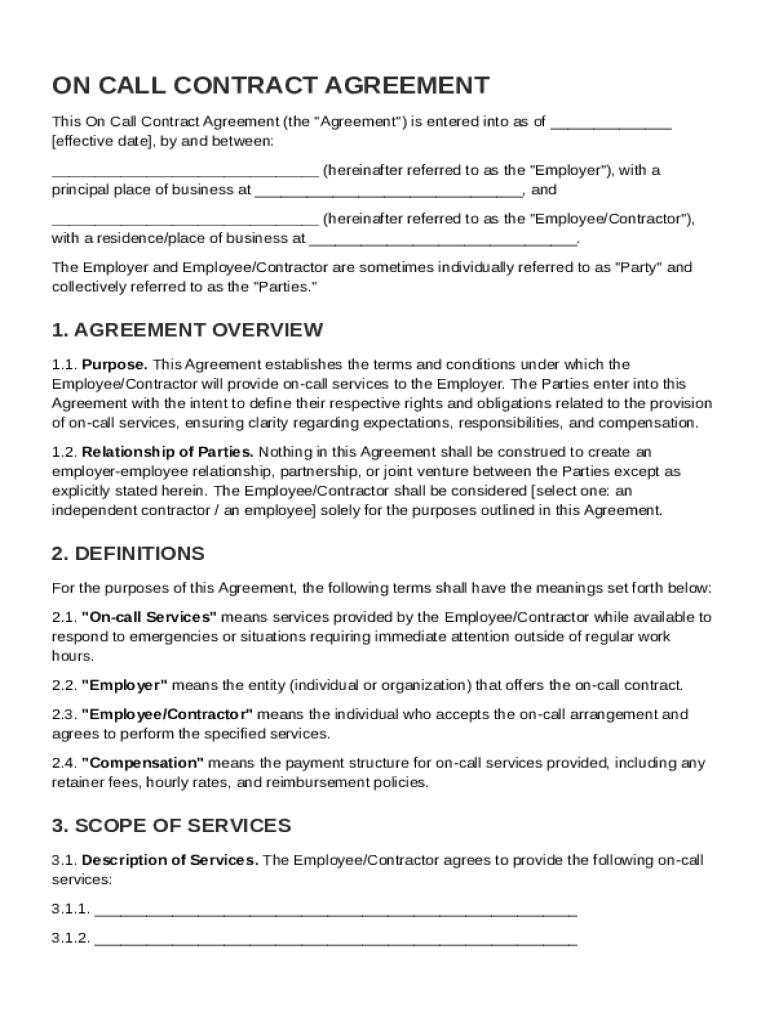




Definition & Meaning
The On Call Contract Template is a specialized document designed to formalize the employment relationship for on-call services between an employer and a contractor or employee. This contractual document outlines the expectations, responsibilities, and rights of both parties involved. It clearly defines the scope of services to be performed, establishing the parameters of availability for the on-call personnel and the compensation structure related to their work. The purpose is to create a clear understanding of mutual obligations, which helps in minimizing possible disputes and ensuring a smooth operational flow.
How to Use the On Call Contract Template
Using the On Call Contract Template involves several key steps to ensure all necessary components are accurately completed. Here's a general outline for effectively using the template:
-
Review the Template: Begin by thoroughly reading the entire contract template. This review ensures you understand all terms and clauses.
-
Customize the Terms: Modify sections to fit the specific dynamics of your employment relationship, including service scope, compensation, and availability requirements.
-
Consult Legal Advice: It's advisable to have legal counsel review the customized template to ensure it adheres to applicable laws and regulations.
-
Finalize the Contract: Once both parties agree on the terms, finalize the document by completing all required fields and ensuring accuracy.
-
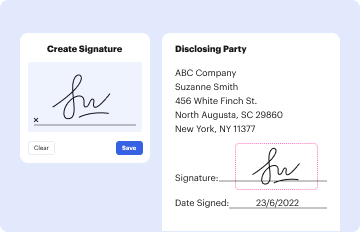
Sign and Distribute: Execute the contract by obtaining signatures from all parties, then distribute copies to the employer and the on-call employee or contractor for record-keeping.
Key Elements of the On Call Contract Template
The On Call Contract Template includes several critical sections that establish a structured agreement:
- Parties Involved: Identifies the employer and the contractor or employee by name and contact information, detailing their roles within the contract.
- Scope of Services: Clearly describes the duties and responsibilities expected from the on-call individual, specifying any limitations on tasks.
- Availability Requirements: Details the hours or conditions under which the personnel must be available to provide services.
- Compensation Structure: Outlines the payment terms, which could be hourly, per call, or based on performance metrics, and may include provisions for overtime or bonuses.
- Confidentiality Obligations: Sets parameters for information sharing and confidentiality to protect sensitive data.
- Indemnification Clauses: Provides details on liability and indemnification agreements to protect both parties from specific risks.
- Dispute Resolution: Explains the process for resolving any disagreements, often involving mediation or arbitration before legal actions.
Important Terms Related to the On Call Contract Template
Understanding some of the terminologies used within the On Call Contract Template is crucial:
- On-call: This term refers to the requirement for an employee to be available to work at irregular intervals as per the company's needs.
- Indemnification: A contractual obligation where one party agrees to cover losses caused by the other party.
- Confidentiality: Ensures that any privileged information disclosed during the term of the agreement is protected from unauthorized access or disclosure.
- Arbitration: A method of dispute resolution involving a neutral third party, whose decision is usually binding.
Legal Use of the On Call Contract Template
Ensuring the legal soundness of the On Call Contract Template involves understanding and adhering to specific legal principles and practices:
-
Compliance with Labor Laws: The contract must align with both federal and state labor laws to ensure legality, particularly concerning employment rights and compensation.
-
Enforceability: The terms should be reasonable and not overly restrictive to ensure the agreement stands up in a legal setting if challenged.
-
Protection of Rights: The template should highlight the rights of both parties, providing legal recourse options in cases of contract violations.
Who Typically Uses the On Call Contract Template
The On Call Contract Template is widely used across various employment and industry sectors where flexible or non-traditional work schedules are common:
-
Healthcare Providers: Medical professionals, such as doctors or nurses, who might need to respond to emergencies or provide care outside of regular hours.
-
Information Technology Services: IT professionals responsible for system maintenance, which could require immediate attention during off-hours.
-
Maintenance Services: Facility management personnel covering repairs and essential maintenance on an as-needed basis.

State-Specific Rules for the On Call Contract Template
When using the On Call Contract Template, it's important to consider variations in state laws that might affect the contract terms:
-
Employment At-will Law Variability: States differ in their interpretation and application of at-will employment, impacting termination clauses.
-
Minimum Wage Differences: Compensation terms must reflect the minimum wage laws, which vary by state, especially concerning on-call pay and overtime.
-
Required Breaks and Time-off Regulations: Certain states have specific mandates for break times and rest periods for on-call employees.
Examples of Using the On Call Contract Template
Practical examples of how the On Call Contract Template can be applied include:
-
Hospital Staffing: A hospital might use the template to formalize agreements with on-call surgeons who are available to perform surgeries as needed.
-
Residential Building Management: Building managers can draw up contracts for maintenance staff responsible for responding to emergencies like plumbing failures.
-
IT Support Services: An IT firm may employ on-call technicians contracted to handle unscheduled network outages or data recovery tasks.