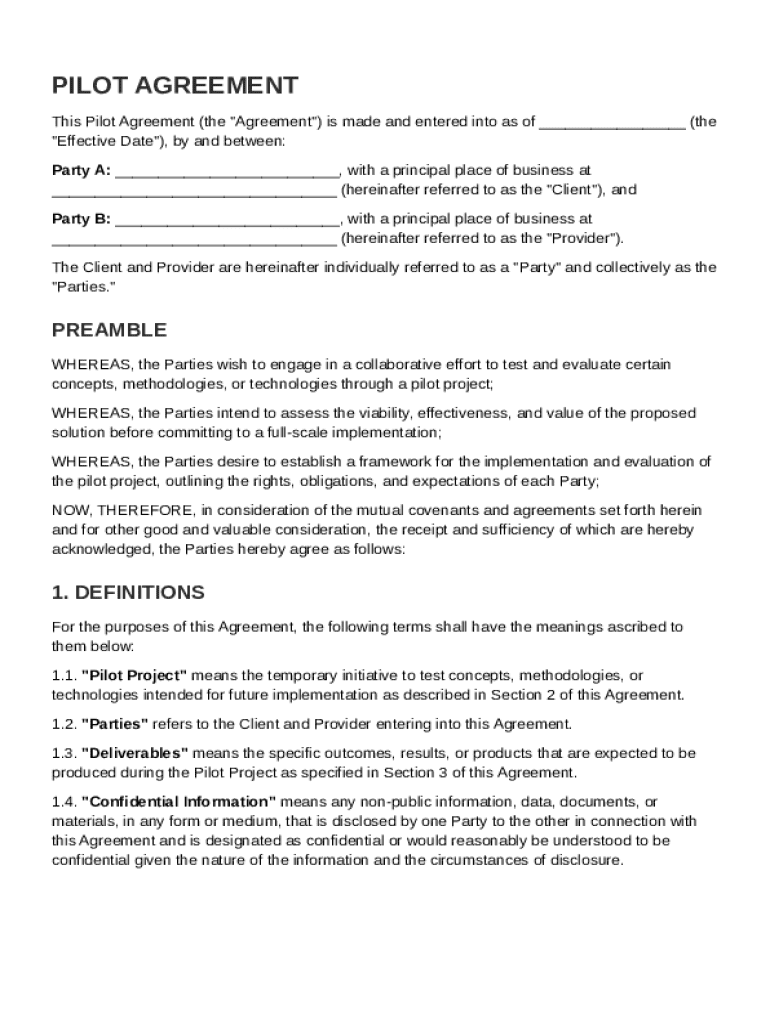







Definition and Meaning of a Pilot Agreement Template
A Pilot Agreement Template is a pre-structured document used to outline the terms and conditions of a collaborative pilot project between a client and a provider. This document serves as a framework for testing and evaluating specific concepts, methodologies, or technologies before committing to full-scale implementation. It ensures that both parties have a clear understanding of project goals, deliverables, roles, responsibilities, confidentiality obligations, payment terms, liability limitations, and termination conditions. Utilizing a template helps streamline the creation process, ensuring that all essential elements are accounted for, providing a foundation for a successful pilot project.
Key Benefits of Using a Pilot Agreement Template
- Ensures clarity on project objectives and timelines
- Provides legal protection through defined terms and conditions
- Facilitates smoother communication between parties
- Reduces time spent drafting agreements from scratch
How to Use the Pilot Agreement Template
Utilizing a Pilot Agreement Template involves customizing the document to meet the specific needs and scenarios of the pilot project at hand. Begin by reviewing the template's standardized sections, such as objectives, scope of work, and deliverables. Adapt these sections to fit the unique context of the project. For instance, modify the project goals to match the expected outcomes of the pilot.
- Review the Standard Structure: Familiarize yourself with the core sections of the template to understand its components.
- Customize Project Details: Input specific information related to the client and provider, such as contact details, resources involved, and scope.
- Specify Roles and Responsibilities: Clearly define the duties of each party to prevent misunderstandings.
- Outline Confidentiality and Security Measures: Ensure sensitive data protection and compliance with relevant laws.
- Formalize Payment and Deliverables: State the financial terms and expected project outcomes clearly.
Steps to Complete the Pilot Agreement Template
Completing a Pilot Agreement Template requires thorough attention to detail to ensure accuracy and compliance with the agreed terms. Follow these steps to complete the template effectively:
- Gather Essential Information: Collect details about the project, client, provider, and any specific requirements.
- Fill Out Each Section: Start by entering general project information, then proceed to detailed sections such as deliverables and timelines.
- Define Legal and Financial Terms: Establish confidentiality obligations, payment schedules, and liability terms.
- Review and Revise: Carefully proofread the entire document to ensure clarity and completeness.
- Seek Legal Counsel if Necessary: Consult a legal expert for complex agreements or when in doubt.
- Final Approval and Signatures: Secure signatures from both parties to formalize the agreement.
Key Elements of the Pilot Agreement Template
Project Goals and Deliverables
Clearly defined project goals and deliverables form the crux of the Pilot Agreement. This section establishes what the pilot aims to achieve and the tangible results expected at its conclusion. It aligns both parties on specific outcomes, preventing scope creep and setting a benchmark for success.
- Goals: Quantifiable targets that guide project execution.
- Deliverables: Specific outputs, such as reports or product prototypes.
Roles and Responsibilities
Assigning clear roles and responsibilities helps in delineating the work expected from each party to avoid overlaps and misunderstandings. This section specifies tasks, authority, and accountability lines, ensuring efficiency and clarity.
- Client Responsibilities: Include providing necessary resources and feedback.
- Provider Responsibilities: Cover developing the project scope, executing tasks, and reporting.
Who Typically Uses the Pilot Agreement Template
The Pilot Agreement Template is frequently utilized by businesses, research institutions, and technology developers engaging in pilot projects to test ideas or technologies. Startups often employ these agreements to validate product concepts with potential clients. Consulting firms also use pilot agreements when introducing new service models to clients.


Examples of Common Users
- Tech Startups: To test innovative software solutions with potential users.
- Healthcare Organizations: For evaluating new treatments or technologies in real environments.
- Consultancy Services: Examining effectiveness of novel business strategies.

Important Terms Related to the Pilot Agreement Template
Understanding the terminology associated with a Pilot Agreement Template is essential for correctly drafting and interpreting the document. Familiarize yourself with common terms such as:
- Mutual Non-Disclosure Agreement (MNDA): A contract to protect confidential information exchanged during the pilot.
- Scope of Work (SOW): A detailed description of the work to be performed during the pilot.
- Termination Clause: Conditions under which the pilot can be prematurely ended.
Legal Use of the Pilot Agreement Template
Using a Pilot Agreement Template requires adherence to legal standards applicable in the United States. It is vital to ensure that the terms of the agreement comply with federal and state laws, especially regarding contract law and data privacy.
Legal Considerations
- Governing Law: Specifies the jurisdiction under which any legal disputes will be resolved.
- Liability Limits: Defines the extent of legal responsibility for each party concerning the pilot outcomes.
- Amendment Procedures: Outlines how changes to the agreement can be made officially.
State-Specific Rules for the Pilot Agreement Template
While the Pilot Agreement Template is generally applicable across the United States, certain states may have specific legal requirements that need to be considered. These can include nuances in contract law or industry-specific regulations.
Common State Considerations
- California: High emphasis on data privacy laws.
- New York: Specific requirements for financial service pilots.
- Texas: Detailed provisions for renewable energy projects.
Understanding these state-specific rules can help ensure that the agreement is fully compliant and enforceable according to regional legal standards.