




01. Edit your form online
Type text, add images, blackout confidential details, add comments, highlights and more.

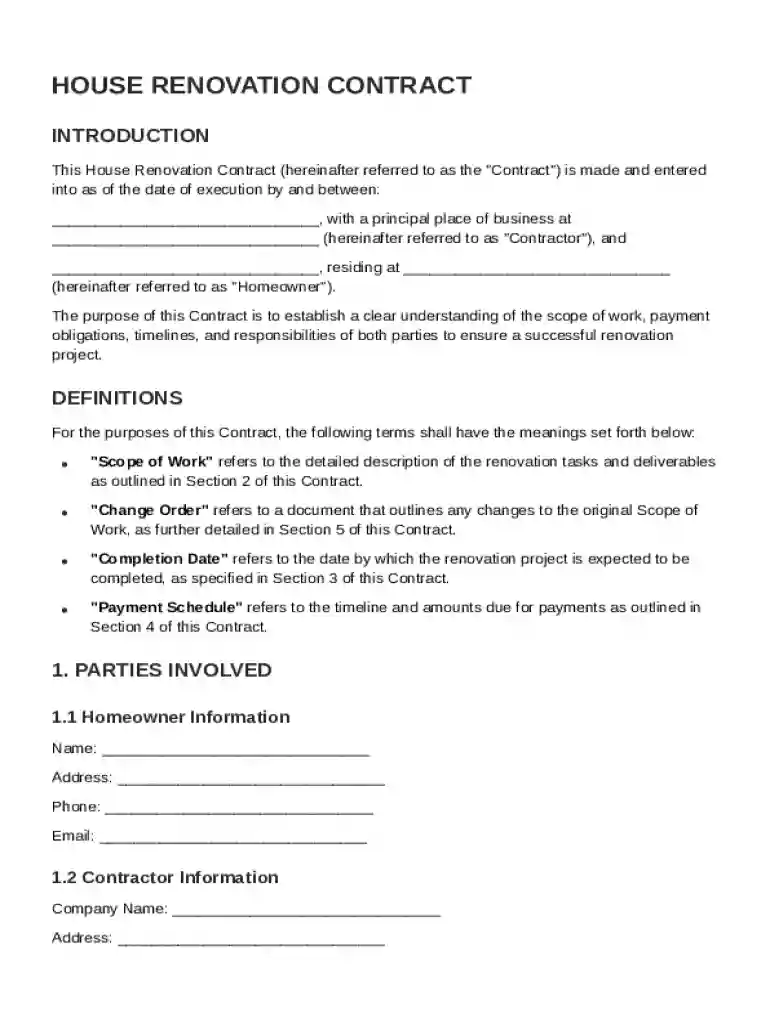
Type text, add images, blackout confidential details, add comments, highlights and more.

Draw your signature, type it, upload its image, or use your mobile device as a signature pad.

Send it via email, link, or fax. You can also download it, export it or print it out.
A House Renovation Contract Template is a formal agreement between a contractor and a homeowner detailing terms for a renovation project. It outlines important aspects, such as the scope of work, payment schedules, responsibilities, timelines, warranties, and dispute resolution pathways. This contract template ensures both parties are aligned in understanding project expectations, reducing the risk of conflicts during the renovation.
The scope of work is a critical component of the House Renovation Contract Template. It defines in detail the specific tasks to be completed, such as demolition, construction, plumbing, or painting. By explicitly outlining each aspect of the renovation, both parties can manage expectations and minimize misunderstandings. For example, specifying the type of materials to be used or the parts of the house to be renovated can prevent disputes over quality or coverage of work.
Payment terms within the contract specify the financial obligations of the homeowner and the compensation schedule for the contractor. This often includes the total contract amount, deposit requirements, installment schedules, and final payment upon project completion. For instance, a common practice might be to require a 30% deposit before work begins, with subsequent payments tied to the completion of significant project milestones, ensuring financial clarity throughout the renovation.
Completing the House Renovation Contract Template involves several key steps, ensuring all necessary details are captured and mutually agreed upon.
When completing the template, ensure all sections are thoroughly reviewed, and all terms are explicitly stated. Double-check all figures and timelines for accuracy and consistency to prevent mistakes that might lead to legal complications.
The House Renovation Contract Template consists of several critical elements essential for a comprehensive and enforceable agreement.
To better understand its practical application, consider the following scenarios where the House Renovation Contract Template proves beneficial.
Homeowners and contractors can adapt the standard template to suit more specific needs, including incorporating additional clauses for penalties or bonuses based on project timelines or quality metrics.
The House Renovation Contract Template is designed to comply with U.S. legal standards. As a legally binding document, it stipulates the precise terms of agreement between the contracting parties and offers a foundation for legal recourse in the event of a dispute. Adhering to statutory requirements, such as obtaining necessary permits or certifications, is crucial to avoid regulatory violations.
While the template provides a strong foundation, consulting with a legal professional is advisable to ensure all local, state, and federal laws are observed and any unique clauses are appropriately drafted.
Understanding certain terminology within the House Renovation Contract Template is essential for both parties.
For clarity, contract terms should be clearly defined within the document to ensure both parties fully understand their implications and applications throughout the renovation process.
The House Renovation Contract Template is commonly utilized by homeowners engaging contractors for home improvement projects, ensuring clear communication and mutual understanding.


While aimed primarily at residential projects, the template may be enhanced to fit more complex renovation contracts, such as commercial spaces or multifamily units, adapting to different scopes and stages of renovation work.
At DocHub, your data security is our priority. We follow HIPAA, SOC2, GDPR, and other standards, so you can work on your documents with confidence.



The Contractor agrees to use only licensed subcontractors, including Home Improvement Contractors licensed by DCWP and plumbers and electricians licensed by DOB
▫ Fast-track renovations and new residential or commercial construction. ▫ Clean and modular, easy to plan. ▫ Long-term protection from moisture and mold
Form is used to start work prior to a contract being executed. docHub extenuating or emergency circumstances are required to request this authorization.


