






Definition and Meaning of Copyright Transfer Agreement
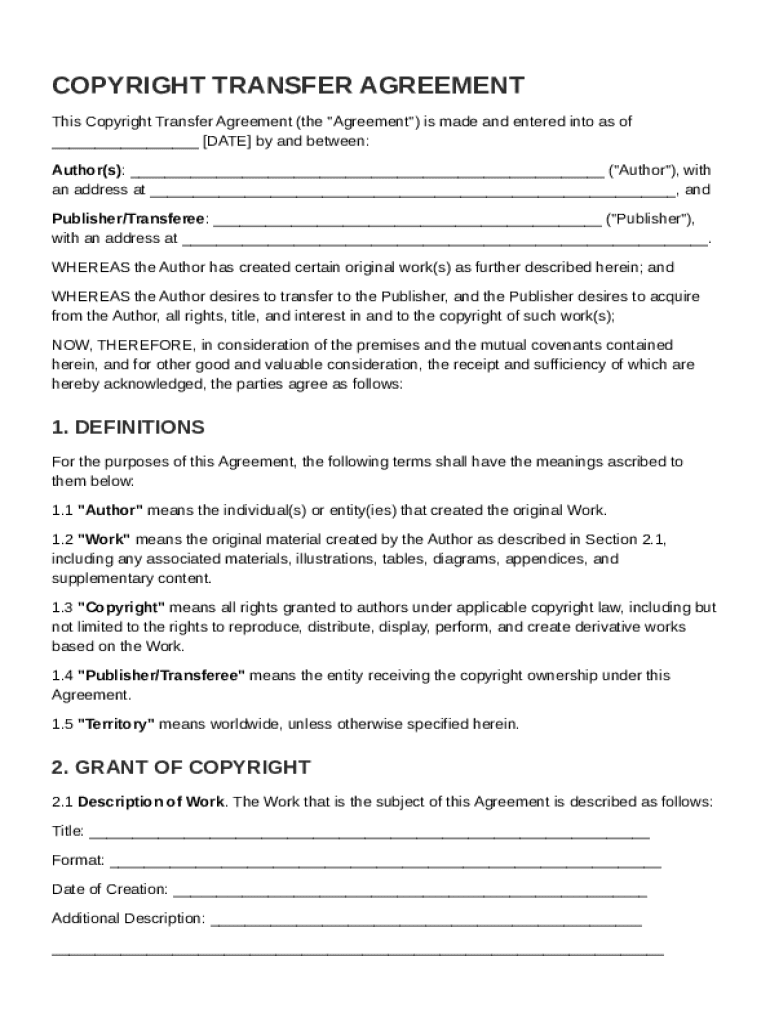
A Copyright Transfer Agreement (CTA) is a legal document that facilitates the transfer of copyright ownership from the original creator (the Author) to another party (the Publisher). This agreement is commonly used in publishing, where authors of various forms such as books, articles, or creative works formally relinquish their rights to the material in favor of the publisher. The CTA typically details the exact rights being transferred, the scope of the transfer, and any conditions under which the copyright may be reverted back to the author.
- Key Elements Transfer: Generally includes all rights such as reproduction, adaptation, distribution, public performance, and display.
- Context of Use: Often used in academic, journal, or book publishing scenarios, where both parties benefit from clear ownership guidelines.
- Framework: Typically composed of detailed sections covering terms, rights transfer scope, and possible limitations or exceptions.
Key Elements of the Copyright Transfer Agreement Template
Understanding the key elements of a Copyright Transfer Agreement Template ensures all necessary legal points are covered effectively.
- Scope of Rights: Defines which specific rights are being transferred from the Author to the Publisher, including reproduction, adaptation, and distribution rights.
- Payment Terms: Details any financial compensations or royalties the Author shall receive.
- Representations and Warranties: Statements by the Author guaranteeing the authenticity and originality of the work.
- Indemnification Clause: Protects the Publisher from legal claims or suits related to errors the Author might have overlooked.
- Termination Conditions: Circumstances under which the agreement can be nullified for breach of terms or other valid reasons.
Steps to Complete the Copyright Transfer Agreement Template
Completing a Copyright Transfer Agreement Template involves several methodical steps to ensure precision and legal compliance.
- Gather Necessary Information: Prepare comprehensive details about the work, the parties involved, and specific rights to be transferred.
- Use Accurate Language: Employ legally sound terminology and reference applicable laws.
- Populate the Template: Fill in the details adhering to the template's prescribed sections to maintain consistency.
- Review the Document Thoroughly: Ensure all terms are accurate, clear, and convey the intended transfer of rights.
- Seek Legal Review: If possible, have a legal professional review the completed template to verify its enforceability.
- Signatures and Dates: Conclude by having both parties sign and date the document, officially marking the transfer.
Who Typically Uses the Copyright Transfer Agreement Template
This template serves a variety of users, primarily in writing and publishing sectors.
- Authors and Writers: To formalize the transfer of rights to their written works.
- Publishers: To secure legal ownership and control of the content they distribute.
- Academic Institutions: For research papers or scholarly articles to ensure clarity on publication and usage rights.
- Content Creators: Such as photographers or designers when their creations need publication or widespread use.


Importance of Using the Copyright Transfer Agreement Template
The rationale behind utilizing a Copyright Transfer Agreement is multifaceted and crucial for both authors and publishers.
- Clarity of Ownership: Establishes clear guidelines and expectations on who holds the rights to use and profit from the work.
- Legal Security: Minimizes disputes by embedding legal clauses that safeguard both parties’ interests.
- Professional Integrity: Upholds the author's contribution and the publisher's capacity to distribute the work without infringing laws.
- Investment Protection: Ensures that any investments by the publisher are safeguarded by legally obtaining necessary rights.
Examples of Using the Copyright Transfer Agreement Template
Applications of the Copyright Transfer Agreement Template span various day-to-day professional scenarios.
- Academic Journals: Researchers transfer copyright of their work to publishers for wider dissemination.
- Book Publishing: Authors transferring rights to a publishing house as part of their book deal.
- Collaborative Projects: Multiple creators collectively assign rights to a unified entity for cohesive project management and release.
Legal Use and Compliance of the Copyright Transfer Agreement Template
Legal compliance when using this template is non-negotiable, rooted in both international and regional copyright laws.
- Adherence to the ESIGN Act: For electronic signatures, ensuring they are legally accepted and binding.
- State Laws: Must consider variances in state-specific copyright regulations, particularly in the United States.
- Copyright Act Considerations: Every agreement must comply with the stipulations in the U.S. Copyright Act for it to be enforceable.
State-by-State Differences in Copyright Transfer Agreements
There can be significant differences in how copyright transfers are treated across various U.S. states.
- Jurisdictional Variances: Some states may have specific requirements or limitations regarding copyright transfer processes.
- Legal Enforcements: The level of enforceability and typical state practices could affect the execution of the agreement.
- Reversion Rights: Certain states might offer enhanced reversion rights to authors, which are critical to understand and incorporate.
Selecting relevant provisions and tailoring the agreement to meet these differences can be crucial in ensuring the agreement's legal standing and effectiveness.