




01. Edit your 8867 form online
Type text, add images, blackout confidential details, add comments, highlights and more.

Type text, add images, blackout confidential details, add comments, highlights and more.

Draw your signature, type it, upload its image, or use your mobile device as a signature pad.

Send form 8867 via email, link, or fax. You can also download it, export it or print it out.
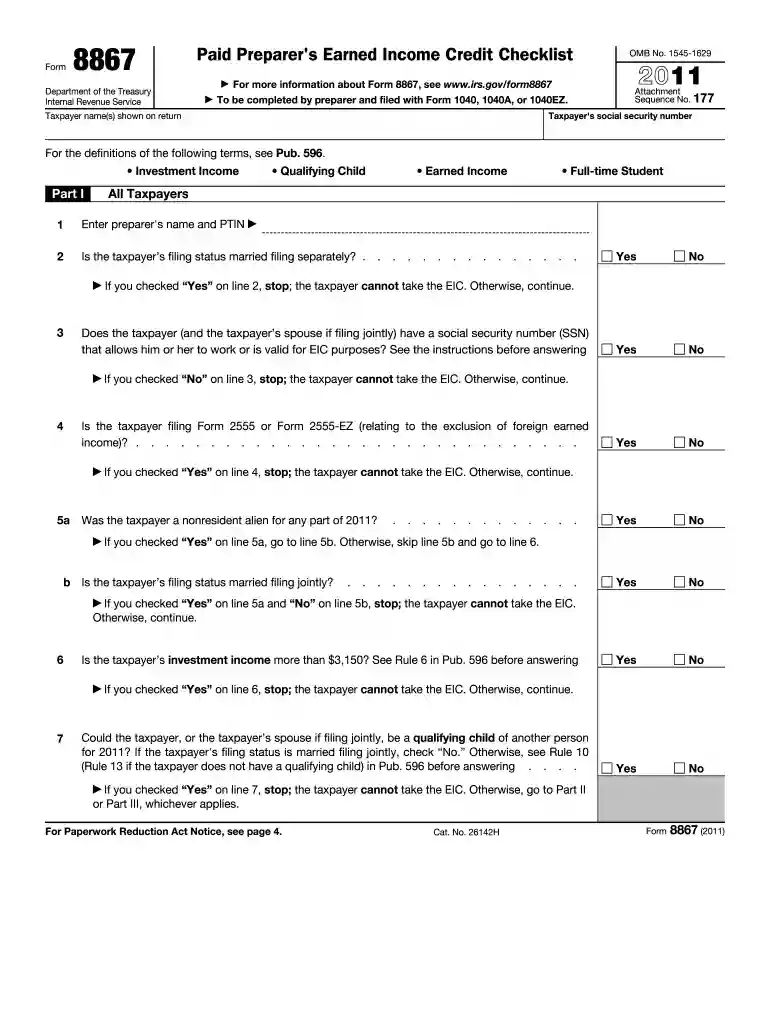
Form 8867, often referred to as the Paid Preparer’s Due Diligence Checklist, is a mandatory document for tax preparers in the United States. It serves as a compliance tool to ensure that preparers meet the eligibility and verification requirements when aiding taxpayers in claiming the Earned Income Credit (EIC). The form is instrumental in mitigating errors and fraud related to the EIC claims by outlining due diligence obligations such as verifying filing status, ensuring the validity of Social Security Numbers, and confirming qualifying child criteria.
Form 8867 can be accessed and downloaded directly from the official Internal Revenue Service (IRS) website. As a common practice, professional tax preparation software like TurboTax and QuickBooks includes the form within their filing procedures. This ensures that tax preparers have the form readily available when they begin tax return preparations. For those preferring physical copies, the form can be requested by mail through the IRS forms distribution center.
Tax preparers must verify that taxpayers meet specific eligibility criteria for each credit claimed. For the EIC, critical factors include:


Form 8867 comprises several crucial sections that tax preparers must meticulously complete, including:
The IRS outlines strict guidelines for the completion and submission of Form 8867, which must accompany any tax return claiming the EIC, Child Tax Credit, or American Opportunity Tax Credit. The form acts as an attestation from paid preparers that they have taken appropriate steps to comply with due diligence requirements. Failure to accurately complete and submit Form 8867 may result in penalties for both the preparer and the taxpayer.
Non-compliance with Form 8867’s due diligence requirements can lead to significant penalties. Tax preparers who fail to attach a completed Form 8867 to EIC-related tax returns or omit essential verification details may face fines exceeding $500 per failure. Continued negligence can result in further disciplinary actions, including suspension from filing tax returns on behalf of others.
Tax preparers can submit Form 8867 using several methods:
In addition to Form 8867, tax preparers must maintain extensive documentation supporting the taxpayer’s eligibility for the claimed credits. Required records typically include:
Consider a self-employed taxpayer with two children eligible for the EIC. The tax preparer must complete Form 8867 to ensure that the taxpayer meets all eligibility criteria, such as income limitations and qualifying child tests, before claiming the credit. By validating these details through comprehensive interviews and documentation checks, the preparer adheres to the IRS's due diligence standards, reducing the likelihood of errors and penalties.
In today’s digital-centric world, many tax preparers opt for the electronic version of Form 8867 due to its integration with tax preparation software, ease of filing, and faster processing times. In contrast, the paper version remains essential for those who prefer traditional methods or lack access to digital filing tools. Both versions require adherence to the same thorough due diligence standards.
Different taxpayer scenarios, such as retirees or students, demand tailored due diligence processes. For instance, a retired taxpayer might qualify for EIC with a part-time job income, while a student must ensure they meet income and residency tests for claiming the credit. Form 8867 standardizes the due diligence required for these diverse situations, safeguarding against improper claims and ensuring that taxpayers receive applicable credits.

Integration with major tax preparation software enhances the utility of Form 8867, offering features like automated data checks and storage of due diligence records. Programs such as TurboTax facilitate the seamless inclusion of the form in digital tax returns, allowing preparers to efficiently manage compliance requirements while maintaining precise records through digital means.
We've got more versions of the 8867 form form. Select the right 8867 form version from the list and start editing it straight away!
| Versions | Form popularity | Fillable & printable |
|---|---|---|
| 2024 | 4.3 Satisfied (36 Votes) | |
| 2023 | 4.9 Satisfied (25 Votes) | |
| 2022 | 4.6 Satisfied (58 Votes) | |
| 2021 | 4.8 Satisfied (90 Votes) | |
| 2020 | 4.4 Satisfied (83 Votes) | |
| 2019 | 4.3 Satisfied (54 Votes) | |
| 2018 | 4.3 Satisfied (151 Votes) | |
| 2017 | 4.4 Satisfied (88 Votes) | |
| 2016 | 4.3 Satisfied (117 Votes) | |
| 2015 | 4.1 Satisfied (67 Votes) | |
| 2014 | 4.3 Satisfied (38 Votes) | |
| 2013 | 3.9 Satisfied (35 Votes) | |
| 2011 | 4.1 Satisfied (38 Votes) |
At DocHub, your data security is our priority. We follow HIPAA, SOC2, GDPR, and other standards, so you can work on your documents with confidence.
Information about Form 8867, Paid Preparers Earned Income Credit Checklist, including recent updates, related forms and instructions on how to file.
Form 8867, paid preparers earned income credit checklist,.-journal.
Feb 19, 2013 Staff Report for the 2012 Article IV consultation, prepared by a staff team of the IMF, following discussions that ended on December 11,Read more


