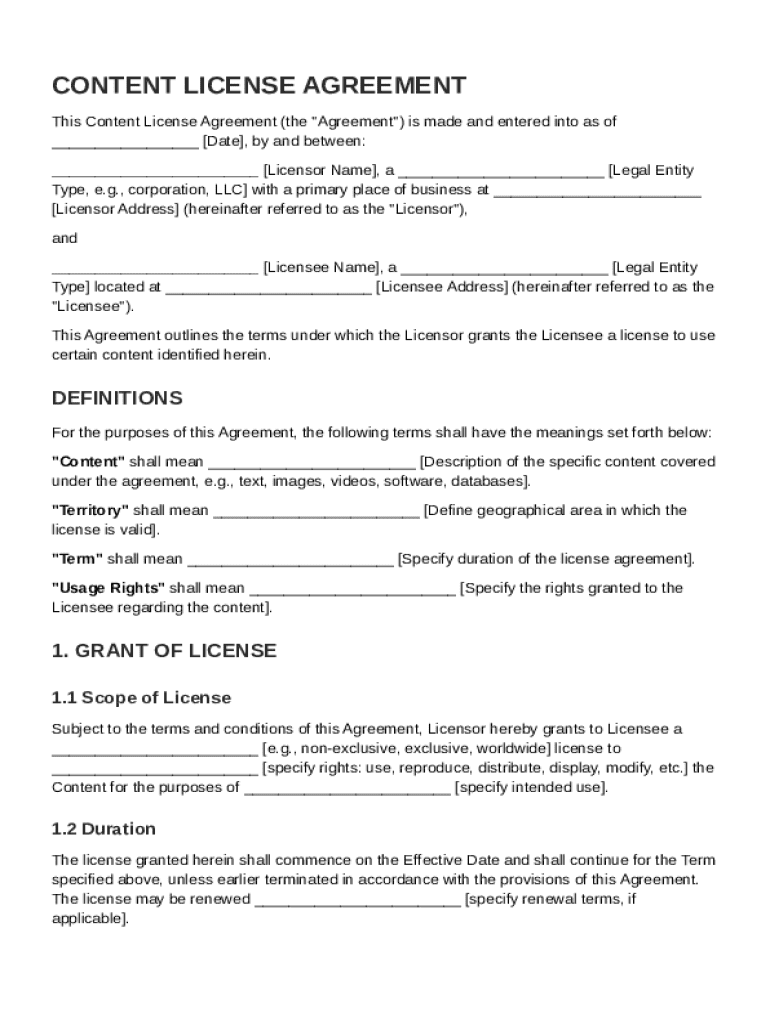







Definition & Meaning
A Content License Agreement Template is a structured legal document that outlines the terms under which a Licensor permits a Licensee to utilize specific content. It serves as a vital tool to define the scope of content usage, detailing aspects such as the duration of use and geographical limits. This agreement acts as a foundation for both parties, ensuring everyone is on the same page regarding responsibilities and rights. Additionally, it includes sections on intellectual property rights, affirming that content ownership remains with the Licensor, along with any licenses or royalties applicable.
Nuanced Definitions
- Licensor: The individual or entity granting permission to use the content.
- Licensee: The party receiving the right to use the content.
- Intellectual Property Rights: Legal entitlements that protect creators’ rights to their original works.
Key Elements of the Content License Agreement Template
The template includes several crucial components to provide comprehensive coverage of the content usage terms. Key elements include:
- Scope and Duration: Specifies how the content can be used and for what period.
- Payment Terms: Details any fees or royalties that the Licensee must pay the Licensor.
- Termination Clauses: Conditions under which the agreement can be terminated by either party.
- Limitation of Liability: Outlines liabilities each party holds in case of a breach.
- Governing Law: Indicates which jurisdiction's laws will govern the agreement.
Scope and Duration
- Specific Use Cases: Eg., advertising, media publication, product packaging.
- Timeframe: Duration for which the content license is valid.
Payment Terms
- One-time Fees: Fixed amount paid upfront or at a specified time.
- Royalties: Ongoing payments based on usage, like sales percentages.
How to Use the Content License Agreement Template
Utilizing a Content License Agreement Template requires an understanding of its structure to ensure all critical legal aspects are addressed. Steps include:
- Review Sections: Examine each section of the template carefully.
- Customize Details: Modify terms depending on the specific requirements of the Licensor and Licensee.
- Legal Terminology: Ensure any legal terms are accurately defined and contextualized.
- Consult Professionals: Engage with legal experts for advice on complex clauses.
Practical Scenarios
- Collaborative Projects: Securing agreements between designers and brands on limited-edition merchandise.
- Digital Content Platforms: Authors licensing online publications for app or website use.
Steps to Complete the Content License Agreement Template
Completing the template is straightforward but requires attention to detail:
- Fill Out Basic Information: Enter names and contact details of both parties.
- Define Content and Usage: Specify the type of content and intended usage scope.
- Include Payment Terms: Outline compensation measures, if applicable.
- Set Termination Conditions: Clearly state the grounds under which the contract may end.
Detailed Instructions
- Content Definition: Clearly articulate what content is being licensed.
- Party Obligations: List the responsibilities each party holds during the agreement.
Legal Use of the Content License Agreement Template
The template ensures compliance with legal frameworks, making sure both parties adhere to agreed terms. For legal recognition:
- Legally Binding: Ensure signatures are obtained to validate the contract.
- Adherence to ESIGN Act: Implement electronic signatures if opting for a digital format.
Jurisdiction and Disputes
- Venue Selection: Decide the court location for potential legal disputes.
- Arbitration Clauses: Optionally include to specify dispute resolution outside court.
Important Terms Related to Content License Agreement Template
Understanding terminology is essential for clarity and reducing ambiguity. Key terms include:
- Exclusive vs. Non-Exclusive Licenses: Determines if the Licensee has sole rights or if rights can be shared.
- Indemnification Clause: Prevents parties from liability due to the other’s actions.
In Practice
- Exclusive: A film studio grants exclusive rights to a movie script.
- Indemnification: A Licensee agrees to indemnify the Licensor against lawsuits arising from misuse or misrepresentation.
Who Typically Uses the Content License Agreement Template
This template is widely used among:
- Creative Professionals: Artists, photographers licensing their original work.
- Media Companies: Outlets licensing multimedia content for distribution.
- Educational Institutions: Licensing academic content or research findings.


Use Cases
- Photography Studios: Licensing images to magazines for feature articles.
- Software Developers: Allowing use of proprietary code within third-party applications.
Examples of Using the Content License Agreement Template
Real-world scenarios highlight the template's versatility:
- Music Licensing: A music label licenses a track to be used in a film for a specific period and territory.
- Brand Collaborations: A popular illustration artist licenses designs to be used on fashion apparel.
Expanded Examples
- Commercial Ad Campaigns: Licensors grant rights for visual content to be used in advertisement campaigns for a specified region.
- Video Game Developers: Licensing character designs for inclusion in a new game release.