






Definition & Purpose
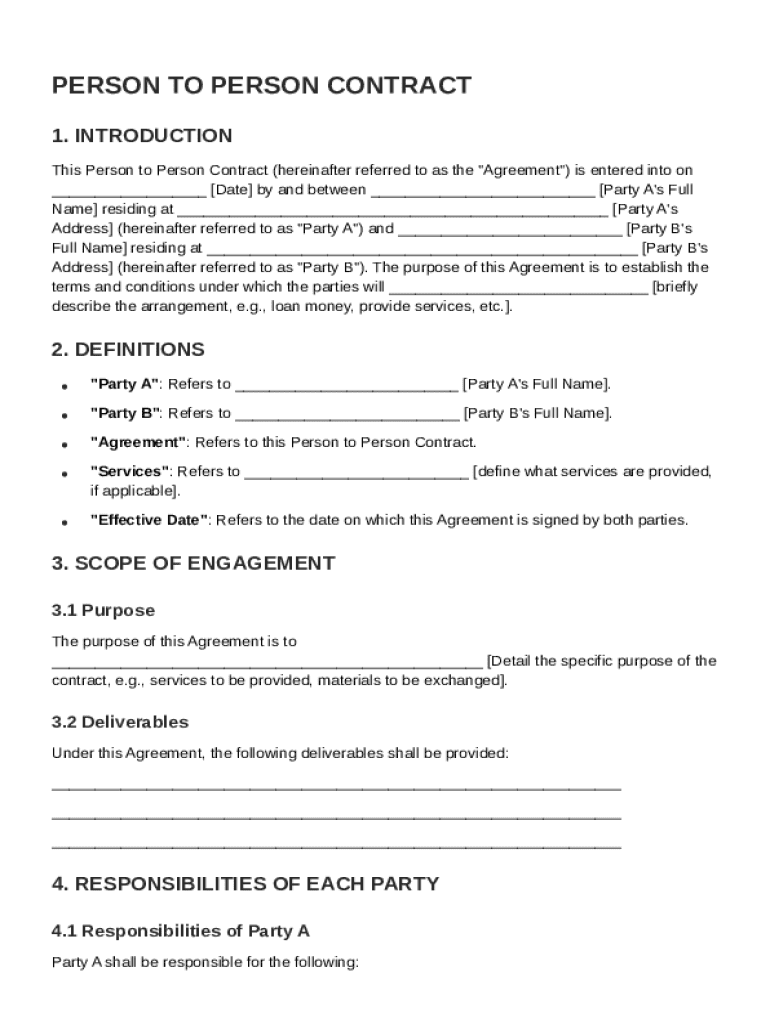
The Person to Person Contract Template is a formal document designed to outline an agreement between two parties, Party A and Party B. This template is used to specify the terms and conditions of a particular arrangement, which could involve either the provision of services or the exchange of materials. The contract encompasses several critical sections, including definitions, each party's responsibilities, payment terms, duration and termination conditions, confidentiality obligations, dispute resolution procedures, and miscellaneous provisions. The primary aim of this contract is to establish clear expectations and legal protections for both parties involved, ensuring a mutual understanding and minimizing potential conflicts over the course of the agreement.
Key Elements of the Contract
-
Definitions: Clarify specific terminologies used within the contract that may require interpretation. This ensures that both parties have a common understanding of terms that could be ambiguous or specific to the agreement.
-
Responsibilities: Identify the duties and obligations of each party involved. This includes specific tasks that each party is expected to fulfill under the contract.
-
Payment Terms: Outline the financial arrangements, including amounts, payment schedules, methods of payment, and any conditions or contingencies related to the payment process.
-
Duration and Termination: Specify the length of the agreement and the conditions under which the contract can be terminated. This may include notice periods and acceptable conditions for contract dissolution.
-
Confidentiality Obligations: Establish the confidentiality requirements to protect sensitive information shared during the execution of the contract.
-
Dispute Resolution: Detail the steps to be followed if a disagreement or conflict arises, including preferred methods such as mediation or arbitration.
-
Miscellaneous Provisions: Cover additional aspects that may not fall under the other categories but are pertinent to the contract’s execution.
How to Use the Person to Person Contract Template
The process of utilizing the Person to Person Contract Template involves several steps that ensure both parties are in agreement and that the document accurately reflects the terms agreed upon.
Steps to Utilize the Template
-
Identify Parties Involved: Clearly specify the individuals or entities entering into the agreement to avoid ambiguity.
-
Specify Agreement Details: Record the particulars of the services or materials being exchanged, aligning with the mutually agreed-upon terms.
-
Customize Key Sections: Modify the template’s sections—such as responsibilities, payment terms, and confidentiality requirements—to suit the specific needs of the arrangement.
-
Draft and Revise: Create an initial draft of the contract using the template, and revise it with legal counsel to ensure compliance with applicable laws.
-
Mutual Agreement: Both Party A and Party B should review the contract, propose changes if necessary, and confirm that it accurately reflects their understanding.
-
Sign and Date: Once finalized, both parties should sign and date the contract to officially enter into the agreement.
Real-World Application Example
Consider a scenario where a freelance graphic designer enters into a contract with a small business owner to design marketing materials. The designer would be Party A, providing the service, while the business owner, Party B, receives the completed materials. The contract would detail the scope of work, deadlines, payment terms, and ownership of the final product.
Who Uses the Person to Person Contract Template?
The Person to Person Contract Template is used by a diverse range of individuals and businesses who wish to formalize an agreement without complex legal requirements.
Typical Users
-
Freelancers: Professionals offering services like graphic design, writing, or consulting where detailed agreements are crucial to project success.
-
Small Business Owners: Engaging in transactions involving services or material exchange that require clear terms and legal backing.
-
Non-Profits and Organizations: When entering agreements for services such as event planning, fundraising campaigns, or collaborative projects.
-
Individuals: Personal transactions, such as selling high-value items or service exchanges that benefit from a formal agreement.
Legal Use of the Person to Person Contract Template
Contracts created using the Person to Person Contract Template are legally binding so long as they are clear, consensual, and comply with relevant laws.
Legal Considerations
-
Compliance with U.S. Law: Ensure the contract adheres to federal and state laws. Legal counsel should verify that all terms and stipulations are enforceable within the jurisdiction where the parties reside.
-
Informed Consent: Both parties must fully understand the contract’s terms and voluntarily agree to them without coercion.
-
Consideration: The contract must include terms of exchange or an action that provides value to both parties, known as consideration, which is a fundamental requirement for contract enforceability.
Important Terms Related to the Person to Person Contract Template
Understanding key terms within the Person to Person Contract Template is critical for both parties to fully apprehend their obligations and rights.
Essential Terms
-
Party A/Party B: The individuals or entities entering into the agreement and their respective roles.
-
Consideration: The exchange of value each party provides, essential for the contract’s validity.
-
Force Majeure: Circumstances beyond a party's control that can affect the fulfillment of contract terms.
-
Non-Disclosure Agreement (NDA): A confidentiality clause that protects the privacy of sensitive information within the contract.
-
Indemnification: Provisions detailing how one party will compensate the other in case of loss or damage related to the contract's execution.
Variations and Alternatives to the Person to Person Contract Template
Depending on the nature of the transaction, variations and specific forms of contracts could be more applicable to certain deals.
Alternatives
-
Service Agreements: Tailored for transactions specifically involving service provision with detailed scope and deliverables.
-
Purchase Agreements: Used when the primary focus is on the sale of goods rather than service exchange.
-
Memorandum of Understanding (MoU): An informal agreement that outlines the intent of the parties to cooperate but may not be legally binding.
Instances for Alternative Use
While the primary contract suits a wide variety of situations, more specialized needs—such as international services, highly regulated industries, or intricate transactions—involve specific legal requirements necessitating further adaptations or more detailed contractual frameworks.