




01. Edit your form online
Type text, add images, blackout confidential details, add comments, highlights and more.

Type text, add images, blackout confidential details, add comments, highlights and more.

Draw your signature, type it, upload its image, or use your mobile device as a signature pad.

Send it via email, link, or fax. You can also download it, export it or print it out.
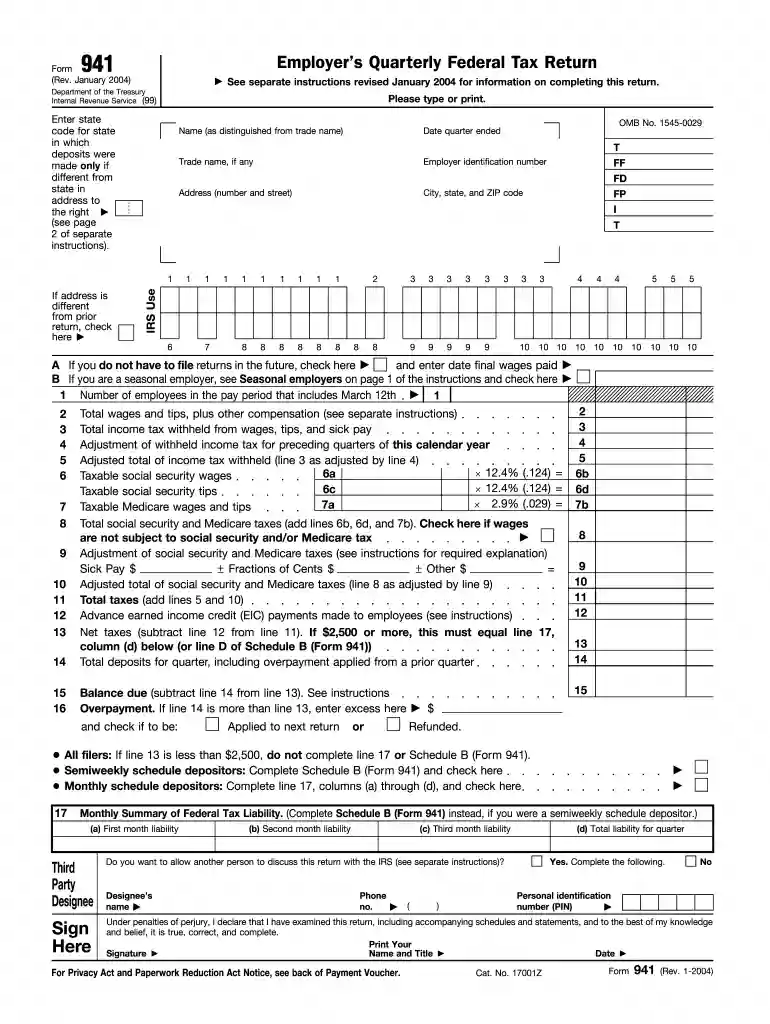
The 2004 941 Form, officially known as the Employer's Quarterly Federal Tax Return, is designed for employers in the United States to report quarterly federal tax liabilities related to employee wages. This includes detailing taxes withheld from employees' paychecks such as income tax, Social Security tax, and Medicare tax.
Understanding the detailed sections of the 2004 941 form can help ensure accurate completion.
Filing the 2004 941 form correctly requires understanding its structure and how each section should be completed.
Consider an employer with ten employees. By detailing each employee's withheld taxes and total wages, the employer systematically fills out each section of the form to ensure complete reporting for the quarter.
Completing the 2004 941 Form requires careful attention to detail and adherence to specific guidelines.
The timing of filing the form is crucial to avoid penalties and remain in compliance.
An employer with a fiscal year starting in January should ensure the completed form reaches the IRS by the designated quarterly deadline after the conclusion of each quarter's fiscal accounting.
This form serves as a critical component for legal compliance in tax reporting.
Failure to comply with the filing requirements or submission deadlines can result in significant penalties.
An employer neglects to file by the April 30 deadline. Not only could this lead to an immediate penalty, but continued delays also incur added interest charges on any due taxes.
Many tax preparation and accounting software options support e-filing of the 2004 941 form, which can simplify the process.
Using a program like QuickBooks can reduce the manual effort involved in tax calculations and form completion, automatically pulling in payroll data and prompting for necessary inputs.
While primarily used by businesses, there are specific scenarios where understanding this form’s application can be crucial.


A new small business owner might initially struggle with understanding required withholdings but over time will benefit from the structured approach provided by the 941, enabling legal compliance and efficient financial planning.
These detailed blocks offer comprehensive insights into the 2004 941 form, serving as an extensive guide for proper understanding and execution regarding employer tax obligations.
We've got more versions of the 2004 941 form form. Select the right 2004 941 form version from the list and start editing it straight away!
| Versions | Form popularity | Fillable & printable |
|---|---|---|
| 2024 | 4.8 Satisfied (58 Votes) | |
| 2023 | 4.2 Satisfied (60 Votes) | |
| 2022 | 4.8 Satisfied (92 Votes) | |
| 2022 | 4.4 Satisfied (44 Votes) | |
| 2021 | 4.3 Satisfied (182 Votes) | |
| 2021 | 4.3 Satisfied (151 Votes) | |
| 2020 | 4.4 Satisfied (186 Votes) | |
| 2020 | 4.3 Satisfied (183 Votes) | |
| 2020 | 4.1 Satisfied (43 Votes) | |
| 2019 | 4.1 Satisfied (40 Votes) | |
| 2018 | 4.4 Satisfied (178 Votes) | |
| 2017 | 4.1 Satisfied (60 Votes) | |
| 2016 | 4.4 Satisfied (389 Votes) | |
| 2015 | 4.3 Satisfied (39 Votes) | |
| 2014 | 4.3 Satisfied (28 Votes) |
At DocHub, your data security is our priority. We follow HIPAA, SOC2, GDPR, and other standards, so you can work on your documents with confidence.
IRS Form 941. AFNA National Education and Research Fund. Quarter 1990; 1991; 1992; 1993; 1994; 1999; 2000; 2001; 2002; 2003; 2004; 2005; 2006; 2007.Read more
Monthly Summary of Federal Tax Liability. (Complete Schedule B (Form 941) instead, if you were a semiweekly schedule depositor.) Date quarter ended. Name (Read more
Defining Agency Records. The FOIA does not specifically define agency record, although it defines a record as any information that would be an agencyRead more


