
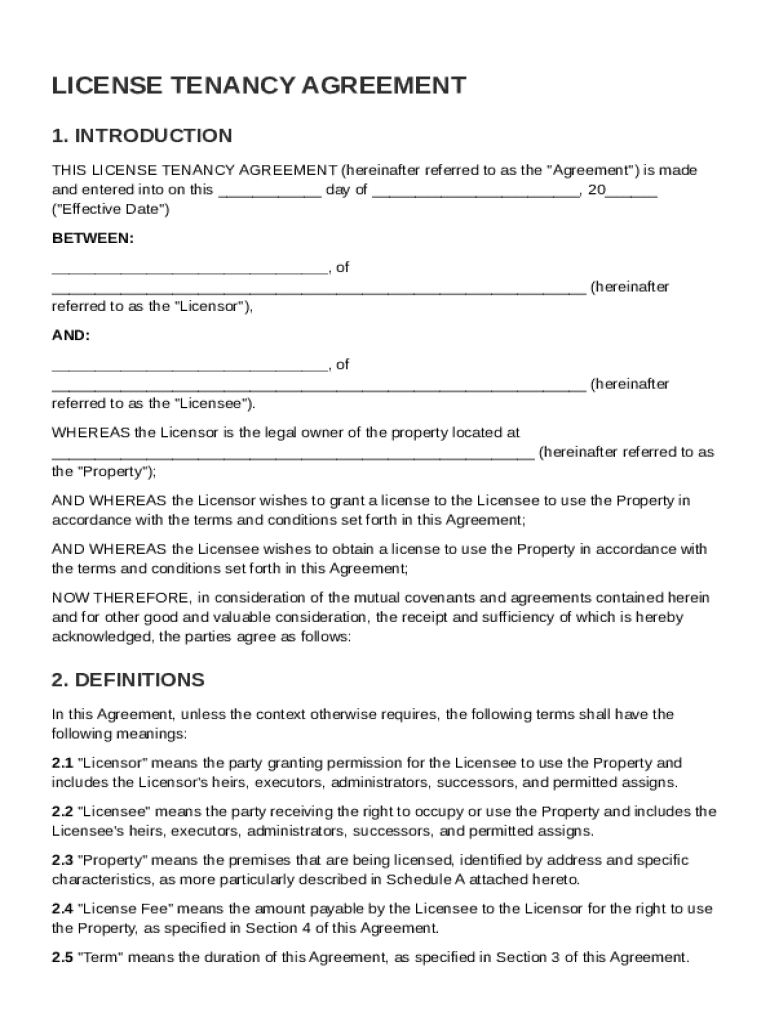







Definition and Meaning
The License Tenancy Agreement Template is a legal document used to formalize the terms under which a Licensor grants a Licensee the non-exclusive right to use a particular property. Unlike traditional lease agreements, this document does not establish a landlord-tenant relationship. Its primary purpose is to outline the specifics of usage rights, including permitted uses, duration, renewal conditions, and payment terms. This template provides a straightforward way to define responsibilities and rights without creating a tenancy, making it suitable for short-term or specific-use arrangements.
Key Elements of the License Tenancy Agreement Template
The License Tenancy Agreement Template consists of several critical elements:
- Definitions of Key Terms: Clearly outlines the meanings of essential terms such as 'Licensor', 'Licensee', and 'Property'.
- Duration and Renewal: Specifies the initial period of the license and outlines the conditions for renewal or extension.
- Payment Terms: Details the license fee, security deposit, and payment schedule.
- Permitted Uses: Defines what activities or purposes the property can be used for.
- Maintenance Responsibilities: Allocates responsibilities for property maintenance between the Licensor and Licensee.
- Termination Conditions: Sets forth the scenarios in which the agreement can be terminated and the notice required.
Steps to Complete the License Tenancy Agreement Template
To complete the License Tenancy Agreement Template, follow these steps:
- Input Party Information: Fill in the names and addresses of both the Licensor and Licensee.
- Specify Property Details: Clearly describe the property subject to the license, including its location and any unique characteristics.
- Define Usage Terms: Detail the permitted uses and any restrictions on the property’s use to prevent misunderstandings.
- Set Financial Terms: Specify the amount, due dates, and method of payment for the license fee and security deposit.
- Outline Responsibilities: Clearly allocate maintenance and repair duties to avoid potential disputes.
- State Termination Clauses: Include the terms under which the agreement can be terminated by either party.
- Gather Signatures: Both parties must sign the document to make it legally binding.
Legal Use of the License Tenancy Agreement Template
The legal framework surrounding the License Tenancy Agreement Template ensures compliance with specific legal requirements:
- Non-Tenancy Relationship: It is crucial that the document expressly states that it does not establish a landlord-tenant relationship, protecting the Licensor from tenant rights claims.
- Compliance with State Laws: While not creating a tenancy, the agreement must still comply with applicable state laws regarding usage rights and responsibilities.
- Dispute Resolution: Include provisions for handling disputes, such as mediation or arbitration, to minimize legal conflicts.
State-Specific Rules for the License Tenancy Agreement Template
Although a License Tenancy Agreement operates under general legal principles, state-specific rules can affect its use:
- Property-Specific Regulations: Certain states may have specific regulations concerning the permissible use of properties, especially in commercial zones.
- Local Government Ordinances: Local governments may impose additional requirements, such as zoning laws or usage restrictions.
- License Fee Taxation: Different states may have unique tax implications for license fees, requiring Licensors to understand these obligations.
Important Terms Related to the License Tenancy Agreement Template
Understanding key terms is crucial for utilizing the License Tenancy Agreement Template effectively:
- Licensor: The party granting the license to use the property.
- Licensee: The party receiving the license to use the property.
- Licensed Property: The specific area or property that the Licensee is permitted to use.
- Non-Exclusive License: An arrangement that does not grant the Licensee exclusive use, allowing the Licensor to grant additional licenses.
Who Typically Uses the License Tenancy Agreement Template
The License Tenancy Agreement Template is advantageous for various users, particularly:
- Property Owners: Those who wish to grant short-term or non-exclusive use of their property without establishing a tenancy.
- Businesses: Companies needing temporary space or resources for specific projects or events.
- Individuals: Those seeking to use a space for events, short-term projects, or seasonal activities without the complexities of a lease.


Examples of Using the License Tenancy Agreement Template
Practical applications of the License Tenancy Agreement Template include:
- Event Venues: Owners providing spaces for weddings or corporate events without entering lease agreements.
- Shared Office Spaces: Coworking spaces offering daily or monthly licenses to various clients without creating tenancy.
- Storage Units: Facilities offering storage spaces on a short-term basis under a license agreement structure.
Versions or Alternatives to the License Tenancy Agreement Template
Depending on specific needs, alternatives or variations of the License Tenancy Agreement Template may be more appropriate:
- Sublocation Agreement: For instances when a Licensee wants to license a portion of the licensed property to a third party.
- Room Use License Agreement: Specifically for rooms rather than entire properties, common in shared housing or hostels.
- Shared Office Agreement: Similar but tailored more specifically for multiple users sharing office environments.




