




01. Edit your form online
Type text, add images, blackout confidential details, add comments, highlights and more.

Type text, add images, blackout confidential details, add comments, highlights and more.

Draw your signature, type it, upload its image, or use your mobile device as a signature pad.

Send it via email, link, or fax. You can also download it, export it or print it out.
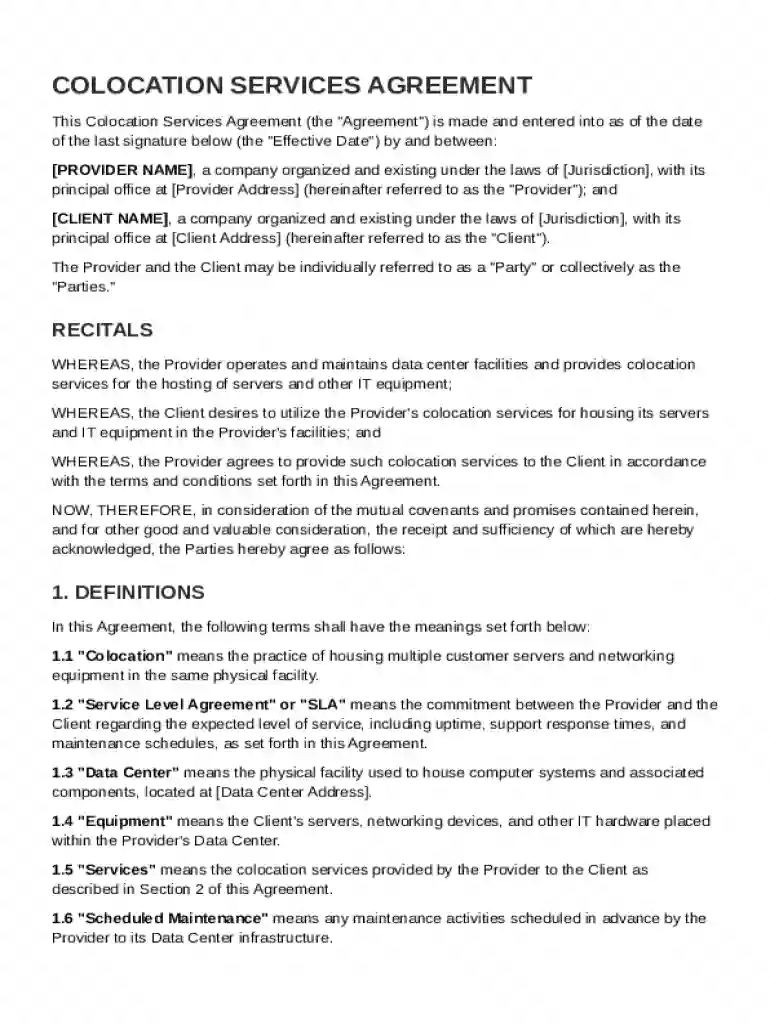
The Colocation Contract Template is a structured document used to outline the legal and operational framework between two parties: the Provider, who offers colocation services, and the Client, who utilizes these services to house IT equipment within a data center. Primarily, this contract is meant to secure mutual understanding on several fronts, including the scope of services, payment agreements, and defined responsibilities.
Purpose and Scope: The primary goal is to formalize the relationship between both parties, detailing services like equipment storage, power supply, and security measures. The document serves as a critical reference point for ensuring that both the Provider and Client are aligned in their expectations.
Legal Context: In the United States, this template plays a pivotal role in mitigating risks associated with hosting critical IT infrastructure. It ensures compliance with regulations surrounding data protection and service delivery standards.
Practical Implications: Clients using this document can better manage their IT needs without owning physical infrastructure, leveraging Provider facilities to support business operations.
Using the Colocation Contract Template effectively requires a clear understanding of its structure and the specific needs it addresses. Here are steps to guide its application:
Review the Contract's Language: Thoroughly read the entire template, ensuring all terms are clearly understood. Pay special attention to sections detailing responsibilities and liabilities.
Customize the Template: Personalize sections to reflect the specific dynamics between the Provider and the Client. This includes tailoring clauses on service levels, compensation details, and termination conditions.
Consult with Legal Counsel: Engaging a legal advisor is crucial for aligning the contract with legal standards and ensuring that the terms are fair and enforceable.
Internal Discussions: Both parties should engage in discussions to address potential misunderstandings, encouraging transparency and cooperation.
Finalization and Execution: Once both parties agree on the terms, execute the contract through authorized signatures, ensuring all parties retain copies for future reference.
Understanding the crucial components of the Colocation Contract Template is vital for its effective use. These elements form the backbone of the contract, ensuring comprehensive coverage of relevant aspects.
Service Description: Specifies the range of services offered by the Provider, including the availability of technical support, physical security measures and data backup services.
Payment Structures: Details the agreed-upon compensation method, whether it's a fixed monthly fee or a more flexible pay-as-you-go basis.
Liability and Indemnification: Defines the scope of liability for both parties and any indemnification arrangements that protect against possible claims or losses arising from service disruptions.
Termination Conditions: Sets out conditions under which either party can terminate the agreement, including breach of contract or unsatisfactory service levels.
Confidentiality Obligations: Outlines the measures both parties will implement to protect sensitive information from unauthorized access or disclosure.
Rights and Obligations: Enumerates rights such as access to facilities for equipment maintenance, along with obligations like maintaining compliance with applicable laws and standards.
The Colocation Contract Template carries significant legal weight, and understanding its legal dimensions is crucial for both Providers and Clients.
Enforceability: The contract's enforceability largely depends on its compliance with prevailing laws, including consumer protection and data security regulations in the U.S.
Dispute Resolution: Includes clauses detailing resolution methods for disputes, such as mediation or arbitration, which helps avoid lengthy court processes.
Regulatory Compliance: Providers must ensure the contract adheres to sector-specific regulations, such as those governing telecommunications and cloud computing services.
Amendments and Modifications: Legal provisions for modifying the contract should be clearly stated, requiring mutual consent before implementing changes.
Filling out the Colocation Contract Template involves several structured steps to ensure thorough completion:
Gather Information: Collect necessary details about both parties, such as company names, addresses, and principal contacts.
Input Service Details: Clearly detail the scope of services included in the agreement, specifying deliverables and quality standards.
Determine Financial Terms: Establish all financial terms, including payment schedules, late fees, and cost-sharing arrangements.
Define Duration: Clearly state the contract's effective date, as well as any renewal or expiration terms.
Review and Approve: Conduct a final review with all stakeholders to ensure accuracy, clarity, and agreement on all terms.
Sign and Date: Secure signatures from authorized representatives of both parties to finalize the agreement.
Familiarizing oneself with the terminology used within the Colocation Contract Template is key to understanding the contract's full scope:
Service Level Agreement (SLA): This outlines expected service standards and metrics that the Provider must achieve.
Uptime Guarantee: A promise by the Provider regarding the amount of time the services will be up and running without interruption.
Bandwidth Allocation: Detailing limitations or allowances regarding data transfer rates provided as part of the service package.
Redundancy Measures: Systems in place to ensure service continuation in the event of component failures.
A range of businesses and entities utilize the Colocation Contract Template, each with unique needs that the document must address:
Tech Startups: Startups with constrained budgets rely on these contracts to access sophisticated IT infrastructure without heavy capital investment.
Large Corporations: These entities leverage data centers for capacity expansion and disaster recovery purposes.
Telecommunications Providers: Companies requiring consistent uptime and secure data centers to support their services find significant value in colocation services.
Healthcare Institutions: Due to stringent data governance requirements, hospitals often utilize these contracts to ensure data safety and integrity.


When using the Colocation Contract Template, it's crucial to consider variations in application based on state-specific legal requirements:
Licensing Requirements: Some states may have additional licensing or regulatory requirements for data center operations.
Tax Implications: Tax obligations related to service provision can vary significantly between states, affecting how these contracts are structured.
State-Specific Regulations: Unique rules may apply in certain states regarding data security and privacy, impacting contract terms.
Understanding these state-specific nuances is essential for ensuring the contract is both compliant and enforceable in the relevant jurisdiction.
At DocHub, your data security is our priority. We follow HIPAA, SOC2, GDPR, and other standards, so you can work on your documents with confidence.





One-time Charges: The contracting party agrees to pay for the following charges associated with the installation of the equipment covered by this agreement.
Nov 17, 2020 Site colocation requests assessed on a reactive basis or where a reciprocal colocation request (including colocation of. Vodafone equipment


