




01. Edit your form online
Type text, add images, blackout confidential details, add comments, highlights and more.

Type text, add images, blackout confidential details, add comments, highlights and more.

Draw your signature, type it, upload its image, or use your mobile device as a signature pad.

Send it via email, link, or fax. You can also download it, export it or print it out.
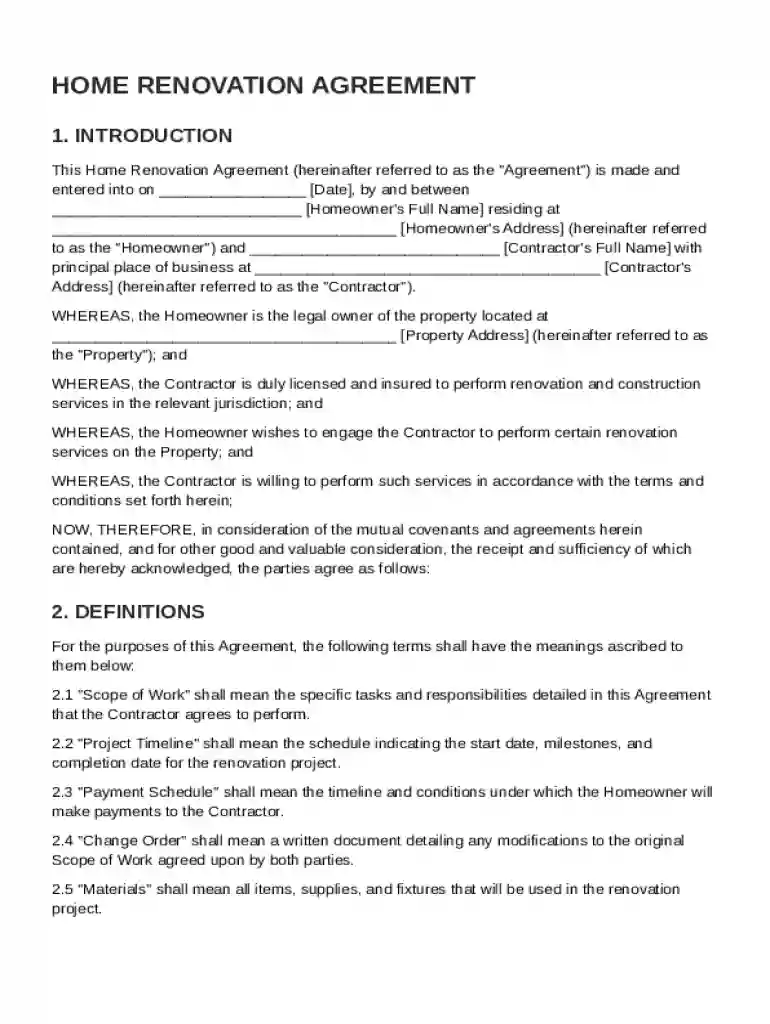
A Home Renovation Agreement Template is a standardized document that outlines the terms and conditions between a homeowner and a contractor for renovation services on a specified property. This legally binding template acts as a comprehensive framework, detailing the responsibilities, expectations, and obligations of both parties involved in the renovation project. Recognizing the diversity of renovation projects, the template can be customized to suit the specific needs and circumstances of each renovation, whether it involves minor updates or major structural changes.
The agreement typically includes sections on the scope of work, project timeline, payment terms, and insurance requirements. It provides clarity on what is expected from both the contractor and the homeowner, ensuring that all parties have a shared understanding of the renovation goals and deliverables. Additionally, it helps avoid disputes by outlining clear communication channels and protocols for change orders or any modifications during the course of the renovation.
Utilizing a Home Renovation Agreement Template is a streamlined process designed to ensure that all necessary aspects of a renovation project are addressed. The first step involves selecting a suitable template that matches the project's scope and complexity. The template should be downloaded or accessed through a platform like DocHub, where it can be edited and customized as per the specific renovation requirements.
Customize the Template: Tailor the agreement to fit the unique aspects of your renovation project. This includes adding detailed descriptions of the work to be performed, specifying the materials to be used, and defining the project timeline.
Clarify Payment Terms: Clearly outline the payment schedule, specifying amounts due at different stages of the project. Include provisions for deposits, progress payments, and the final payment upon project completion.
Specify Roles and Responsibilities: Define the roles of both the contractor and the homeowner. This includes specifying who is responsible for obtaining permits, managing subcontractors, and ensuring compliance with local building codes.
Review and Sign: Both parties should thoroughly review the completed document to ensure all terms are agreed upon. Once reviewed, signatures from both the contractor and the homeowner are required to finalize the agreement.
Completing a Home Renovation Agreement Template involves a systematic approach to ensure that all details are accurately captured and mutually agreed upon. The following steps delineate the process:
Gather Information: Collect all relevant details such as project timelines, scope of work, contact information for both parties, and any specific contractual obligations.
Insert Project Specifics: Add a detailed description of the renovation work to be undertaken. Specify any particular constraints or unique elements related to the project.
Define Financial Arrangements: Outline the financial terms, including the total contract price, payment schedule, and any conditions related to advance payments or retention.
Include Legal Clauses: Ensure the template includes necessary legal protections such as dispute resolution mechanisms, termination conditions, warranties, and indemnity clauses.
Review and Amend: Cross-verify all sections for accuracy and completeness. Make amendments where necessary, ensuring compliance with applicable state laws.
Finalize and Store: Once both parties are satisfied with the agreement, finalize it by obtaining signatures. Electronically store the signed agreement for ease of access and future reference.
The Home Renovation Agreement Template is comprehensive and covers several critical components to ensure a legally sound and effective contract:
Scope of Work: A precise description of the renovation tasks, including any design elements or specific construction requirements.
Project Timeline: Clearly defined start and end dates, with intermediate milestones to assess progress.
Payment Terms: Detailed breakdown of the payment schedule, including initial deposits, interim payments, and the final settlement.
Change Orders: A formal process for managing any modifications to the original scope of work, including provisions for additional costs and time extensions.
Warranties and Guarantees: Clauses detailing the warranties provided for materials and workmanship, including duration and claims processes.
Dispute Resolution: Methods for managing disagreements, such as mediation or arbitration, preferred over litigation for cost and time efficiency.
Termination Conditions: Conditions under which the agreement may be terminated by either party, including breach of contract or unforeseen circumstances.
The legal applicability of a Home Renovation Agreement Template is contingent upon compliance with state-specific laws and requirements. It's vital to tailor the agreement to align with regulations in the state where the renovation is taking place, including compliance with licensing, permits, and building codes.
State-Specific Regulations: Each state has its own laws governing home renovations, which may affect contract terms related to contractor licensing, insurance requirements, and consumer protections.
Governing Law: The agreement should specify the state law that governs the contract, ensuring legal matters are adjudicated in the appropriate jurisdiction.
Permit Requirements: Both parties should confirm if specific permits are required for the renovation and identify who is responsible for obtaining them to avoid legal infractions.
State-specific regulations can significantly impact the terms and execution of a Home Renovation Agreement. Adaptations may include:
Licensing and Bonding: Requirements for contractors to hold valid licenses and demonstrate financial stability through bonds, protecting homeowners from incomplete or substandard work.
Building Codes: Adherence to regional building standards to ensure safety and compliance during the renovation process.
Consumer Protection: Enhanced clauses to protect homeowners, such as lien waivers to prevent contractors from placing liens against the property for unpaid labor or materials.
These nuances are crucial for ensuring legal compliance and safeguarding the interests of all parties. It is advisable to consult a legal professional for state-specific adaptations to the template.
Understanding key terms within a Home Renovation Agreement ensures clear communication between homeowners and contractors:
Change Order: A request for alterations to the original scope of work, often requiring additional time and payment.
Force Majeure: Events beyond control (natural disasters, etc.) that may delay the project without penalty.
Indemnification: A provision wherein one party agrees to compensate the other for certain damages or losses incurred during the project.
These terms help outline the rights and responsibilities within the renovation agreement, making it essential for both parties to be familiar with their implications.
At DocHub, your data security is our priority. We follow HIPAA, SOC2, GDPR, and other standards, so you can work on your documents with confidence.


NOTE: This is a sample contract. It is not intended to be, and is not, legal advice. This is general information about the basic information you must
ARTICLE. 1 SCOPE OF WORK. 2 CONTRACT DOCUMENTS. 3 DEFINITIONS. 4 DESIGN/BUILD CONTRACTORS GENERAL RESPONSIBILITIES. 5 PRE-CONSTRUCTION PHASE.
With provisional application from March 2008, the agreement would replace all existing bilateral air services agreements between the EU Member States and the


