




01. Edit your form online
Type text, add images, blackout confidential details, add comments, highlights and more.

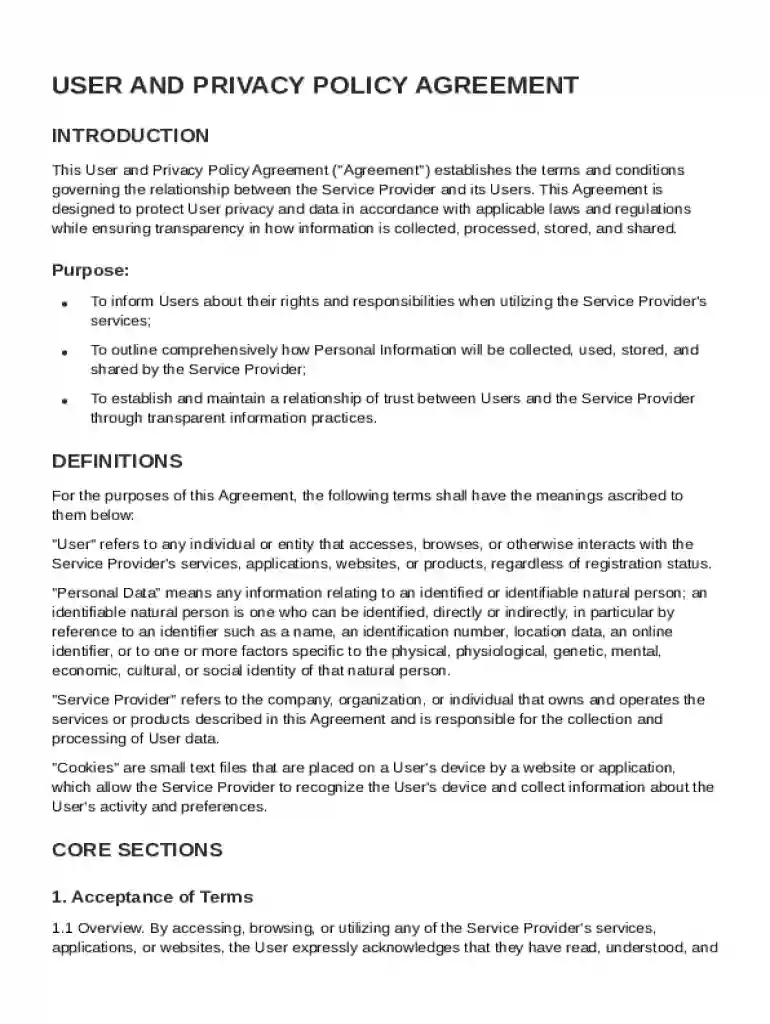
Type text, add images, blackout confidential details, add comments, highlights and more.

Draw your signature, type it, upload its image, or use your mobile device as a signature pad.

Send it via email, link, or fax. You can also download it, export it or print it out.
The User and Privacy Policy Agreement Template is a legal document designed to establish clear terms between a service provider and its users. It primarily focuses on protecting user privacy and data by outlining how personal information is collected, used, stored, and potentially shared. This template also informs users about their rights and responsibilities concerning their data. It typically includes definitions of key terms, acceptance of the terms, the methods used for collecting information, and the purposes for using such data. Additionally, it addresses data sharing practices, user rights concerning their data, and the security measures in place to protect that data.
Using the User and Privacy Policy Agreement Template involves several essential steps to ensure it meets the specific needs of your organization.
Customization: Tailor the template to reflect accurate practices of your organization. Adjust sections related to information collection methods, data usage, and security measures.
Legal Compliance: Ensure that all elements comply with federal and state laws, including regulations such as the General Data Protection Regulation (GDPR) if users are outside the United States.
Review and Approval: Before implementation, have the agreement reviewed by legal counsel to ensure it is comprehensive and legally binding.
Implementation: Make the policy easily accessible to users, often as part of the user registration or sign-up process.
Notifications: Inform users of any updates to the policy and retain their consent for the modified terms.
Completing the User and Privacy Policy Agreement Template involves the careful address of several key points to ensure it is effective and legally enforceable.
Identify Relevant Data: Determine what types of personal information will be collected and for what purpose.
Clarify Collection Methods: Specify how this data is acquired, whether through user input, cookies, or third-party sources.
Define Data Use: Clearly outline the permissible uses of data, such as for service enhancement or marketing.
State Sharing Practices: Include details on who data may be shared with, such as affiliates or third-party service providers.
User Rights: Highlight user rights under relevant legislation, such as data access or correction rights.
Security Protocols: Describe technical and administrative measures in place to protect user data.
Change Notifications: Explain how users will be informed of changes to the agreement.
Contact Information: Provide contact details for inquiries or complaints regarding the policy.
Several key components must be present in a comprehensive User and Privacy Policy Agreement Template to guarantee its effectiveness and compliance.
Definitions Section: Establishes precise meanings for important terms within the agreement.
Information Collection Procedures: Details how user data is collected, who it pertains to, and under what circumstances.
Data Usage and Sharing: Stipulates the scope and limits of data usage within the company and any third-party involvement.
User Rights and Responsibilities: Outlines user obligations and the rights to request access or deletion of their data.
Security and Confidentiality: Highlights methods, such as encryption and access controls, used to protect user data.
Cookie Policy: Discloses how cookies are used and managed within the website or service.
Children's Privacy: Additional protections if the service is accessible to minors under the Children's Online Privacy Protection Act (COPPA).
A properly drafted User and Privacy Policy Agreement Template must comply with various legal frameworks to be enforceable in the United States.
State Regulations: Abide by local privacy laws, which may vary significantly from federal guidelines, to avoid potential legal pitfalls.
Federal Laws: Ensure compliance with overarching regulations, including the Health Insurance Portability and Accountability Act (HIPAA) and the Children's Online Privacy Protection Act (COPPA), depending on the user demographic.
International Guidelines: If your service operates globally, consider additional compliance to international standards like the GDPR for users outside the U.S.
Each state might have its privacy laws impacting how a User and Privacy Policy Agreement must be tailored.
California: The California Consumer Privacy Act (CCPA) mandates extra disclosures and rights for data subjects, such as the right to opt-out of data sales.
Vermont: Requires specific disclosures regarding third-party data brokers.
Nevada: Offers a limited opt-out right from data sale practices that may impact policy content.
Understanding these state-by-state differences is crucial in ensuring comprehensive legal compliance.
Grasping the vocabulary within the User and Privacy Policy Agreement Template is vital to understanding its stipulations.
Personal Information: Data that identifies an individual, including names, addresses, and identification numbers.
Data Processor: A business entity processing personal data on behalf of the data controller.
Consent: User's permission for data collection and management practices detailed within the agreement.
Data Controller: The entity determining the purposes and means of processing personal data.
These terms clarify the roles and responsibilities defined within the agreement and highlight the different facets of data management.
Various scenarios benefit from applying a User and Privacy Policy Agreement Template.
E-commerce Platforms: Essential for laying out data practices regarding payment information, purchase history, and personalized marketing.
Social Media Networks: Helps define practices specific to user-generated content, personal data sharing policies, and consent for data usage.
Healthcare Applications: Critical for detailing how sensitive health information is handled in compliance with HIPAA regulations.
Understanding these examples and related case studies reinforces the necessity of a comprehensively structured agreement template tailored to specific use cases.
At DocHub, your data security is our priority. We follow HIPAA, SOC2, GDPR, and other standards, so you can work on your documents with confidence.
This privacy policy explains the collection, use, and sharing of Personal Information. This policy applies to AGP Worldwide Operations GmbH and to our
This Information Privacy and Security Agreement (IPSA) is entered into by and between the. City of Redmond (City) and [insert name and address of


