




01. Edit your handover letter format in word online
Type text, add images, blackout confidential details, add comments, highlights and more.

Type text, add images, blackout confidential details, add comments, highlights and more.

Draw your signature, type it, upload its image, or use your mobile device as a signature pad.

Send project handover letter format in word via email, link, or fax. You can also download it, export it or print it out.
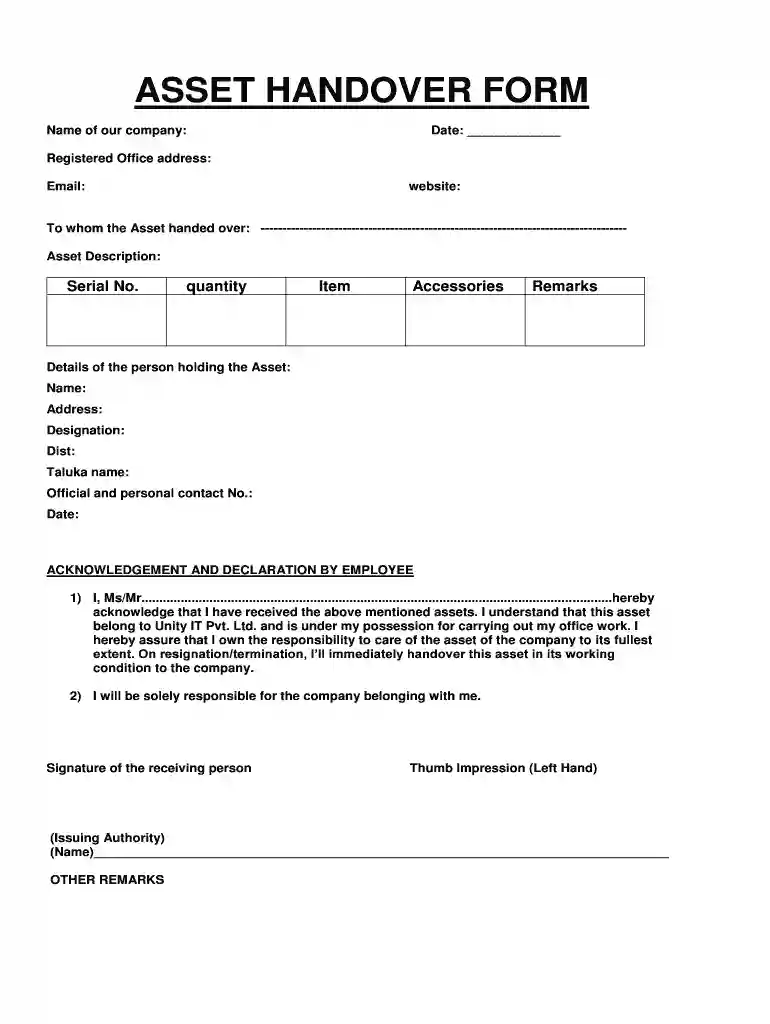
An asset handover letter serves as a formal document used to transfer ownership and responsibility for specific assets from one party to another, often within a workplace or business context. This type of letter outlines the details of the assets being transferred and may be required for accounting purposes, inventory management, or workplace compliance.
The handover letter can be particularly useful in various scenarios, such as transferring equipment to a new employee or when ending a contract with a vendor. The clear documentation aids in ensuring that both the transferring and receiving parties understand their rights and responsibilities.
A well-structured asset handover letter includes several key elements that provide clarity and legal protection for both parties involved in the transfer. Understanding these components will enhance the importance and usability of the document.
Each element of the asset handover letter contributes to a full understanding of the transfer process, protecting the interests of both parties involved.
Completing an asset handover letter requires a systematic approach to ensure all necessary information is captured accurately. Follow these steps to create an effective letter.
Employing this structured approach will facilitate a smoother handover process and minimize any potential for misunderstandings.
Asset handover letters are commonly used in various professional contexts to ensure that all parties involved in transferring assets understand their responsibilities. The following parties routinely utilize this document:
This document is essential in maintaining operational efficiency and transparency, allowing all parties to be on the same page regarding asset management.


While the asset handover letter format in Word is a standard method, alternative documents or variations may serve specific needs within different industries or job functions. Familiarity with these can broaden the understanding of asset management and documentation.
Understanding and utilizing these variants can enhance adaptability in documenting asset transfer situations across various contexts.
Legal implications play an essential role in the creation and use of an asset handover letter. Awareness of these considerations ensures compliance with relevant laws and organizational policies.
Being informed about these legal guidelines strengthens the integrity of the asset transfer process and protects against potential disputes.
Applying asset handover letters in real-world scenarios provides clarity on their functionality and importance. Examples can demonstrate how these letters protect both parties and streamline operations.
These examples illustrate the broad applicability and essential nature of asset handover letters in maintaining professionalism and accountability.
At DocHub, your data security is our priority. We follow HIPAA, SOC2, GDPR, and other standards, so you can work on your documents with confidence.
I would like to hand over the charge of the department to you as per the direction of the. Principal. I am handing over the following documents / assets to youRead more
I hereby DocHub that I, NAME, am the Principal Officer of COMPANY XYZ, INC, and that I am duly authorized to execute and deliver this Authorization.Read more
by PA Schrodt 2012 Cited by 1 Usage Notes This event form is typically, although not exclusively, a verbal act. There is no limitation on types of policies that could be underRead more


