







Definition and Meaning
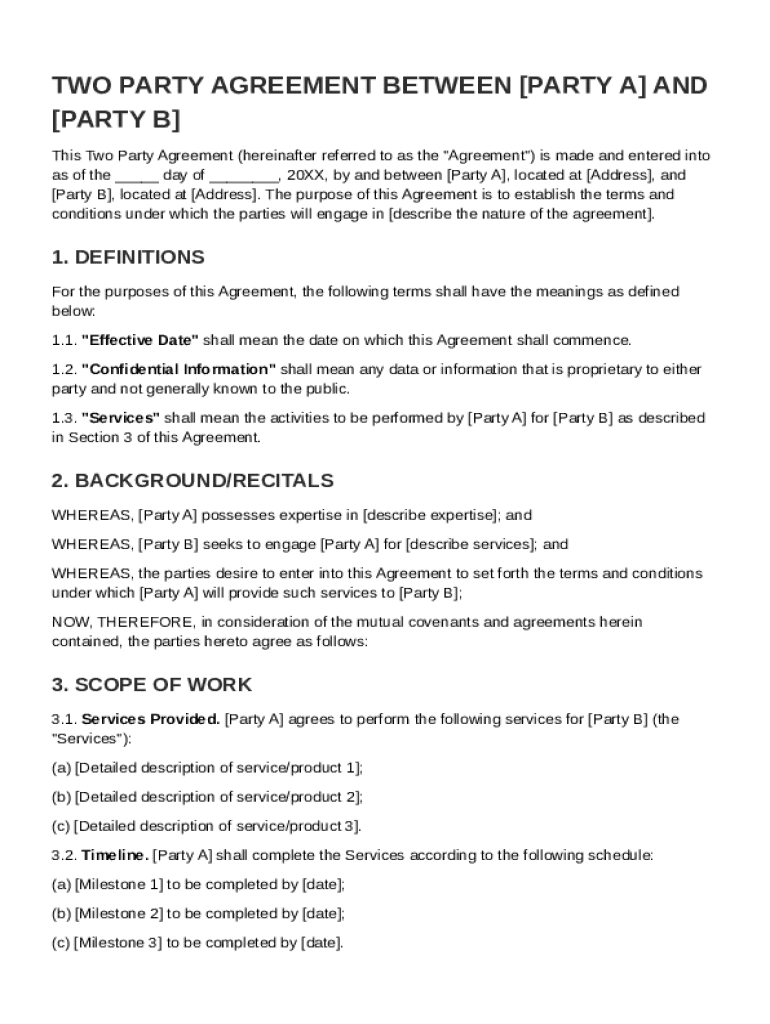
A Two Party Agreement Template is a contractual document designed to establish a formal arrangement between two entities, referred to as Party A and Party B. This template delineates the obligations and responsibilities each party agrees to fulfill. Typically, the agreement covers various aspects such as the scope of work, payment terms, confidentiality responsibilities, termination conditions, liability clauses, and applicable legal jurisdiction. The primary objective is to set a transparent foundation for collaboration, ensuring mutual understanding and protecting the interests of both parties involved. Each provision within the agreement is intended to clarify expectations and reduce potential disputes.
Key Elements of the Two Party Agreement Template
The Two Party Agreement Template consists of several essential components that are vital for its effectiveness:
- Parties Involved: Clearly identify each party, including their legal names and contact information. This eliminates ambiguity regarding who is bound by the agreement.
- Scope of Work: Details the specific services or tasks Party A is obligated to perform for Party B, setting clear boundaries for project expectations.
- Compensation: Outlines the monetary or non-monetary consideration to be exchanged for the services rendered. This section may include payment schedules and methods.
- Confidentiality Provisions: Ensures any exchanged proprietary information between the parties remains protected and defines the duration of confidentiality obligations.
- Termination Clauses: Specifies conditions under which either party may terminate the agreement, including required notice periods and repercussions for breach.
- Liability and Indemnification: Defines the extent of liability for each party and provisions for indemnifying the other against specific risks or claims.
- Governing Law: Declares the legal framework and jurisdiction that will govern the interpretation and enforcement of the agreement.
How to Use the Two Party Agreement Template
Utilizing the Two Party Agreement Template involves several critical steps to ensure thoroughness and legality:
- Identify Parties: Begin by specifying the legal names and details of Party A and Party B.
- Define the Scope: Clearly outline the services or work to be provided, including deadlines and specifications.
- Negotiate Terms: Discuss and agree upon the compensation, payment schedules, and any additional terms with the other party.
- Fill in the Template: Enter the negotiated details into the template, including responsibilities and obligations for each party.
- Consult Legal Experts: Consider having a legal professional review the draft to ensure compliance with relevant laws and regulations.
- Sign the Agreement: Both parties should sign and date the document to formalize the agreement. Digital signatures can be utilized for convenience.
- Maintain a Copy: Ensure both parties retain a copy of the signed agreement for future reference.
Legal Use of the Two Party Agreement Template
The Two Party Agreement Template holds significant legal standing when properly executed. It serves as a binding contract between the involved parties, establishing enforceable rights and obligations. Legal considerations include:
- Compliance with Laws: The agreement must adhere to the laws of the jurisdiction specified in the governing law clause.
- Legally Binding: Once signed, the agreement is binding, subjecting both parties to its terms unless formally amended.
- Dispute Resolution: In cases of disagreement, the document provides a framework for resolving disputes, potentially through mediation or legal proceedings.
- Electronic Signatures: With advancements in digital documentation, electronic signatures can speed up the execution process while maintaining legal validity under the ESIGN Act.
Steps to Complete the Two Party Agreement Template
Completing a Two Party Agreement Template involves a structured approach to ensure all necessary information is accurately captured:
- Prepare Required Information: Collect all relevant details such as parties' information, scope, payment terms, deadlines, and specific clauses.
- Customize the Template: Edit the provided fields to reflect the unique terms and conditions agreed upon by both parties.
- Clarify Key Terms: Ensure that definitions and interests are precisely expressed to avoid misunderstandings.
- Review Provisions: Evaluate the termination, liability, and governing law clauses to confirm they are applicable and equitable.
- Finalize and Approve: Perform a comprehensive review of the document for accuracy, then confirm acceptance from both parties.
- Execute the Agreement: Obtain signatures (digital or written) from both parties. Store the agreement securely.
State-Specific Rules for the Two Party Agreement Template
Different states may impose unique requirements or interpretations affecting the enforceability of agreements:
- Choice of Law: Some jurisdictions may require explicit declarations regarding governing law.
- Statutory Regulations: States might have distinct rules, like minimum wage laws or licensing requirements, that impact agreement terms.
- Enforcement Practices: Document enforcement, including penalties for breach, may differ based on local precedent.
- Public Policy: Clauses conflicting with state public policy may be voided, requiring careful legal consideration when drafting contracts.
Examples of Using the Two Party Agreement Template
The template can be adapted across various industries and scenarios:
- Service Contracts: Freelancers creating agreements with clients outlining deliverables, timelines, and payment.
- Supplier Agreements: Companies formalizing terms with vendors for consistent supply of goods or materials.
- Partnership Ventures: Two businesses entering collaborative projects, detailing roles, profit-sharing, and exit strategies.
- Lease Agreements: Property owners and tenants agreeing on rental terms for residential or commercial spaces.
Important Terms Related to Two Party Agreement Template
Understanding the specific language within contractual contexts enhances clarity and enforceability:
- Consideration: Refers to anything of value exchanged to legitimize the contract, typically the services and reimbursement involved.
- Force Majeure: Clause excusing parties from liabilities due to unforeseeable events like natural disasters or war.
- Breach of Contract: Occurs when one party fails to uphold their obligations, triggering possible legal action.
- Non-disclosure Agreement (NDA): Supplementary covenant to maintain confidentiality beyond the primary contract's scope.
By including such key terms, the agreement becomes more comprehensive and provides a sound basis for resolving uncertainties or disputes.




