



01. Edit your form online
Type text, add images, blackout confidential details, add comments, highlights and more.

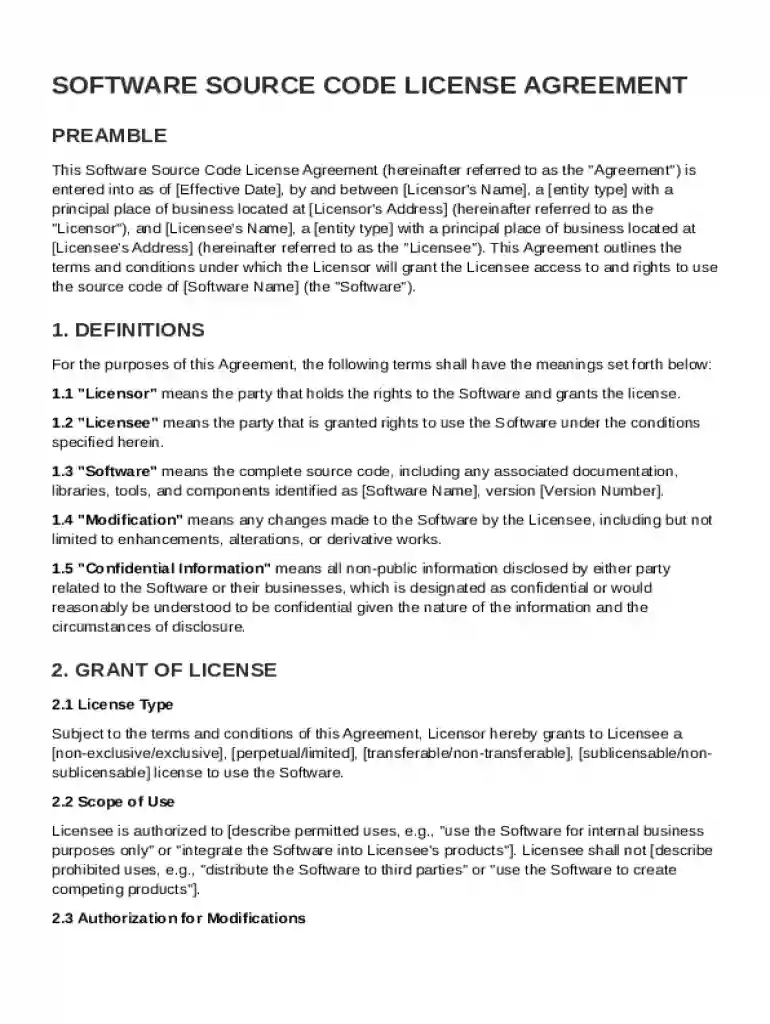
Type text, add images, blackout confidential details, add comments, highlights and more.

Draw your signature, type it, upload its image, or use your mobile device as a signature pad.

Send it via email, link, or fax. You can also download it, export it or print it out.
A Software Source Code License Agreement Template is a legal document that outlines the terms and conditions under which the licensor allows the licensee to access, use, and modify the source code of a specified software. It serves as a guideline for both parties to ensure the proper and legal use of the software's source code. The agreement typically includes sections on definitions, the type of license granted, payment terms, and the obligations and rights of the parties involved.
License Types: The agreement defines whether the license is exclusive or non-exclusive and the extent to which the licensee can modify or redistribute the source code.
Payment Terms: Specifies how and when the licensee pays for the rights to use the software source code, if applicable.
Ownership Rights: Clarifies that the licensor retains ownership of the source code and grants specific usage rights to the licensee.
Termination Conditions: Details the conditions under which the agreement can be terminated, including breach of contract or completion of predetermined terms.
Confidentiality Clauses: These clauses ensure that the licensee agrees to keep the source code confidential and does not disclose it to unauthorized parties.
Legal Compliance: Both parties must comply with relevant laws and regulations related to software licensing and intellectual property rights.
Limitations on Liability: Often included to protect the licensor from losses or damages that may arise from the licensee's use of the source code.
Warranties: The agreement may include warranties regarding the source code, such as guarantees against defects or assurances about its performance.
Review the Template: Understand each clause and adapt it to suit the specific software being licensed.
Customize the Agreement: Modify sections such as the license type and payment terms according to the agreements between the parties.
Consult Legal Counsel: Before finalizing, it is advisable to have a legal expert review the agreement to ensure it is legally binding and enforceable.
Import the agreement template into a document-editing platform like DocHub to make necessary changes and additions.
Use collaboration features to get feedback from legal teams or other stakeholders before finalizing the document.
Adherence to the ESIGN Act: If electronic signatures are used, ensure they comply with the ESIGN Act to make them legally binding.
Governing Law Clause: Specify which jurisdiction's laws will govern the agreement to avoid legal ambiguities.
Source Code: The human-readable set of instructions that define the software's functionality.
Licensee / Licensor: The parties involved, where the licensee is granted rights to use the code, and the licensor provides such rights.
Modification Rights: Details whether the licensee can alter the source code and under what conditions.

Software Developers: To protect their intellectual property when sharing code with partners or clients.
Corporations and Startups: When licensing software to third parties or internal teams for further development.
Legal Professionals: Law firms and attorneys who specialize in intellectual property and software licensing.

Gather Relevant Information: Collect details about the software, parties involved, and the scope of the license.
Draft Initial Agreement: Use standardized clauses from the template and customize them with specific details as required.
Review Clauses Thoroughly: Ensure each party understands their rights and responsibilities outlined in the agreement.
Sign and Execute the Agreement: Finalize the agreement by getting signatures from authorized representatives using DocHub's electronic signature features.
Technology Companies: To safely distribute source code among development teams and external partners.
Consultancies: For firms providing software solutions to clients where sharing source code is a part of the service.
Educational Institutions: When sharing developed software as a part of academic collaborations or research projects.
Startups Sharing Proprietary Code: A tech startup might use the template when outsourcing additional development work but wants to maintain control over their source code.
Joint Ventures: Two companies working together on a project may use this agreement to define how code is shared and modified.
Software Released to Open Source: The template can be adapted for software projects transitioning to an open-source model, specifying how contributors can use and modify the code.
At DocHub, your data security is our priority. We follow HIPAA, SOC2, GDPR, and other standards, so you can work on your documents with confidence.



2.1 University hereby grants, and Licensee hereby accepts, subject to the terms and conditions of this Agreement, a(n) (non)exclusive, nontransferable and
Aug 1, 2016 The terms and conditions of those license agreements are available below, as well as in the header files and documentation file accompanying


