




01. Edit your form online
Type text, add images, blackout confidential details, add comments, highlights and more.

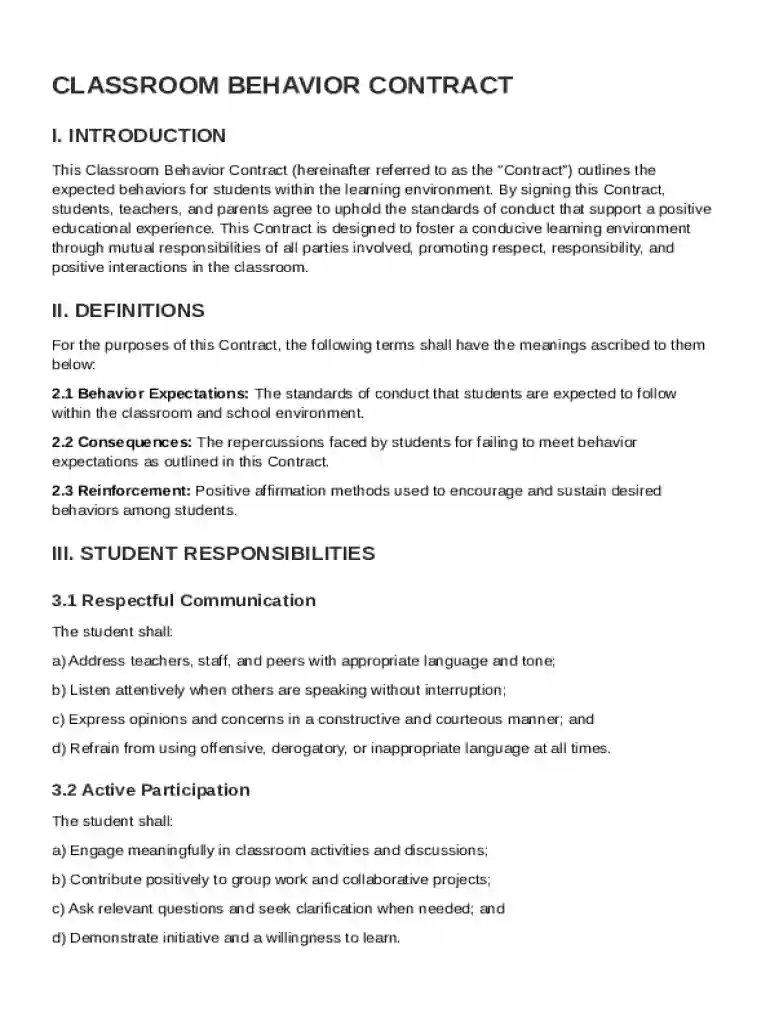
Type text, add images, blackout confidential details, add comments, highlights and more.

Draw your signature, type it, upload its image, or use your mobile device as a signature pad.

Send it via email, link, or fax. You can also download it, export it or print it out.
A Classroom Behavior Contract Template is a structured document designed to outline the expected behaviors and responsibilities of students, teachers, and parents within an educational setting. The primary goal of this template is to promote a positive and efficient learning environment by clearly defining the roles and responsibilities of all parties involved.
In essence, the contract functions as a mutual agreement where students commit to behaviors such as respectful communication, active participation, and preparedness. Teachers, on the other hand, agree to set clear expectations and enforce rules consistently, ensuring a fair and supportive atmosphere. Parents take on the role of reinforcing these expectations at home, creating a cohesive approach to behavior management. Together, these commitments serve to enhance the educational experience by reducing disruptions and encouraging a focus on learning.
The Classroom Behavior Contract Template comprises several essential components that collectively establish a framework for acceptable conduct:
Behavior Expectations: This section outlines the standards of behavior expected from students. This includes treating peers and teachers with respect, following classroom rules, and participating actively in lessons.
Prohibited Actions: To maintain a conducive learning environment, certain behaviors are deemed unacceptable. This section lists actions such as bullying, cheating, or disrupting the class, clearly delineating what is considered inappropriate and the rationale behind it.
Consequences for Misbehavior: A vital aspect of the contract is outlining clear and fair consequences for failing to adhere to the agreed-upon standards. This ensures students understand the repercussions of their actions, which may include warnings, loss of privileges, or more severe disciplinary measures.
Positive Reinforcement Strategies: The template also includes methods to reward and reinforce good behavior, such as praise, recognition, or tangible rewards. Positive reinforcement encourages students to maintain high standards of behavior.
Completing a Classroom Behavior Contract Template involves several key steps to ensure clarity and mutual understanding:
Review Expectations and Responsibilities: Begin by carefully reviewing the template's content with students and parents. Discuss the expectations, responsibilities, and rationale for each element.
Customize as Necessary: Depending on the unique needs and dynamics of the classroom, customization may be required. Adjust sections to accommodate specific rules or behaviors relevant to the educational setting.
Agreement and Commitment: All parties—students, parents, and teachers—should sign the contract to indicate agreement and commitment to adhere to the outlined terms. This mutual consent is crucial for the contract's effectiveness.
Periodic Review and Adjustments: Regularly revisit the contract to ensure it remains relevant and effective. Make necessary adjustments to reflect any changes in classroom dynamics or behavioral trends.
Record Keeping: Maintain copies of signed contracts for reference. This documentation serves as a useful tool in case of disputes or the need for reminders.
The Classroom Behavior Contract Template is predominantly used by:
Educators: Teachers utilize the template as a tool to establish clear behavior expectations, thus minimizing disruptions and maximizing teaching effectiveness.
School Administrators: Administrators may introduce these contracts as part of broader school policies aimed at maintaining consistent discipline standards across various classrooms.
Parents: Engaged parents often use these contracts to reinforce school expectations at home, facilitating a cohesive support system for students.
Students: Although primarily the contract focuses on students as the primary subjects, it empowers them to take responsibility for their actions, leading to personal growth and improved behavior.


While not legally binding in the same way as contracts governing business transactions, a Classroom Behavior Contract Template holds significance within the educational environment by:
Establishing Clear Expectations: By clearly outlining behavior standards and consequences, the template helps mitigate misunderstandings among students, parents, and educators.
Facilitating Consistent Enforcement: The template allows teachers to enforce rules consistently, backed by a pre-established agreement that parents and students are aware of.
Providing Documentation: The contract serves as a documented agreement that can be referred to in cases of disputes or when communicating with parents about behavioral issues.
Understanding the terminology associated with a Classroom Behavior Contract is crucial for all parties involved:
Active Participation: Engagement in class discussions, tasks, and activities without prompting from the teacher.
Respectful Communication: Using polite language and gestures when interacting with peers and faculty, avoiding derogatory remarks or interruptions.
Consequences: Pre-determined actions taken in response to breaches of behavior expectations, aimed at correcting misbehavior.
Reinforcement Strategies: Techniques employed to encourage and sustain desired behavior through positive feedback or rewards.
While many principles behind the Classroom Behavior Contract Template are universally applicable, some state-specific regulations may influence its implementation:
Educational Guidelines: States often have established frameworks or guidelines that dictate acceptable conduct in educational settings, influencing contract content.
Disciplinary Policies: Procedure for managing student behavior may vary by state, necessitating customization to align with local policies.
Parental Notification Requirements: Certain states mandate informing parents about disciplinary actions or requiring their acknowledgment of behavioral agreements.
Data Privacy Regulations: Ensure compliance with state laws regarding the storage and sharing of students' signed agreements and personal information.
Illustrative scenarios where the Classroom Behavior Contract Template proves valuable include:
New School Year: Educators implementing the contract at the start of the school year to set a positive tone and establish a culture of mutual respect and accountability.
Challenging Class Dynamics: For classes exhibiting frequent disruptions, introducing a behavior contract can serve as an effective intervention strategy to restore order and focus.
Parent-Teacher Conferences: Contracts provide a tangible point of reference during discussions about student behavior, facilitating constructive dialogue and action plans.
Conflict Resolution: In instances of reoccurring behavioral issues, the contract acts as a documented account of expectations and agreed-upon consequences, aiding in conflict resolution.
In conclusion, the Classroom Behavior Contract Template is a vital resource for ensuring a well-organized, positive educational experience. By clearly defining expectations, responsibilities, and consequences, it effectively supports students, parents, and educators in creating a harmonious learning environment.
At DocHub, your data security is our priority. We follow HIPAA, SOC2, GDPR, and other standards, so you can work on your documents with confidence.






Purpose: This set of behavioral strategies was developed for classroom teachers to use with students who may require academic and/or behavioral support.
behavior contracts. A behavior contract is exactly that a contract. Two parties, with informed consent, enter into an agreement of their own free will
Behavior contracts are negotiated agreements between teacher and student to increase positive behaviors, with both parties benefiting from the agreement.


