01. Edit your form online
Type text, add images, blackout confidential details, add comments, highlights and more.

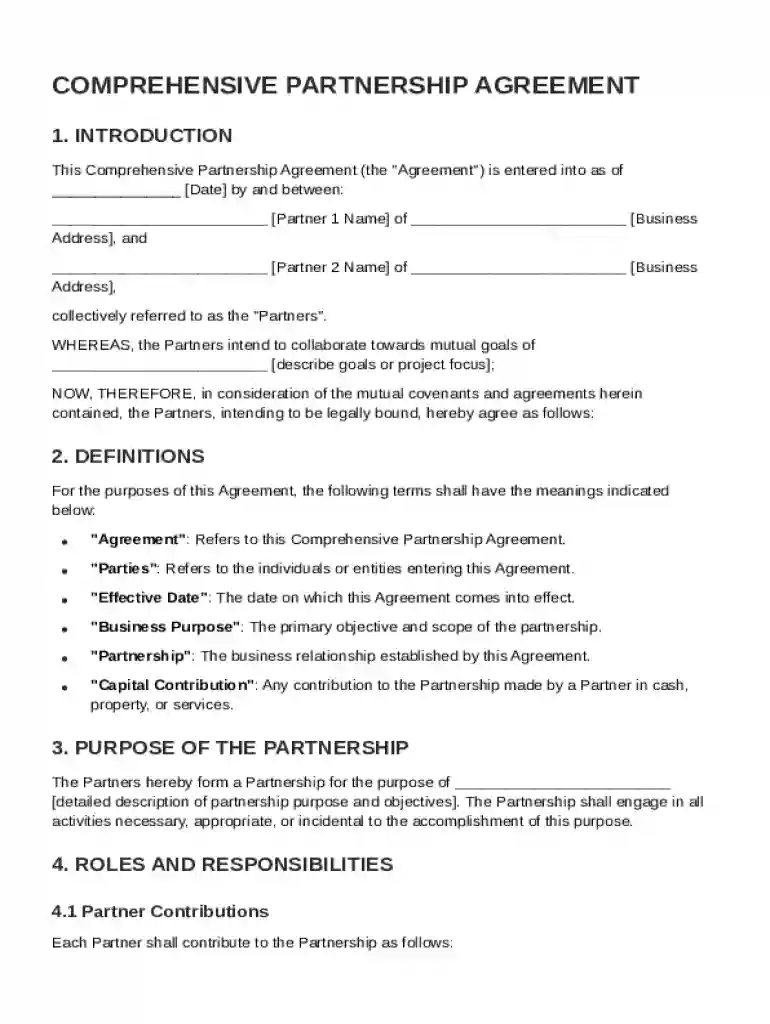
Type text, add images, blackout confidential details, add comments, highlights and more.

Draw your signature, type it, upload its image, or use your mobile device as a signature pad.

Send it via email, link, or fax. You can also download it, export it or print it out.
A Comprehensive Partnership Agreement Template is a structured document that outlines the terms and conditions under which two or more entities agree to collaborate towards common goals. This template provides a framework for establishing a legally binding partnership, ensuring that all relevant aspects of the partnership are documented clearly. The agreement typically covers critical areas such as partnership purpose, roles, and responsibilities, financial arrangements, and mechanisms for dispute resolution. Using a template helps streamline the drafting process by providing a ready-to-use structure that can be tailored to fit the specific needs of the partners involved.
A Comprehensive Partnership Agreement Template includes several key sections, each serving a specific purpose. These sections are essential for creating a clear understanding between partners and minimizing potential disagreements. They include:
Using a Comprehensive Partnership Agreement Template begins with understanding its structure and components. The template acts as a guideline, directing you on what information to include and where. Here’s a step-by-step approach to utilizing the template effectively:
Review the Template: Begin by going through the entire template to familiarize yourself with its sections and required details.
Customize the Sections: Tailor each section to reflect the specific terms agreed upon by the partners. This includes modifying language to fit the context of your partnership.
Include Additional Clauses: Depending on the nature of the partnership, you may need to add unique clauses that address particular needs or potential future scenarios.
Seek Legal Advice: For clarity and compliance with legal standards, consider having a legal professional review the completed document.
Gather Signatures: Ensure that all involved parties review and sign the final document to confirm acceptance of the terms.
The legal use of a Comprehensive Partnership Agreement Template involves ensuring that the template aligns with applicable legal requirements and standards within your jurisdiction. This is crucial for safeguarding the interests of each partner and ensuring enforceability.
Engaging a legal professional provides an additional layer of security. They can spot potential pitfalls in the agreement and suggest enhancements that protect against future legal disputes.
The template contains specific elements without which the agreement would be incomplete. Recognizing and incorporating these elements ensures clarity and mutual understanding among partners.
Management Structure: Defines how decisions will be made and by whom, outlining procedures for resolving disputes within the management team.
Profit-Sharing Model: Details how profits and losses will be distributed among partners, which is vital for financial planning and transparency.
Amendment Process: Establishes how changes to the agreement can be made, ensuring all partners have input on modifications.
A real-world application might involve two businesses entering a joint venture to develop new technology. Their agreement must specify aspects like intellectual property rights distribution and product marketing responsibilities to pre-emptively address potential conflict areas.
Understanding specific terminology within a Comprehensive Partnership Agreement is crucial for accurate interpretation and compliance.
Indemnification: A provision by which one party agrees to compensate the other for any losses or damages incurred during the partnership.
Liability: Describes the extent of each partner's responsibility for the debts and obligations of the partnership.
Confidential Information: Information that must be kept private, often detailed in a separate Non-Disclosure Agreement (NDA).
Clarifying these terms within the agreement ensures mutual understanding and helps avoid future disputes. Formal definitions set in the document's introduction can provide permanent reference points for all parties involved.
Each state may impose unique requirements for partnership agreements, making it vital to adjust the template according to your state’s laws.
Registration Requirements: Some states require partnerships to register and may dictate specific operational standards.
Tax Implications: Understand the tax liabilities specific to partnerships in your state, including potential filings and due dates.
In California, partnerships might need to comply with more stringent disclosures in terms of privacy and environmental impact than in other states. Adjusting the agreement to comply with state rules is critical for ensuring legality and avoiding penalties.
Deciding between using a digital or paper version of the Comprehensive Partnership Agreement Template impacts the management and organization of your documents.
Digital Version: Offers benefits such as ease of distribution, real-time collaboration, and integration with document management systems like DocHub.
Paper Version: While traditional, it provides a tangible copy that some partners prefer for record-keeping and auditing purposes.
The choice may depend on the technological sophistication of the parties involved or the specific requirements of regulatory bodies. Ensure that digital signatures, if used, comply with legal standards to ensure enforceability.
Practical examples can illustrate how diverse partnerships apply the template to meet their specific needs.
Startup Ventures: In forming a startup, partners might focus heavily on how intellectual property and equity are allocated in the agreement.
Business Expansion: Established businesses entering a partnership for expansion purposes may highlight terms related to profit sharing and market responsibilities.
Consider a case where an online retailer partners with a local logistics company. Their agreement would prioritize details about the supply chain, delivery timelines, and cost-sharing methods, demonstrating how partners can align their strengths through a well-structured partnership agreement.
At DocHub, your data security is our priority. We follow HIPAA, SOC2, GDPR, and other standards, so you can work on your documents with confidence.