






Definition & Meaning
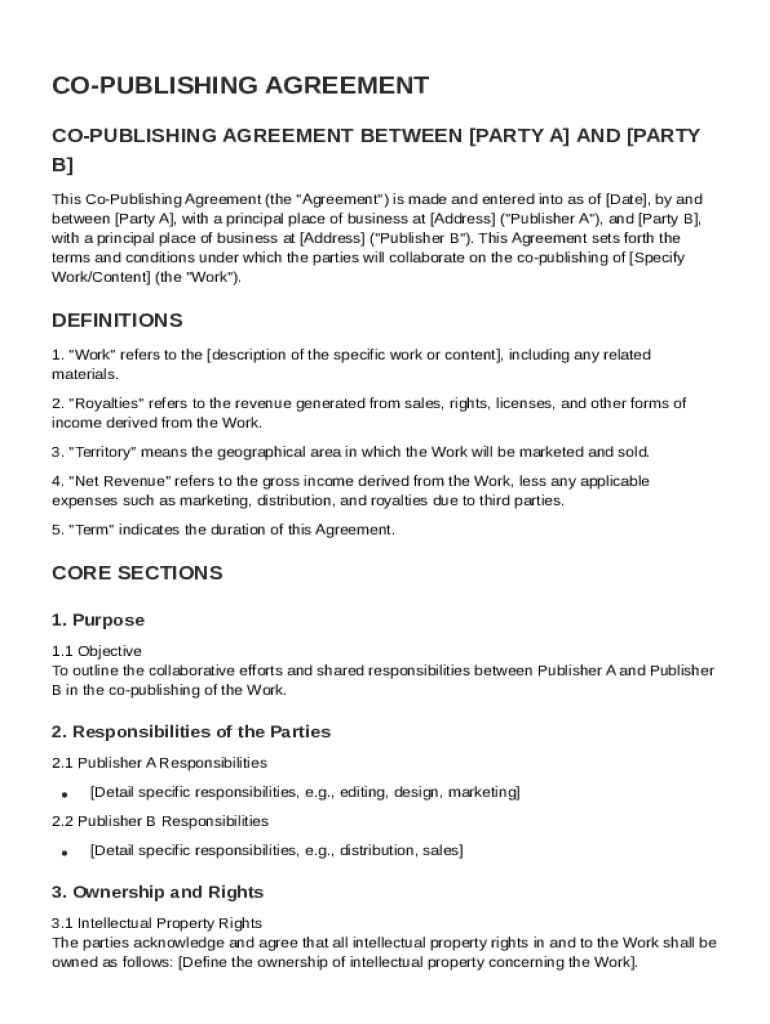
A Co-Publishing Agreement Template is a legal document that details the collaboration between two or more publishers who agree to jointly publish a specific work. This agreement outlines the responsibilities, rights, and revenue-sharing arrangements between the involved parties. By establishing clear guidelines, it aims to prevent misunderstandings and disputes, ensuring a smooth co-publishing process. The primary objectives of this document include clarifying ownership rights, financial arrangements, and joint marketing strategies to promote the work effectively.
Key Elements of the Co-Publishing Agreement Template
The agreement includes several crucial components that define the collaboration:
- Parties Involved: Identifies Publisher A and Publisher B who are entering the agreement.
- Work Description: Details the specific work being co-published, including its title and nature.
- Ownership Rights: Clearly indicates the ownership and intellectual property rights for each party.
- Revenue Sharing: Outlines how profits will be shared between the parties, specifying percentages or formulas.
- Marketing Strategies: Describes joint efforts in promoting the work and the responsibilities of each publisher.
- Reporting Requirements: Establishes how and when sales and financial reports will be exchanged.
- Confidentiality Obligations: Mandates privacy regarding sensitive information.
- Governing Law and Dispute Resolution: Specifies the legal framework governing the agreement and the process for resolving disputes.
Steps to Complete the Co-Publishing Agreement Template
Completing the Co-Publishing Agreement Template involves several steps:
- Identify the Parties: Clearly name the publishers involved in the agreement.
- Describe the Work: Include a detailed description of the work being co-published.
- Define Responsibilities: Assign specific roles and tasks to each party, such as marketing and distribution.
- Specify Ownership and Financial Details: Clearly detail the ownership rights and the agreed revenue-sharing model.
- Outline Reporting and Confidentiality Requirements: Establish timelines for financial reporting and maintain confidentiality clauses.
- Include Governing Law: Identify the jurisdiction governing the agreement and processes for dispute resolution.
- Review and Sign: Ensure both parties review the document thoroughly before signing.
Legal Use of the Co-Publishing Agreement Template
The use of a Co-Publishing Agreement Template must adhere to legal standards to ensure its enforceability:
- Compliance with Local Laws: The agreement should comply with the legal requirements of the jurisdiction it operates under.
- Adherence to the ESIGN Act: If executed electronically, it should adhere to regulations governing electronic signatures in the U.S.
- Validity of Signatures: Signatures should be obtained from authorized representatives of both parties.
- Document Authentication: Ensure the document is authenticated, often through notarization or similar processes.
Who Typically Uses the Co-Publishing Agreement Template
The Co-Publishing Agreement Template is commonly used by:
- Publishing Companies: Large and small publishers looking to collaborate on a mutual project.
- Authors and Agencies: Authors who wish to expand their reach by engaging with multiple publishers.
- Educational Institutions: Universities or educational bodies collaborating on educational materials.
- Media and Entertainment Companies: Enterprises in the media industry aiming to jointly publish digital content.

Important Terms Related to the Co-Publishing Agreement Template
Understanding specific terminology is crucial for both parties in a co-publishing arrangement:
- Intellectual Property (IP): Legal rights over creations of the mind, such as publications or digital media.
- Royalties: Payments made to rights holders based on sales or usage of a work.
- Advance Payment: Initial payment made to an author or publisher before sales revenue.
- Editing and Production: Processes involved in preparing the work for publication, possibly shared between parties.
State-Specific Rules for the Co-Publishing Agreement Template
While the Co-Publishing Agreement Template provides a general framework, it’s essential to consider state-specific rules:
- Governing Law: Some states may have unique laws affecting intellectual property rights and publishing agreements.
- Sales Tax Implications: Regulations regarding the collection of sales tax on published works can vary by state.
- Dispute Resolution Mechanisms: States may differ in their preferred methods for handling disputes, such as mediation or arbitration.
Examples of Using the Co-Publishing Agreement Template
Real-world scenarios where a Co-Publishing Agreement Template might be utilized include:
- Joint Book Publishing: Two publishers team up to publish a cross-genre novel, combining resources for broader distribution.
- Academic Journal Collaboration: Multiple educational institutions collaborate to publish a scientific journal, enhancing its reach and credibility.
- Multimedia Projects: Media companies working together on a project that includes printed material and digital content, requiring clearly defined roles and profit-sharing models.