Child Support and Visitation Agreement Template 2026

Get Form
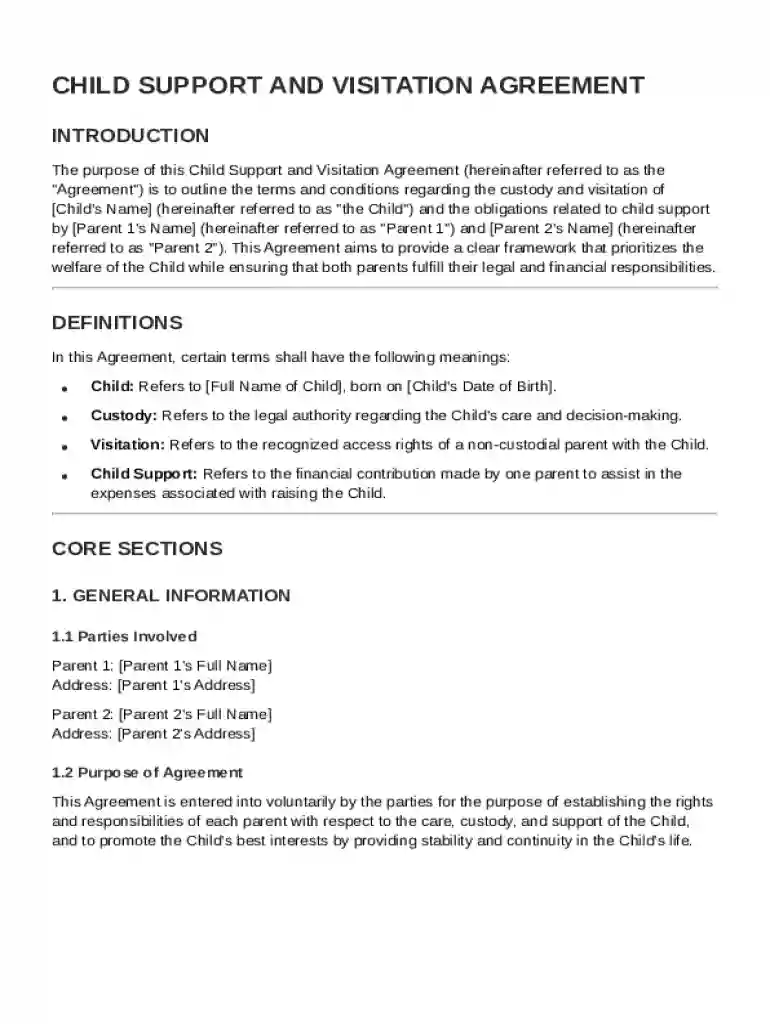
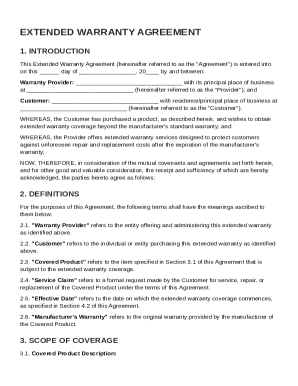
Child Support and Visitation Agreement Template Preview on Page 1

Here's how it works

01. Edit your form online
Type text, add images, blackout confidential details, add comments, highlights and more.

02. Sign it in a few clicks
Draw your signature, type it, upload its image, or use your mobile device as a signature pad.

03. Share your form with others
Send it via email, link, or fax. You can also download it, export it or print it out.

Definition & Meaning

A Child Support and Visitation Agreement Template is a legal document used by separated or divorced parents to outline the arrangements related to child support payments and visitation rights. It includes the terms that govern legal and physical custody, visitation schedules, child support amounts, and the responsibilities of each parent. The primary goal of this template is to ensure that the child's welfare is prioritized while fulfilling the parents' legal and financial obligations towards their child.

Key Components

  • Custody Arrangements: Details whether one parent has full custody or if custody is shared.
  • Visitation Schedules: Specifies when and how visitation will occur.
  • Child Support: Defines the financial obligations each parent has to support their child.

Importance

Understanding the purpose and meaning of this agreement helps in creating a clear and enforceable plan that ensures the well-being of the child and fair collaboration between parents.

How to Use the Child Support and Visitation Agreement Template

Employing the Child Support and Visitation Agreement Template involves several steps, beginning with comprehending the requirements of both parents and the specific needs of the child.

Step-by-Step Instructions

  1. Review the Template: Make sure the sections like custody, visitation, and support are relevant to your situation.
  2. Customize the Document: Adjust the fields to reflect your agreed terms, including specifics about visitation days and financial responsibilities.
  3. Consult a Legal Professional: It’s crucial to have a legal expert review the template to ensure adherence to state laws.
  4. Finalize the Agreement: Once both parties agree, finalize the document by signing it in the presence of a notary.

Practical Example

Consider a case where both parents share joint custody. The template would include alternating weekends for visitation and a fixed monthly child support payment from one parent.

Steps to Complete the Child Support and Visitation Agreement Template

Completing the Child Support and Visitation Agreement Template effectively requires attention to detail and collaboration between the parents.

Detailed Steps

  1. Collect Necessary Information: Before filling out the form, gather all relevant details about income, work schedules, and the child's needs.
  2. Discuss with the Other Parent: Negotiation is key to agreeing on terms suitable for both parents and the child.
  3. Use Clear and Precise Language: Ambiguities can lead to disputes later.
  4. Revise As Needed: Be open to revisions based on feedback or changes in circumstances.
  5. Sign and Notarize: Ensure that the agreement is legally binding by having it signed and notarized.

Real-world Application

In a situation where one parent relocates due to job changes, revisiting and updating the agreement to accommodate new visitation arrangements is necessary.

Important Terms Related to Child Support and Visitation Agreement Template

Understanding the terminology used in the Child Support and Visitation Agreement Template is critical for both legal compliance and effective communication.

Key Terms

  • Legal Custody: Refers to the right to make major decisions about the child's welfare, including education and medical care.
  • Physical Custody: Pertains to where the child lives on a day-to-day basis.
  • Visitation Rights: The non-custodial parent’s right to visit their child.
  • Child Support: Financial contributions made by the non-custodial parent to assist with the child's living expenses.

Common Misunderstandings

Misinterpreting the distinction between legal and physical custody often leads to confusion. Legal custody involves decision-making power, while physical custody determines the child's residence.

Legal Use of the Child Support and Visitation Agreement Template

The legality of a Child Support and Visitation Agreement Template is based on adherence to state laws and proper execution.

Ensuring Compliance

  • State Laws: Each state has specific regulations governing child support and visitation, which must be reflected in the agreement.
  • Professional Legal Advice: Engaging a legal professional to review the agreement before finalization is recommended.
  • Modification Clause: Including a clause to allow for modifications as circumstances change ensures that the agreement remains relevant and enforceable.

Case Study

Consider a scenario in which one parent wants to relocate. A well-drafted modification clause allows easy update of visitation terms to suit the new logistics.

Key Elements of the Child Support and Visitation Agreement Template

A comprehensive Child Support and Visitation Agreement Template should cover critical elements to be legally effective and practically useful.

Essential Elements

  • Custody Assignments: Specifies who has custody and the nature of it (shared, sole, etc.).
  • Visitation Schedules: Clearly outlines time-sharing arrangements and holidays.
  • Financial Details: Precise amounts for child support and any additional financial responsibilities.
  • Communication Protocols: Guidelines for communication between parents concerning the child’s welfare.
  • Dispute Resolution Methods: Procedures to address disagreements without litigation.

Example Inclusion

A provision for alternating holiday visitation ensures both parents can spend important occasions with the child, reducing potential conflicts.

State-specific Rules for the Child Support and Visitation Agreement Template

State-specific guidelines play a critical role in shaping the Child Support and Visitation Agreement Template to ensure it is legally binding and appropriate.

Variations by State

  • Income Calculation: States differ in calculating support amounts based on parental income and needs of the child.
  • Custody Preferences: Some states may have preferences like favoring joint custody.
  • Standard Visitation Protocols: Established schedules or guidelines provided by the court help in standardizing the agreement.

Considerations for Compliance

Adhering to a state’s unique requirements is essential. For instance, in California, the income shares model might be used to determine child support, unlike percentage models in other states.

Examples of Using the Child Support and Visitation Agreement Template

Understanding practical applications of the Child Support and Visitation Agreement Template can provide clarity and direction.

Scenario Examples

  • Employment Changes: If a parent's employment status changes, revising the child support section could reflect the new financial situation.
  • School Schedule Adjustments: Incorporate changes in visitation according to the child’s school calendar to ensure minimal disruption.

Benefits of Real-life Examples

These examples illustrate how adaptable and functional the template can be in various real-world situations, promoting better understanding and smoother implementation.

be ready to get more

Complete this form in 5 minutes or less

Get form

Got questions?

We have answers to the most popular questions from our customers. If you can't find an answer to your question, please contact us.
Contact us
70/30 Parenting Schedule The child spends the week (Monday - Friday) with parent A, and the weekend (Saturday and Sunday) with parent B. The child spends two consecutive weeks (14 days) with parent A and one week (7 days) with parent B.
Emotions: The inability of parents to consistently control their emotions, and avoid emotional decision making, is the most common mistake we see in child custody cases. The reason: it is such an easy mistake to make, and so pervasive in all aspects of the case.
Why Is Joint Custody the Most Common Child Custody Arrangement? Joint custody arrangements have become more common over the years. For many families, joint custody is the best possible situation after a divorce because both parents spend meaningful time with their children and remain involved in their lives.
The best way to win child custody is to work with the other parent to make a custody agreement both of you support. This helps avoid a long, expensive court battle and makes your parenting plan easier to follow. You can negotiate an agreement with the other parent on your own or through lawyers.
The common perception has historically favored mothers, but recent shifts in family law show that this assumption is no longer universally accurate. Courts today aim to make custody decisions based purely on the childs best interests, balancing various factors regardless of parental gender.

Security and compliance

At DocHub, your data security is our priority. We follow HIPAA, SOC2, GDPR, and other standards, so you can work on your documents with confidence.
Learn more
ccpa2
pci-dss
gdpr-compliance
hipaa
soc-compliance

People also ask

So, most divorcing parents hope for amicable child custody arrangements. The child custody arrangement you settle on will depend on your family. However, joint custody tends to be the most common child custody arrangement.

Related links