






Definition & Meaning
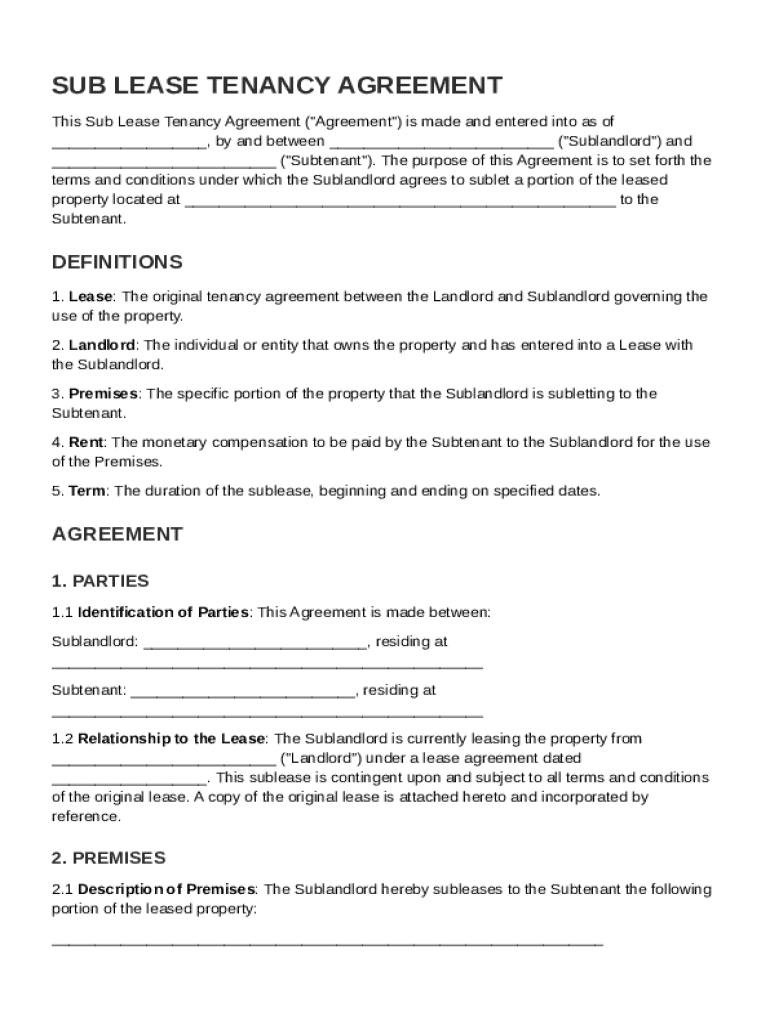
A Sub Lease Tenancy Agreement is a formal contract that outlines the arrangement where a Sublandlord leases a portion of their leased property to a Subtenant. This agreement details essential terms such as rental obligations, premises description, and compliance with the original lease. It serves to protect the rights and responsibilities of both parties by providing a clear, legal framework for subleasing.
- Sublandlord: The original tenant who is subletting part or all of the leased property to another person.
- Subtenant: The individual or entity who occupies the leased premises under the sublease agreement.
Examples of premises that might be subleased include apartments, commercial spaces, or office sections, each requiring specific details to be outlined in the agreement.
How to Use the Sub Lease Tenancy Agreement Template
Using the Sub Lease Tenancy Agreement Template involves filling out specific sections to customize the document to suit the particular sublease arrangement. Here’s how to effectively use this template:
-
Download the Template: Obtain the Sub Lease Tenancy Agreement Template from a reliable source. Ensure it is compatible with your document editor, such as DocHub.
-
Customize Key Sections: Modify sections to reflect the specific details of the sublease. This includes the names of the Sublandlord and Subtenant, descriptions of the leased premises, and agreed-upon terms.
-
Incorporate Legal Requirements: Check for any state-specific laws or requirements that must be incorporated into the agreement to ensure its enforceability.
The template also allows for the addition or removal of clauses to better fit the unique needs of the subleasing parties.
Steps to Complete the Sub Lease Tenancy Agreement Template
Completing the template requires diligence to ensure all necessary information is duly captured. Follow these steps for a comprehensive agreement:
-
Input Basic Information: Begin with details such as names and contact information of the Sublandlord and Subtenant.
-
Define Lease Premises: Clearly describe the part of the property being subleased, including units or specific areas.
-
Set Terms and Conditions: Outline the rental period, payment schedule, and any additional costs, such as utilities.
-
Specify Obligations: Detail the responsibilities of each party regarding maintenance, repairs, and compliance with the main lease.
-
Include Legal Provisions: Add clauses related to governing law, dispute resolution, and indemnification.
-
Sign and Date: Both parties should sign and date the agreement to signify acceptance and binding intent.
Review each section thoroughly to ensure completeness and accuracy before finalizing the document.
Key Elements of the Sub Lease Tenancy Agreement Template
The Sub Lease Tenancy Agreement Template contains several critical elements designed to safeguard both the Sublandlord and Subtenant:
-
Premises Description: Details the portion of the property being leased, crucial for clarity and legal enforcement.
-
Rent and Payment Terms: Specifies the amount, frequency, and method of rent payment.
-
Security Deposit: Outlines requirements for any security deposits, including conditions for its return.
-
Usage Terms: Defines permissible uses of the property, aligning with the main lease agreement restrictions.
These elements ensure both parties understand their roles, responsibilities, and the nature of their agreement.
Legal Use of the Sub Lease Tenancy Agreement Template
Legal compliance is vital in any leasing situation to prevent future disputes. Here’s how the agreement ensures legal soundness:
-
Alignment with Main Lease: The sublease must not contradict the original lease terms to prevent violations.
-
State Law Compliancy: Incorporate state-specific provisions required for subleasing agreements, such as disclosure requirements.
-
Dispute Resolution: Includes terms for mediation or arbitration in case of disagreements.
Consulting a legal professional can further ensure that all aspects of the agreement are legally binding and enforceable.
Important Terms Related to Sub Lease Tenancy Agreement Template
Understanding terminology is crucial for drafting an effective sublease agreement. Here are some important terms:
-
Original Lease: The binding contract between the original tenant (Sublandlord) and the property owner.
-
Modifications Clause: Allows for changes to the agreement with mutual consent from both parties.
-
Termination Clause: Specifies conditions under which the agreement can be ended.
A familiarity with these terms helps in writing a comprehensive and clear agreement, preventing misunderstandings.
State-Specific Rules for the Sub Lease Tenancy Agreement Template
Subleasing rules can vary significantly between states, impacting how agreements are written and enforced. Key considerations include:
-
Disclosure Requirements: Some states mandate specific disclosures that must be included in sublease agreements.
-
Tenant Rights: States may have unique laws protecting tenant rights that need to be reflected in the agreement.
-
Permission from Landlord: Certain jurisdictions may require explicit consent from the original landlord to sublease a property.
Research state laws to ensure that these regional rules are properly integrated into your agreement template.
Examples of Using the Sub Lease Tenancy Agreement Template
Real-world scenarios are instrumental in understanding the practical applications of the template:
-
Apartment Sublease: A tenant subleases their apartment during a temporary work relocation, stipulating use and occupancy conditions.
-
Office Sublease: A business sublets part of their rented office space to another company, detailing shared utility and maintenance responsibilities.
These examples highlight how different environments can influence the specifics of a subleasing agreement, demonstrating the importance of adaptation to circumstances.
State-by-State Differences
Each state may have different regulations regarding subleasing, which can impact the formulation of the subleasing agreement. Some aspects to consider include:
-
Security Deposit Limits: States may have specific caps on how much can be charged as a security deposit.
-
Notice Requirements: Varying notification periods for termination or lease alterations across states.
-
Permitted Use Regulations: Restrictions on business activities in residential properties or vice versa.
Familiarizing oneself with these variations helps tailor the sublease agreement to align with local legislation and ensure enforceability.
Why Use a Sub Lease Tenancy Agreement Template
Utilizing a Sub Lease Tenancy Agreement Template streamlines the creation process by offering a structured document that adheres to legal standards. Benefits include:
-
Consistency: Ensures all critical components of a sublease agreement are covered.
-
Efficiency: Saves time by providing a ready-to-use format that requires minimal adjustments.
-
Legal Compliance: Offers a foundation that can be adjusted to meet legal requirements.
Using a template also helps to quickly adapt to specific needs, making it a practical choice for individuals and businesses alike.