
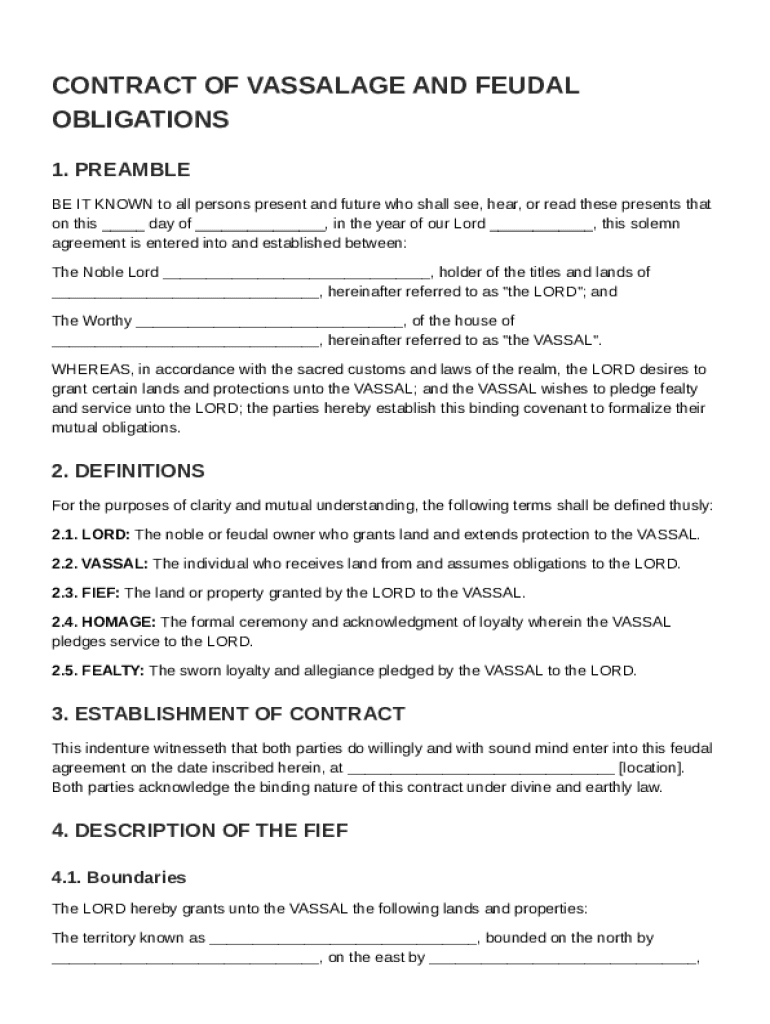







Definition and Meaning of the Medieval Contract Template
The Medieval Contract Template is a structured document representing the historical feudal agreements between a noble lord and a vassal. These contracts capture the essence of medieval authority and social structure, outlining mutual responsibilities such as land grants, military service, and financial obligations. These agreements are pivotal for understanding feudal systems, as they not only establish the terms of land ownership and protection but also embody the hierarchical nature of medieval society. By serving as a written acknowledgement of duties and privileges, medieval contracts solidify the interconnected relationships and power dynamics prevalent during that era.
How to Use the Medieval Contract Template
To effectively utilize a Medieval Contract Template, one needs to understand the template's components and their historical significance. Begin by identifying the parties involved, specifically the noble lord and the vassal. The template’s utility lies in its ability to formalize their relationship through:
- Detailed description of land grants provided to the vassal.
- Stipulation of military services or other responsibilities expected from the vassal.
- Inclusion of financial or material obligations.
Users should replace placeholders with specific details pertaining to their understanding of medieval agreements, ensuring historical accuracy and relevance.
Steps to Complete the Medieval Contract Template
Completing a Medieval Contract Template involves a few critical steps:
- Specify the Parties: Clearly identify the noble lord and the vassal involved.
- Detail Grant and Service: Outline the land granted to the vassal and the services expected in return.
- State Financial Obligations: Describe any taxes or monetary tributes required.
- Include Duration and Termination: Set the contract’s duration and conditions under which it may be terminated.
- Finalize with Signatures: Use period-appropriate methods to simulate the signing process.
Accurate completion requires knowledge of the vocabulary and customary practices of medieval times, thus enriching the template’s authenticity.
Important Terms Related to the Medieval Contract Template
Understanding the Medieval Contract Template necessitates familiarity with several key terms:
- Vassalage: The condition of allegiance and service owed by a vassal to a lord in exchange for tenure of land.
- Fief: An estate of land granted to a vassal by a lord, under conditions of feudal service.
- Fealty: A pledge of loyalty by the vassal to their lord.
- Liege Lord: The sovereign lord to whom the vassal has pledged loyalty.
These terms capture the social and legal exchanges characterized in medieval feudal society.
Key Elements of the Medieval Contract Template
Key elements within the template revolve around the reciprocal obligations and benefits inherent in feudal contracts:
- Mutual Responsibilities: Both parties outline explicit duties and privileges.
- Land Grant: Specifies the portion of land allocated to the vassal.
- Service Requirements: Documents expected military or advisory services.
- Financial Commitments: Details any rents, taxes, or tributes.
- Loyalty Clauses: Reinforces the vassal’s obligation to remain loyal to the lord.
Each element serves a vital role in defining the scope and expectations of vassalage.
Legal Use of the Medieval Contract Template
While the medieval period is long past, modern interpretations or reenactments of these contracts can serve educational and illustrative purposes. Legally, such templates do not hold authority in contemporary jurisdictions but offer insight into the historical basis of contractual law. When reenacting or interpreting these documents, individuals should:
- Maintain Historical Context: Preserve authenticity by using period-specific language and customs.
- Educational Application: Employ templates to educate about historical legal principles and societal structures.
Examples of Using the Medieval Contract Template
The Medieval Contract Template can be applied across various scenarios:
- Historical Reenactments: Used by history enthusiasts in live-action role-playing or educational reenactments to demonstrate feudal systems.
- Academic Research: Aiding scholars in constructing historical narratives or analyzing medieval power dynamics.
- Teaching Tools: Educators can use the templates to help students visualize and understand feudal society's structure and obligations.
These applications highlight how historical documents can provide deep insights into the past.
Digital vs. Paper Version of the Medieval Contract Template
In modern contexts, the Medieval Contract Template can exist in both digital and paper formats, each with distinct advantages:
- Digital Versions: Allow for easy modifications, storage, and sharing, benefiting educational and collaborative projects.
- Paper Versions: May appeal to historical accuracy enthusiasts, providing a tangible, authentic medium for interpretation.
Choosing between digital and paper largely depends on the user’s goals and the intended use of the template.




