






Definition and Meaning
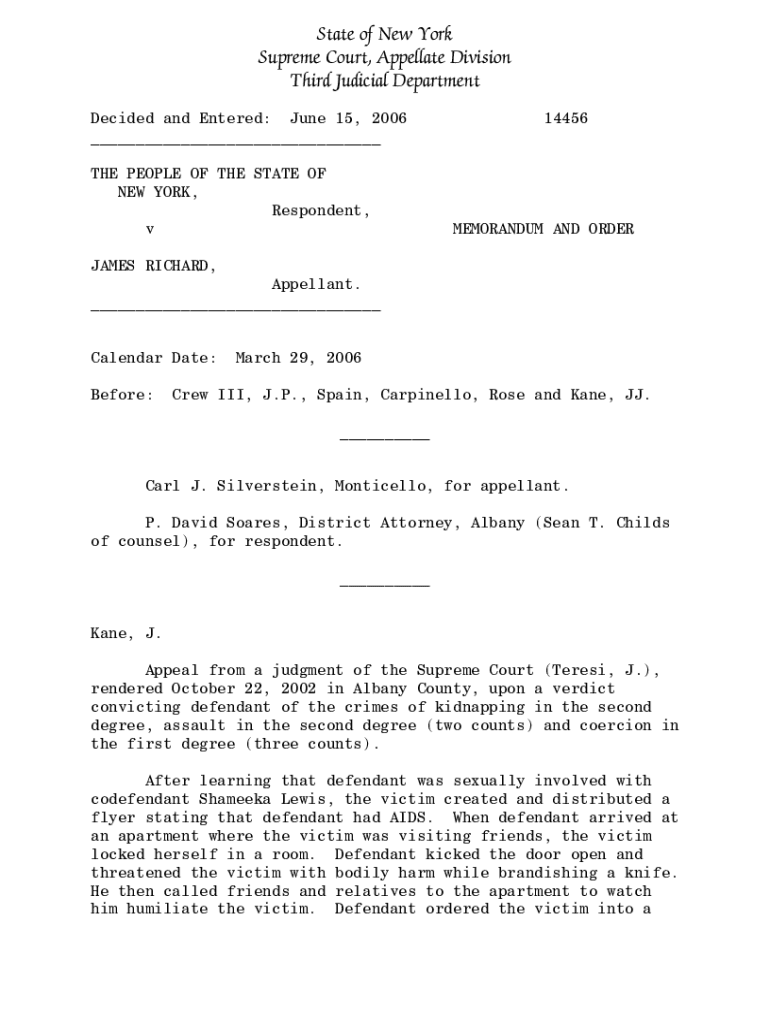
The term "JAMES RICHARD," when referenced within the context of managing legal documentation, pertains to case-specific details tied to a notable legal proceeding. It involves examining a memorandum and order from the New York Supreme Court, Appellate Division. This documentation is of significant importance, particularly for legal professionals and parties involved in similar cases, as it provides insights into how certain legal arguments and offenses are handled within the judicial system.
How to Obtain the JAMES RICHARD Documentation
To acquire official documents or legal memorandums like the one involving "JAMES RICHARD," interested parties generally need to engage in a series of steps. Firstly, these documents can often be accessed through the court where the case was heard. In this case, documents would be sourced from the New York Supreme Court, Appellate Division. Alternatively, legal databases or public records online might house these documents, offering them for research or educational purposes. When documents are restricted, legal representation might be required to assist in obtaining them.
Steps to Complete the JAMES RICHARD Assessment
Reviewing a case like "JAMES RICHARD" involves several steps:
-
Obtain Case Materials: First, gather all associated documents, including court filings, rulings, and any supplementary materials.
-
Analyze the Legal Context: Understand the legal background, including charges and alleged actions, to provide context.
-
Read the Verdict and Rulings: Focus on how the court addressed each charge, noting any legal principles or precedents involved.
-
Identify Key Legal Points: Highlight any modifications made to charges, such as the recognition of errors in the original trial.
-
Cross-Reference with Legal Norms: Compare the documented rulings against existing laws and previous cases to understand potential legal implications.
Key Elements of the JAMES RICHARD Case
Key elements of a legal proceeding such as "JAMES RICHARD" typically include:
- Charge Details: Enumerate the specific crimes, such as kidnapping and assault, with legal definitions.
- Victim Testimonies and Evidence: Examine how evidence and testimonies supported the accusations.
- Court's Analysis: Review the court’s interpretation of evidence and legal standards applied.
- Judicial Outcomes: Document which charges were upheld and which were modified or dismissed, including reasoning.
- Sentencing: Summarize any punishments handed down and factors influencing them.
Legal Use of JAMES RICHARD Documentation
Legal documents like those in the "JAMES RICHARD" case serve several purposes:
- Research: They are critical for legal research, helping lawyers analyze similar cases and prepare defense or prosecution strategies.
- Precedent Setting: Such cases can influence future rulings, making them indispensable in ongoing legal education.
- Transparency and Accountability: They provide transparency into judicial processes, bolstering public trust in the legal system.
Who Typically Uses JAMES RICHARD Case Documentation
Legal professionals who might utilize case documentation include:
- Attorneys: Both defense and prosecution can use such cases to support or counter their legal positions.
- Judges: They review past cases to ensure consistent application of the law.
- Law Students: They use these cases for study and analysis during their training.
Examples of Using the JAMES RICHARD Documentation
Consider scenarios in which "JAMES RICHARD" documentation may be referenced:
- Training Sessions: Legal educators might use the case in discussions or mock trials for illustrative purposes.
- Analytical Articles: Legal analysts or commentators might cite the case to discuss trends in legal interpretations concerning violent crimes.
- Comparative Legal Studies: Researchers might use this case as part of a larger study examining how various courts handle cases with similar charges.
State-Specific Rules for Similar Legal Proceedings
State-specific rules can greatly influence case outcomes:
- New York Legal Precedents: The approach taken in the "JAMES RICHARD" case might reflect unique New York statutes or legal standards.
- Comparison Across States: Different jurisdictions may have varying legal frameworks which could influence indictments and sentencing.
- Application of Federal Law: Some elements may involve broader, federal statutes that apply consistently across states, influencing how state courts rule.
Penalties for Non-Compliance in Legal Procedures
Penalties for failing to comply with legal standards, as seen in cases similar to “JAMES RICHARD,” can encompass:
- Fines or Sanctions: Failing to adhere to court orders or legal protocols could lead to monetary fines.
- Dismissal of Charges or Cases: Errors or omissions might result in part or all of a case being dismissed.
- Professional Repercussions: Legal professionals may face censure or other repercussions for mistakes affecting the fairness or progression of a case.
Important Terms Related to JAMES RICHARD
Understanding critical terms related to the case aids clarity:
- Kidnapping: Unlawfully seizing and carrying away a person by force or fraud.
- Assault: Actions creating an apprehension of imminent harm, which, under certain statutes, can vary widely in definition and penalty.
- Appellate Division: The part of the Supreme Court that hears appeals, essential for understanding the case review process.
Versions or Alternatives to the JAMES RICHARD Case
Examining alternative cases helps maintain insight and adapt strategies:
- Related Court Cases: Reviewing similar appellate decisions within the same jurisdiction can highlight how courts evolve in handling repeated issues.
- Previous Versions of Charges: Looking at older cases can unearth adjustments in legal qualifications or ramifications for particular offenses.