




01. Edit your form online
Type text, add images, blackout confidential details, add comments, highlights and more.

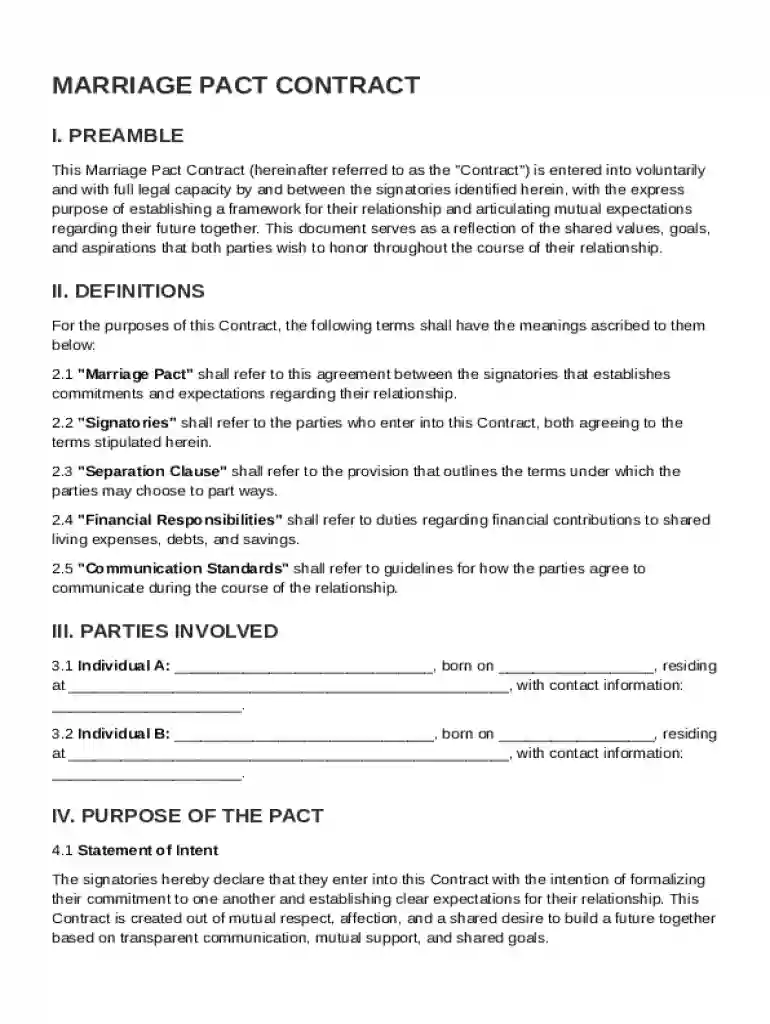
Type text, add images, blackout confidential details, add comments, highlights and more.

Draw your signature, type it, upload its image, or use your mobile device as a signature pad.

Send it via email, link, or fax. You can also download it, export it or print it out.
A Marriage Pact Contract is a formal agreement that helps partners articulate and agree upon various aspects of their relationship. It outlines mutual expectations, responsibilities, and commitments, serving as a document to guide partners in maintaining a healthy partnership. The objective is to foster a supportive environment that is rooted in shared values and goals. By detailing emotional responsibilities, financial arrangements, and communication standards, the contract serves as a foundation for strengthening the relationship.
Emotional Responsibilities: The template includes sections outlining each partner’s role in maintaining emotional well-being within the relationship. This may involve commitments to regular communication, quality time, and mutual support during challenges.
Financial Arrangements: It specifies how financial responsibilities will be shared or divided. Partners may agree on joint accounts, savings goals, or how expenses like rent and utilities will be handled.
Conflict Resolution: Provisions related to resolving disputes constructively are included, ensuring that both parties have agreed-upon steps to follow when disagreements arise.
Provisions for Separation: The template might also outline how a separation would be handled, including asset division and living arrangements, to ensure clarity in adverse situations.
The template should cover several essential areas to be effective. These elements provide a comprehensive framework that guides couples through various relationship dynamics:
Commitment Clauses: Clearly defined clauses that articulate the partners' commitment in various aspects of life, such as career support, personal development, and family planning.
Expectations and Goals: Sections that allow partners to articulate their long-term goals and expectations. This can involve career aspirations, children, or even lifestyle plans like travel.
Communication Standards: Agreements on how and when significant issues should be communicated, including regular check-ins or mechanisms for discussing sensitive topics.
Boundaries and Privacy: Acknowledgement of personal boundaries, ensuring both partners respect their individual privacy and autonomy.
Legal Provisions: While not a legally binding contract in itself, the Marriage Pact Contract may contain clauses that would hold up in certain legal scenarios, especially in states recognizing cohabitation agreements.
Using the Marriage Pact Contract Template involves several critical steps to ensure that it serves its intended purpose effectively:
Open Communication: Begin the process by having an open discussion with your partner about your relationship goals and expectations.
Customize the Template: Adapt the template to suit your personal requirements. Modify sections, add clauses, or remove irrelevant parts to create a document that best reflects your relationship.
Draft and Review: Write out your completed contract and review it with your partner. This review process can reveal new insights and additional areas to cover.
Consult a Professional: Consider speaking with a relationship counselor or legal advisor to gain perspective on its completeness and enforceability.
Sign and Store: Once both partners agree on the terms, sign the document and store it safely. Determine whether to revisit and update it regularly to account for life’s changes.
State-specific variations can significantly impact the interpretation and enforceability of a Marriage Pact Contract. In the U.S., these agreements are mostly recognized as informal contracts with no legal enforceability unless they pertain to specific cohabitation laws or pre-nuptial agreements in some states.
California & New York: These states view such agreements under cohabitation laws, which recognize them as valid provided they are written and signed willingly by both partners.
Texas & Florida: These states may not recognize the contract itself, but they appreciate the insights it provides into the intentions and living arrangements of the partners.
Variations: Always check local state laws to understand how a Marriage Pact Contract may be perceived in legal terms, especially if disputes about property or custody arise later on.
Practical examples illustrate how beneficial a Marriage Pact Contract can be in setting clear, mutual expectations:
Young Couples: Those considering marriage or long-term partnerships often use this template to address major life changes, such as buying a home together or starting a family.
Second Marriages: Individuals entering into second marriages use the contract to address complexities like blended families, previous commitments, or management of separate finances.
Long-Distance Relationships: Couples facing geographical barriers use the agreement to set schedules for visits, communication routines, and future relocation plans.
Completing the Marriage Pact Contract Template requires meticulous attention to detail to ensure it comprehensively covers essential relationship dynamics:
Identify Core Areas: Discuss and determine the key aspects that the contract should cover, focusing on areas most critical to your relationship.
Draft Sections: Write clear and concise sections starting with expectations, emotional bonds, financial arrangements, and conflict resolution strategies.
Discuss Each Part: As each section is drafted, discuss its contents thoroughly with your partner to ensure mutual understanding and agreement.
Review and Amend: Multiple revisions may be necessary. Consider feedback from both partners and make necessary amendments.
Seek Guidance: Seek professional advice if there are complex elements such as existing legal obligations or shared business interests.
Finalize and Sign: Once finalized, both partners should sign the document. Reaffirm your commitments by reading the contract together periodically.
While primarily focusing on mutual understanding and relationship maintenance, the Marriage Pact Contract can have implications in legal contexts:
Binding Nature: Generally, Marriage Pact Contracts are not legally binding but can indicate intent in cohabitation or separation cases.
Court Consideration: Courts might consider the contract when resolving disputes, particularly in matters of joint property or parenting plans.
Coherent Alignment: For couples seeking legally binding agreements, integrating this template with prenuptial agreements or cohabitation contracts might provide legal enforceability.
Legal professionals can offer insight into creating sections that can enhance its validity within specific legal contexts.
At DocHub, your data security is our priority. We follow HIPAA, SOC2, GDPR, and other standards, so you can work on your documents with confidence.


Parents and Children Together (PACT): Documentation Report for PACT Healthy Marriage Restricted Use Data Files. PACT STUDY ABSTRACT AND DATA COLLECTION
Such a contract, agreed upon prior to the marriage itself, can add depth and meaning to the vows that the couple recites during the wedding ceremony.


