






Definition and Meaning
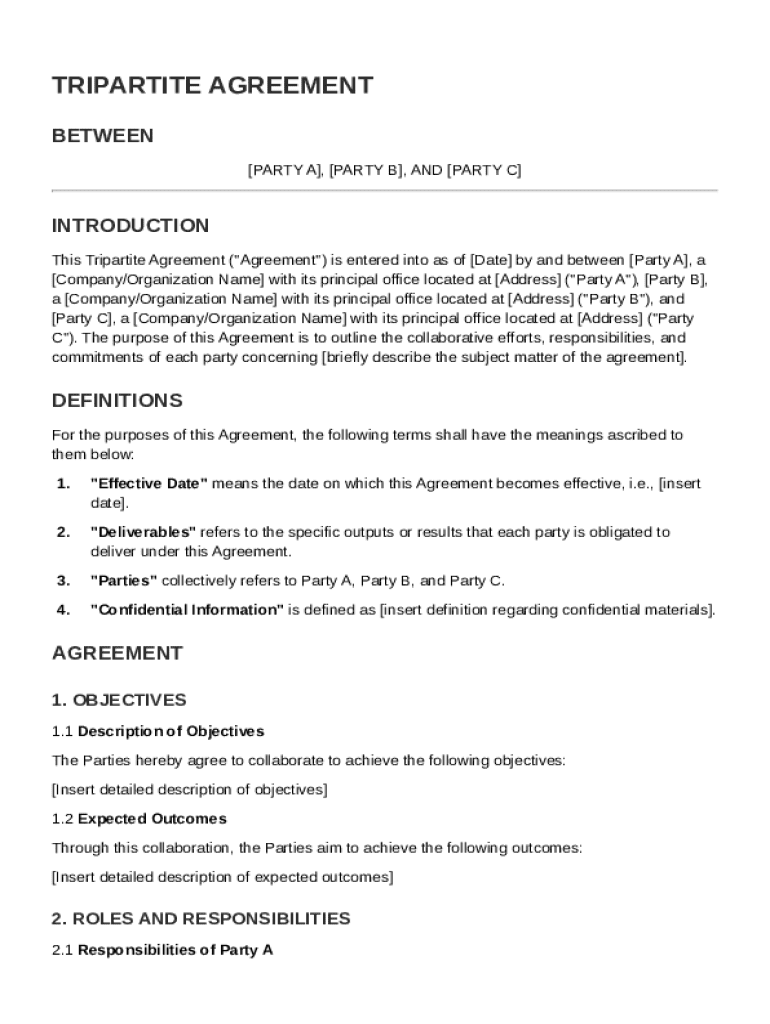
A Tripartite Agreement Template serves as a structured framework outlining the collaborative efforts and responsibilities among three distinct parties—Party A, Party B, and Party C. It typically defines the key terms, objectives, roles, and responsibilities of each party involved in the agreement. These agreements are essential in situations where multiple parties need to coordinate their actions, resources, or strategies to achieve common goals, such as financial transactions or complex business arrangements.
Key Elements of the Tripartite Agreement Template
There are several critical components that form the backbone of a Tripartite Agreement. Understanding these elements helps ensure that the agreement covers all necessary aspects:
- Parties Involved: Clearly identifying the three parties involved, their roles, and contact details.
- Objectives: Defining the purpose and desired outcomes of the agreement.
- Roles and Responsibilities: Detailing the specific duties of each party to avoid conflicts and ensure accountability.
- Duration: Establishing the timeframe for the agreement, including start and end dates.
- Funding and Resources: Specifying the financial contributions or resources each party will provide.
- Communication Protocols: Setting guidelines for how and when parties will communicate throughout the duration of the agreement.
Each element must be fully understood and agreed upon to ensure a successful collaboration among the parties.
Steps to Complete the Tripartite Agreement Template
Filling out a Tripartite Agreement requires careful consideration and precision. Following a step-by-step methodology guarantees comprehensive coverage of all pertinent aspects:
- Identify Parties: Begin by listing all parties involved with complete contact information.
- State Objectives: Outline the main goals of the agreement, ensuring clarity and mutual understanding.
- Assign Roles: Clearly delineate the responsibilities and duties of each party.
- Define Terms: Specify the terms of the agreement, including duration and funding commitments.
- Outline Communication Protocols: Establish how the parties will interact and communicate.
- Review Clause for Dispute Resolution: Include a well-defined process for resolving any disputes that may arise.
- Finalize and Sign: Ensure all parties thoroughly review the document, then sign and date the agreement.
Executing these steps will produce a detailed and mutually agreed-upon document that effectively serves all parties.
Legal Use of the Tripartite Agreement Template
The Tripartite Agreement Template is used legally to safeguard the interests of all involved parties by clearly stating their rights and obligations. It is crucial for maintaining transparency and accountability within any collaborative process. The agreement is legally binding, so ensuring compliance with relevant laws and regulations, like the ESIGN Act for electronic signatures, is essential for preventing legal disputes.
Who Typically Uses the Tripartite Agreement Template
The Tripartite Agreement Template is often used by various sectors that require coordinated efforts from multiple stakeholders, including:
- Financial Institutions: For complex lending arrangements where banks, borrowers, and guarantors are involved.
- Construction Industry: Where developers, contractors, and financiers must agree on project specifics.
- International Business: For partnerships involving domestic and international entities where compliance with multiple legal systems is needed.
These organizations benefit from clear documentation of their collaborative efforts, preventing misunderstandings and facilitating smooth operations.

Important Terms Related to Tripartite Agreements
Understanding foundational terms is crucial for effective agreement formulation. Key terminology includes:
- Indemnity: Compensation for any loss or damage incurred.
- Confidentiality: Rules governing the sharing of sensitive information.
- Force Majeure: Conditions under which the parties are exempted from fulfilling their obligations due to unforeseen events.
- Termination Clause: Conditions under which the agreement can be ended prematurely by any party.
Grasping these terms ensures all parties are on the same page and reduces the potential for misinterpretations.
Software Compatibility (DocHub, QuickBooks, etc.)
Working with tripartite agreements digitally is enhanced by compatibility with software tools that streamline document management processes:
- DocHub: Facilitates editing, signing, and managing the template seamlessly.
- QuickBooks: Assists in tracking financial agreements and obligations.
- Google Workspace: Enables integration for collaborative editing and sharing among parties.
These tools simplify creating, modifying, and securely storing the agreement digitally, catering to diverse workflow needs.
Examples of Using the Tripartite Agreement Template
The template finds versatile uses across industries, illustrated by real-world scenarios:
- Bank Loans: Ensuring clarity between borrower, lender, and insurer regarding obligations and terms.
- Construction Projects: Coordinating responsibilities among developers, builders, and investors.
- Research Collaborations: Aligning efforts among academic institutions, corporations, and funding bodies for shared research endeavors.
These examples demonstrate the flexibility and applicability of the Tripartite Agreement Template in various contexts.