01. Edit your form online
Type text, add images, blackout confidential details, add comments, highlights and more.

Type text, add images, blackout confidential details, add comments, highlights and more.

Draw your signature, type it, upload its image, or use your mobile device as a signature pad.

Send it via email, link, or fax. You can also download it, export it or print it out.
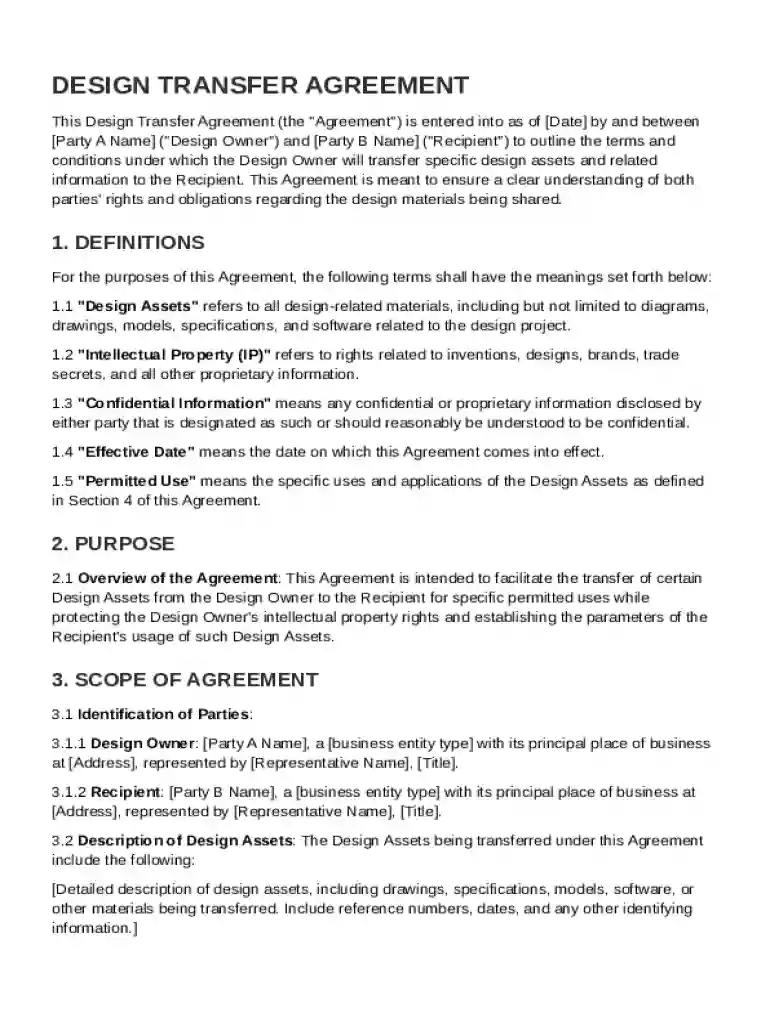
The Design Transfer Agreement Template serves as a formal contract outlining the transfer of design assets and related information between a design owner and a recipient. This section delves into the critical elements found within the agreement, ensuring both parties understand their obligations, rights, and responsibilities.
Parties Involved: Clearly defines the design owner (transferor) and the recipient (transferee), including contact details and roles in the transfer process.
Transferred Assets: Lists the specific design assets being transferred, such as sketches, CAD files, and prototype models, ensuring comprehensiveness and clarity.
Purpose of Transfer: Describes the intent behind transferring the design assets, whether for modification, commercial production, or research and development.
Intellectual Property Rights: Outlines ownership rights, ensuring that the transfer does not inadvertently include intellectual property rights unless explicitly agreed upon.
Confidentiality Clauses: Protects sensitive information from unauthorized disclosure or use, safeguarding the design owner’s proprietary information.
Indemnification and Liability: Specifies the conditions under which each party will indemnify the other against third-party claims and limits their liabilities to prevent excessive legal costs.
Proper usage of the Design Transfer Agreement Template ensures a seamless transfer process that protects both parties’ interests. Follow these steps to successfully implement and execute the agreement:
Customize the Template: Adjust the template to reflect the nuances of the specific transaction, including replacing placeholders with relevant information about the parties and assets.
Consult Legal Counsel: Engage with a legal expert to ensure all terms comply with applicable laws and serve the interests of both parties.
Review Terms Thoroughly: Both the design owner and recipient should carefully review the terms to prevent misinterpretations or omissions.
Negotiate Amendments: Before finalizing, discuss any necessary amendments to cater to unique circumstances, such as adjustments in payment terms or asset delivery timelines.
Sign and Execute: Once both parties agree on the terms, they should sign the document, placing dated signatures to mark the agreement’s commencement.
Understanding key terms within the Design Transfer Agreement facilitates clearer communication and mutual understanding between involved parties. This section explains critical legal and technical terminologies used in the agreement:
Assignment: Refers to the transfer of rights or interests without transferring actual ownership.
Licensing: Differentiates from transfer by allowing temporary use of intellectual property without ownership change.
Derivative Works: Explains modifications or adaptations made from the original design, addressing ownership and rights concerning such works.
Non-Disclosure Agreement (NDA): Often accompanying the main agreement, the NDA further solidifies the confidentiality of shared information.
Due Diligence: The investigation carried out by the recipient to verify design validity and compliance before agreeing to the transfer.
Legal applications of the Design Transfer Agreement Template ensure regulatory compliance and enforceability in various jurisdictions, particularly within the United States.
ESIGN Act Compliance: Electronic signatures collected through platforms like DocHub meet the criteria for legality under this act.
Intellectual Property Law: Compliance with laws governing patents, copyrights, and trademarks ensures the proper handling of owned designs.
Contract Law Precedents: The template should adhere to standard contract laws to withstand legal scrutiny, focusing on valid consent, consideration, and capacity.
Dispute Resolution Clauses: Often included within the template, these specify the method of resolving conflicts, typically through arbitration or mediation.
Amendments and Termination: Legal clauses regarding how changes can be made post-signing and conditions that may justify contract termination.
A step-by-step guide facilitates comprehensive completion of the Design Transfer Agreement Template, ensuring all sections are accurately filled out.
Identify Parties: Enter the legal names and contact information of the design owner and recipient.
List Design Assets: Specify each asset distinctly to avoid future disputes regarding what was transferred.
Detail Transfer Conditions: Include any stipulations regarding how and when the transfer will occur, and any costs involved.
Define Usage Rights: Clearly outline the recipient's authorized use to prevent unauthorized exploitation of the design assets.
Limitations and Restrictions: Highlight any specific prohibitions or restrictions tied to the use or modification of the transferred assets.
Execute Contract: Once all sections are completed and verified by legal advisors, both parties sign, marking the agreement active.
The Design Transfer Agreement Template caters to various business scenarios where design assets need to be transferred securely and legally.
Manufacturers: Companies producing goods that require detailed technical designs often engage in transferring design documents to optimize production.
Design Firms: Creative agencies dealing with multiple clients and projects use these agreements to secure their intellectual work for collaborations.
Developers: Software and tech developers who create prototypes or mockups can officially transfer ownership or usage rights without losing intellectual property control.
Educational Institutions: Universities engaging in research initiatives may transfer design rights to industrial partners as part of licensing agreements.
Entrepreneurs: Start-ups transferring their product designs to partners or investors require robust legal agreements to protect their innovations.


Although the template provides a standardized format, state-specific legal requirements may alter certain terms of the agreement.
California: Requires certain disclosures to be made in agreements under the state's strong consumer protection laws.
New York: Has specific rules regarding the enforceability of non-compete clauses that may affect design transfer agreements.
Texas: Often requires agreements to be witnessed in specific business circumstances to ensure validity.
Florida: Imposes certain privacy laws that might impact how personal information related to the design assets is handled.
Illinois: Enforces strict data retention and destruction policies that may necessitate additional clauses in confidentiality agreements.
Real-world scenarios demonstrate the utility and importance of the Design Transfer Agreement Template in securing design transfers.
Startup Collaboration: A tech startup needs to transfer app design outlines to a large tech corporation for development purposes.
Architectural Designs: An architectural firm transfers cityscape design blueprints to a construction company for implementation.
Fashion Design Handoff: A fashion designer signs an agreement transferring dress patterns to a manufacturing partner for mass production.
Prototype Development: A robotics company shares prototype designs with a research institution for testing and evaluation.
Media Content Creation: A media agency uses the agreement for video series design templates transferred to a production studio.
These comprehensive sections of the document guide professionals and businesses through the intricacies involved in safely transferring design assets while safeguarding their intellectual property rights.
At DocHub, your data security is our priority. We follow HIPAA, SOC2, GDPR, and other standards, so you can work on your documents with confidence.