




01. Edit your form online
Type text, add images, blackout confidential details, add comments, highlights and more.

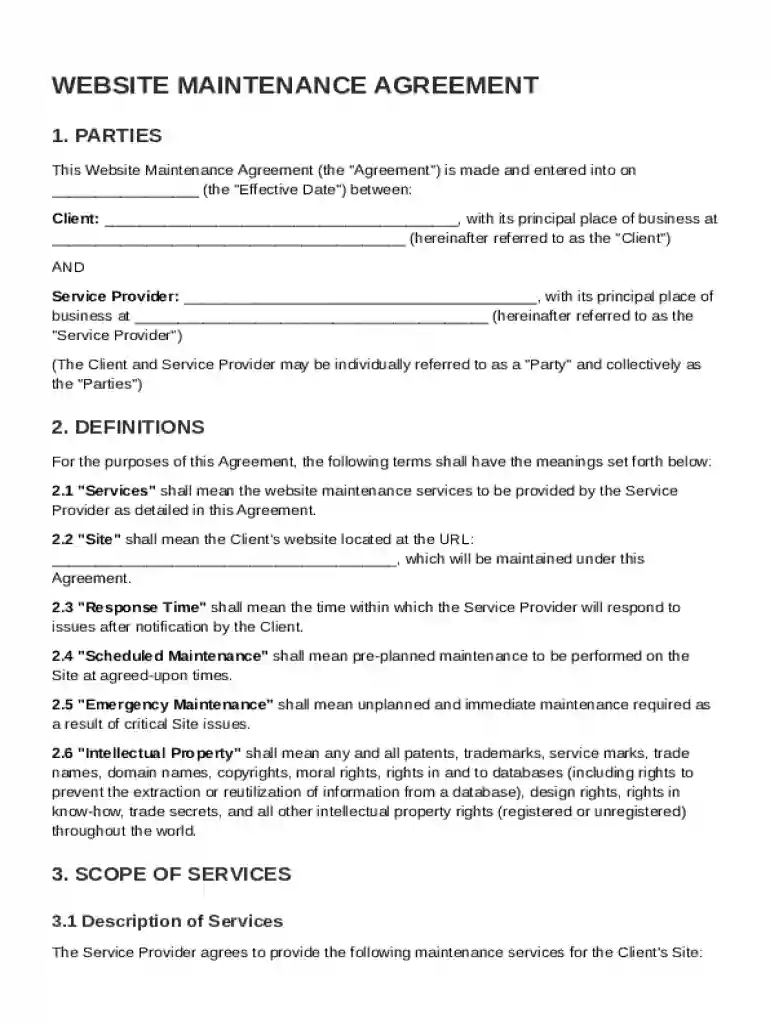
Type text, add images, blackout confidential details, add comments, highlights and more.

Draw your signature, type it, upload its image, or use your mobile device as a signature pad.

Send it via email, link, or fax. You can also download it, export it or print it out.
A Website Maintenance Contract Template is a comprehensive document that outlines the specifics of a maintenance agreement between a service provider and a client. For software compatibility, platforms like DocHub allow these contracts to be edited, signed, and managed efficiently online. The template typically contains several critical elements, ensuring that both parties clearly understand their roles, responsibilities, and expectations.
Scope of Services: This section describes the specific maintenance tasks that will be performed, which might include updates, bug fixes, backups, and security checks. It ensures that there are no ambiguities about what is included in the agreement.
Service Level Agreements (SLAs): It defines performance standards and timeframes for service delivery. This might include guaranteed response times for addressing issues or scheduled maintenance windows to minimize disruption.
Payment Terms: Details regarding how and when payments are to be made are included. This might cover the payment schedule, method of payment, and conditions for payment adjustments under specific circumstances.
Responsibilities of Both Parties: The template clearly outlines what is expected from both the client and the service provider. This might involve the client's obligation to provide access to the site or the provider's duty to maintain confidentiality.
Confidentiality and Intellectual Property Rights: Protecting sensitive information is paramount, and this section ensures that data and intellectual property remain secure and that proprietary information shared between parties is safeguarded.
Understanding specific terminologies in a Website Maintenance Contract Template is crucial to prevent misinterpretations. Here are some of the most commonly encountered terms within these contracts:
Maintenance Window: The timeframe designated for routine updates and bug fixes, minimizing disruptions to users.
Downtime: Refers to periods when the website is unavailable due to maintenance activities; SLAs often guarantee minimum downtime.
Incident Management: The documented approach to addressing and resolving unexpected issues that cause website disruptions.
Performance Metrics: These are the criteria set for evaluating how effectively the maintenance service is carried out, such as site load speed or uptime percentages.
Completing a Website Maintenance Contract Template typically involves several steps designed to ensure that all necessary information is included and agreed upon:
Review Each Clause: Both parties should read through the document carefully to understand the terms.
Fill in Basic Information: Include names, contact details, and other identifying information for both the client and service provider.
Define the Scope: Clearly specify the services that will be performed under the contract.
Add Specific Details: Insert specific performance metrics, response times, and maintenance windows.
Review Payment Terms: Confirm agreement on how and when payments will be made.
Sign the Contract: Use electronic signature options like those provided by DocHub for convenience and legality.
The legal enforceability of the Website Maintenance Contract Template relies on its proper execution:
Compliance with Legislation: Ensure that the contract aligns with relevant laws, such as state data protection laws or federal regulations.
Electronic Signatures: Under the ESIGN Act, digital signatures provided through platforms like DocHub are legally binding.
Dispute Resolution: Include clauses that describe how disputes will be resolved, such as through arbitration or litigation.
Practical scenarios demonstrate how a Website Maintenance Contract Template can be effectively employed:
Small Businesses: A local coffee shop might engage a web service agency using this template to continuously update their website with new promotions.
Non-Profit Organizations: An NGO could use it to ensure their site is safe from cyber threats and remains operational during fundraising campaigns.
Corporate Enterprises: Large companies might leverage tailored versions to standardize maintenance across multiple international branches.
This template is highly versatile and can be employed by various entities:
Freelance Developers: For establishing clear terms with their clients concerning ongoing website services.
Digital Agencies: They utilize the template to manage their obligations towards various clients efficiently.
In-house IT Departments: Corporates use them to formalize maintenance schedules with external service providers.


Using electronic templates for website maintenance contracts requires certain software compatibility:
DocHub Platform: Allows for the editing, signing, and sharing of contracts universally recognized by both parties.
Cloud Integration: Easy access through integrations with Google Drive and other cloud storage solutions.
File Format Support: Flexibility to work with different document formats like DOC, PPT, and PDF.
Website Maintenance Contracts should be tailored to adhere to state-specific regulations:
Data Protection Laws: Some states may have additional data protection requirements that must be included in maintenance contracts.
Consumer Protection Regulations: Varying consumer rights laws affecting how disputes can be handled or terminated.
Contractual Obligations: Ensure whichever state laws govern contract formation meet state-specific regulatory requirements.
Understanding these nuances can lead to more effective and legally compliant contract implementation.
At DocHub, your data security is our priority. We follow HIPAA, SOC2, GDPR, and other standards, so you can work on your documents with confidence.


Oct 1, 2025 Examples of services. General Website Maintenance For websites, PCS fulfills requests for maintenance and minor enhancements
1. Definitions. In the Merchant Agreement, and in the Terms Conditions, the following definitions shall apply: 3D Secure The Three-Domain Secure protocolRead more


