
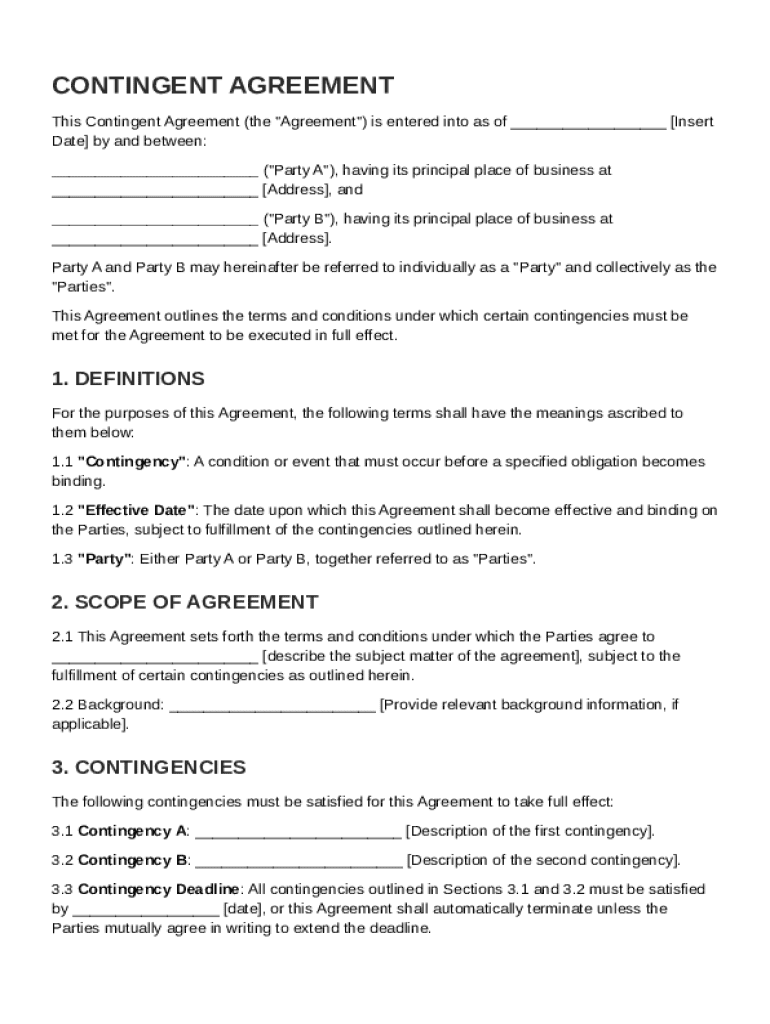







Definition and Meaning of a Contingent Agreement Template
A Contingent Agreement Template sets the groundwork for an agreement between two or more parties, specifying the conditions required for the agreement to become binding. This template outlines various aspects like definitions, obligations, and rights of involved parties. Contingencies refer to specific conditions or events that must occur for the agreement to hold true. These could be economic conditions, legal approvals, or any external event impacting the parties' collaboration. The template is a valuable tool in managing expectations and ensuring clarity over the contingencies critical to the agreement's validity. By spelling out these terms, the template reduces ambiguity and potential disputes.
How to Use the Contingent Agreement Template
Using a Contingent Agreement Template involves several key steps that ensure the document effectively captures the intended contingencies.
-
Identify Key Parties: Clearly state who the agreement involves. Identify each party by name and role to provide a clear understanding of responsibilities.
-
Define Contingencies: Clearly articulate the conditions or events that must occur for the agreement to be enforceable. Use precise language to avoid misunderstandings.
-
Outline Obligations: Specify the obligations of each party involved. This includes actions to be taken under specific circumstances and who is responsible for what tasks.
-
Include Termination Clauses: These clauses explain scenarios in which the agreement may be terminated if the contingencies are not met. This protects both parties' interests, providing a clear exit strategy.
-
Review and Revise: Before finalizing, review the document for completeness and accuracy. It's advisable to involve legal counsel to ensure compliance with applicable laws.
Key Elements of the Contingent Agreement Template
Several key elements are essential for the Contingent Agreement Template to fulfill its purpose effectively.
- Definitions: Provides clarity on specific terms used within the agreement.
- Obligations and Rights: Details duties and rights of each party.
- Contingencies: Outlines conditions necessary for the agreement to take effect.
- Termination Clauses: Describes how and when the agreement may terminate if conditions are unmet.
- Dispute Resolution: Provides mechanisms for resolving disagreements, such as mediation or arbitration.
- Governing Law: Specifies which jurisdiction's laws govern the agreement.
- Amendment Provisions: Explains how changes to the agreement will be handled.
Legal Use of the Contingent Agreement Template
Contingent Agreement Templates are valuable legal tools that align with U.S. contract law principles. These agreements ensure that all parties consciously agree to the contingencies that dictate contract enforceability. Legal use requires that:
- Compliance with Contract Law: The conditions outlined must be legal and achievable.
- Mutual Agreement: All parties should willingly agree to the terms, emphasizing the voluntary nature of the commitments.
- Good Faith and Fair Dealing: Parties must act honestly and fairly to fulfill the contract.
Understanding the legal context provides a foundation for enforcing the terms in court, should disputes arise.
Steps to Complete the Contingent Agreement Template
Completing the Contingent Agreement Template involves detailed steps:
-
Gather Information: Collect all necessary details regarding parties involved and the contingencies.
-
Draft Contingencies: Articulate the specific conditions clearly and concisely.
-
Include Obligations: Describe the responsibilities each party will undertake.
-
Write Termination Options: Specify how parties can exit the agreement if contingencies fail.
-
Review Legal Requirements: Ensure the agreement adheres to contractual laws and any relevant regulations.
-
Finalize and Sign: Have all parties review, agree, and sign the document.
This step-by-step approach ensures comprehensive completion, reducing potential legal challenges.
Who Typically Uses the Contingent Agreement Template
A wide range of entities utilizes the Contingent Agreement Template, including:
- Businesses: Frequently used in mergers, acquisitions, and partnerships where specific conditions need fulfillment.
- Individuals: Often used in personal agreements, like real estate transactions, where mortgage approval could be a contingency.
- Legal Professionals: Lawyers and legal advisors use these templates to draft precise agreements for their clients.
- Project Managers: Use it to clarify conditions under which projects move forward or change direction.
This diversity in use underscores the template's flexibility across various sectors.

Important Terms Related to the Contingent Agreement Template
Various terms are integral to understanding and effectively using a Contingent Agreement Template:
- Condition Precedent: A condition that must be met for the agreement to take effect.
- Condition Subsequent: A condition that might modify or terminate obligations post-formation of the agreement.
- Force Majeure: Events, such as natural disasters, that may absolve a party from obligations due to unforeseen circumstances.
- Material Breach: A failure, of possible consequence, by a party to uphold the agreement's essential elements.
- Arbitration: A method of resolving disputes outside courts, provided in the agreement.
Familiarity with these terms ensures the user effectively navigates the agreement's complexities.
Examples of Using the Contingent Agreement Template
Considering practical scenarios helps illustrate the template's utility:
- Merger and Acquisition: Company A acquiring Company B may use contingencies related to regulatory approval.
- Real Estate Purchase: Buyer and seller agree to terms contingent upon the buyer securing funding.
- Vendor Contracts: Supplier agreements might contain contingencies about delivery performance targets.
These examples demonstrate how contingencies ensure parties commit only under certain fulfilled conditions, making the template versatile across industries.




