






Definition and Importance of a Scope of Work Agreement
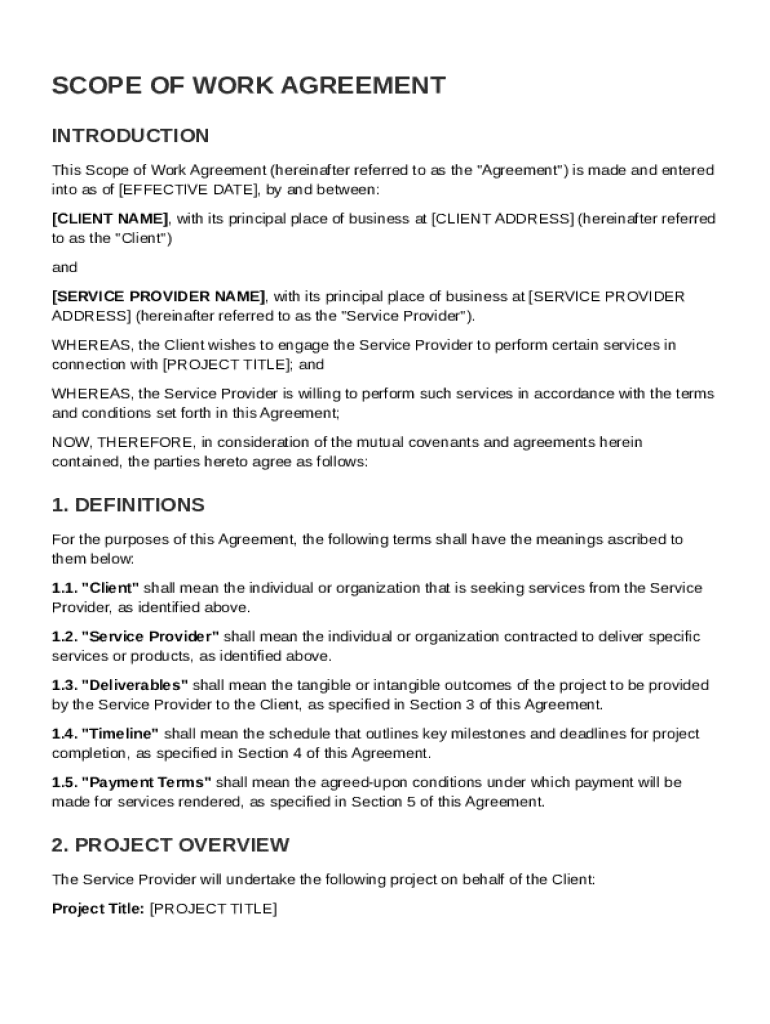
A Scope of Work Agreement is a critical document that outlines the terms and conditions between a client and a service provider for executing specific services related to a designated project. This formal agreement serves as a comprehensive framework to ensure that both parties have a mutual understanding of the project's requirements. It typically includes details such as project objectives, deliverables, timelines, payment terms, roles, and responsibilities. By providing clarity and structure, the document helps prevent misunderstandings and disputes, ensuring smooth project execution and compliance.
Steps to Complete the Scope of Work Agreement Template
-
Identify Project Details: Begin by clearly defining the scope of the project, including objectives and goals. Specify the start and end dates, as well as the overall timeline.
-
List Deliverables: Detail all expected deliverables, including descriptions, deadlines, and any standards or quality criteria they must meet.
-
Assign Roles and Responsibilities: Clearly delineate the roles and responsibilities of each party involved in the project, ensuring that everyone understands their contributions.
-
Outline Payment Terms: Document the payment structure, including milestones, due dates, and any penalties for late payments.
-
Define Change Management Procedures: Establish processes for handling changes to the project scope, including how alterations will be requested, approved, and documented.
-
Include Confidentiality and Dispute Resolution Clauses: Specify any necessary confidentiality agreements and outline the process for resolving disputes.
-
Review and Finalize: After filling out the template, review it for completeness and accuracy before final approval by all parties.
Key Elements of the Scope of Work Agreement Template
- Project Overview: A general description of the project to set the context.
- Scope of Work: Details the specific tasks and activities to be performed.
- Deliverables: Includes a list of expected deliverables, along with timelines.
- Payment Terms: Specifies the payment schedule and conditions.
- Roles and Responsibilities: Outlines the duties of each party involved.
- Change Management: Provides a system for managing changes to the scope.
- Confidentiality Clauses: Establishes any necessary privacy protections.
- Dispute Resolution: Defines how disputes will be resolved.
Legal Use and Compliance
In the United States, a Scope of Work Agreement must comply with general contract laws. This legality ensures that the document serves as a binding agreement between parties. It must be clearly written, with both parties understanding and agreeing to the terms outlined. Each provision within the document should be explicitly stated to avoid potential legal disputes. Additionally, inclusion of elements such as termination conditions and liability clauses adds further legal protection.
Who Typically Uses the Scope of Work Agreement Template
A wide range of professionals use Scope of Work Agreements, including freelancers, consultants, contractors, and businesses across various industries such as construction, IT, marketing, and event planning. These agreements are particularly useful in project-based work where clarity and detail are paramount. The template can be adapted for both small-scale and large-scale projects, making it a flexible tool for diverse professional needs.


State-Specific Rules and Variations
While the general format of a Scope of Work Agreement remains consistent across the United States, state-specific rules may affect certain provisions. For instance, states have varying laws regarding contract enforceability, termination clauses, or non-compete agreements. Therefore, it's crucial to tailor the template to comply with state-specific legal requirements. Consulting with a legal professional knowledgeable in the jurisdiction where the agreement will be executed can ensure compliance.
Examples and Real-World Scenarios
A marketing consultant might use a Scope of Work Agreement to define the deliverables for a campaign, such as a set number of advertisements, social media posts, and press releases, along with their respective deadlines. Similarly, in construction, a contractor may outline specific building phases, materials needed, and timelines to meet the client's requirements. These examples highlight how the agreement can adapt to different fields, ensuring that projects of all types and sizes proceed smoothly and efficiently.
Digital vs. Paper Versions
With advancements in digital technology, most Scope of Work Agreements now exist in electronic format. Digital versions facilitate easy sharing and editing, allowing for real-time collaboration and updates. They can also be integrated with document management systems for streamlined tracking and storage. Additionally, electronic signatures ensure that the document can be finalized quickly, saving time compared to traditional paper-based processes. However, a paper version might be preferred in scenarios where parties require hard copies for records or legal submissions.