



01. Edit your form online
Type text, add images, blackout confidential details, add comments, highlights and more.

Type text, add images, blackout confidential details, add comments, highlights and more.

Draw your signature, type it, upload its image, or use your mobile device as a signature pad.

Send it via email, link, or fax. You can also download it, export it or print it out.
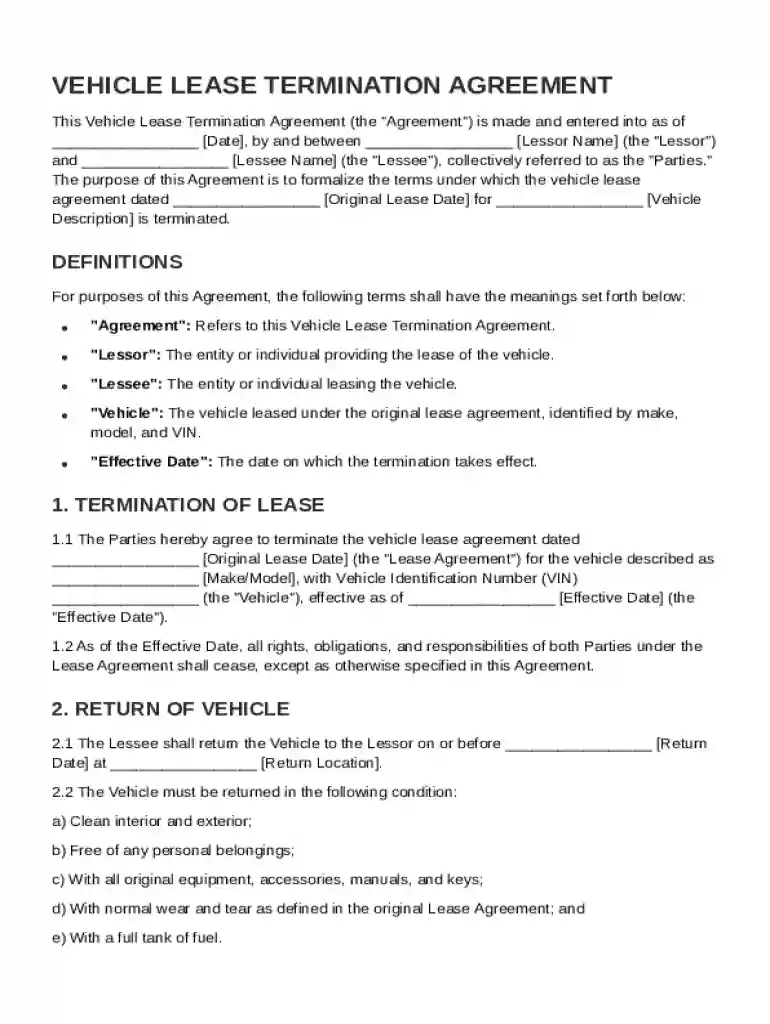
The Vehicle Lease Termination Agreement Template is a legally binding document used to formalize the end of a vehicle lease agreement between a lessor and lessee. This document delineates the specific terms and conditions for the termination process, helping to ensure that both parties understand their rights and obligations upon the conclusion of the leasing period. Typically, it includes crucial clauses related to the return of the vehicle, final financial settlements, and the handling of any potential disputes.
Fulfilling a Vehicle Lease Termination Agreement Template involves a structured approach to ensure all aspects are accurately addressed. Here is a step-by-step guide:
Review Lease Terms: Begin by reviewing the original lease agreement to understand conditions that apply during termination.
Complete Personal Information: Fill in the necessary details for both the lessor and lessee, including names, contact information, and any identification numbers associated with the lease agreement.
Detail Vehicle Information: Include comprehensive data on the vehicle, such as make, model, VIN, and any pertinent registration details.
Specify Termination Details: Clearly outline the termination date, vehicle return conditions, and any financial settlements, such as outstanding rents or penalty fees for early termination.
Review and Include Additional Clauses: Consider any additional clauses that may be relevant, such as confidentiality agreements or additional warranties.
Gather Signatures: Ensure that signatures are collected from all parties involved, indicating mutual agreement on the termination terms.
A well-constructed Vehicle Lease Termination Agreement Template will include several critical elements to ensure clarity and enforceability:
Identification of Parties: Clearly list the names and addresses of the lessor and lessee.
Vehicle Details: Accurate identification of the leased vehicle, including make, model, and VIN.
Termination Date: The exact date when the termination becomes effective.
Return Conditions: Detailed expectations on the vehicle's condition at return, accounting for normal wear and tear versus damage.
Final Payment Terms: Specification on how final payments are to be calculated, including any accrued interest or overdue lease itself.
Release of Liability: Mutual release clauses that absolve each party from future claims related to the lease once obligations are fulfilled.
Using this template legally ensures compliance with applicable regulations and protection against future disputes or claims. Here's how to ensure your agreement is legally sound:
Adhere to Governing Laws: Ensure the agreement aligns with the legal framework of the state where the lease was initially executed.
Compliance with Lease Act Regulations: All terms should be in line with the Uniform Commercial Code (UCC) and any pertinent leasing acts.
Mutual Consent: Both parties should voluntarily consent to the terms laid out within the document without any coercion.
This template is vital for various users, providing a framework for a smooth lease conclusion:
Lessee: Vehicle lessees who wish to terminate their lease agreement and return the vehicle.
Lessor: Dealerships, leasing companies, or financial institutions acting as the lessor, seeking a formal termination process.
Legal Advisors: Attorneys specializing in contract law who facilitate the drafting and execution process.


Laws governing vehicle lease termination can vary significantly by state. Here’s what you need to consider for compliance:
Specific Clauses Per State Laws: Some states might require specific clauses within the termination agreement to ensure enforceability and compliance.
Fee Structures: Differences in permissible fees for early termination could influence the financial calculations stipulated within the agreement.
Consumer Protection Regulations: Be aware of any state-specific consumer protection laws that could impact lease termination terms, especially regarding vehicle condition and return policies.
Real-life scenarios can highlight the utility of this document:
Scenario 1: A lessee wishes to end their lease early due to relocation. The agreement outlines the conditions, financial implications, and a clear exit strategy for both parties.
Scenario 2: A dealership uses the template to handle a batch termination for multiple leases, ensuring consistency and compliance across all documents.
Using such a template provides several advantages:
Clarity and Understanding: It establishes clear communication, outlining responsibilities and expectations for both parties.
Mitigate Risks: Reduces the risk of legal disputes post-termination by having a written, agreed-upon document.
Efficiency: Facilitates a quicker resolution process, allowing both lessee and lessor to manage transition periods smoothly.
Demonstrating best practices through detailed templates ensures successful, legally compliant vehicle lease terminations, protecting all involved interests.
At DocHub, your data security is our priority. We follow HIPAA, SOC2, GDPR, and other standards, so you can work on your documents with confidence.


