






Definition and Meaning of the Co-Owner Agreement Template
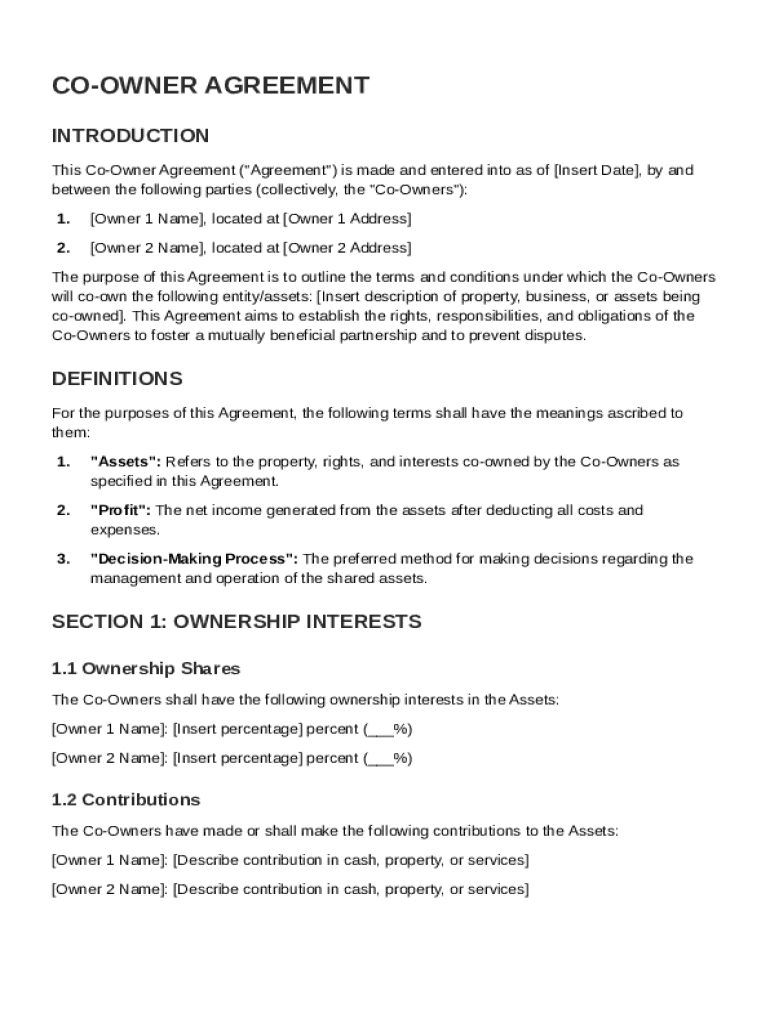
The Co-Owner Agreement Template is a legally binding document designed to outline the terms of co-ownership between two or more parties. This template establishes the framework for sharing ownership of specified assets, detailing aspects such as ownership interests, management roles, financial obligations, and operational responsibilities. By clearly defining these elements, the agreement helps prevent conflicts and ensures all parties are aware of their duties and benefits. The Co-Owner Agreement is crucial for maintaining a harmonious and productive co-ownership arrangement, offering a proactive solution to potential disputes.
How to Use the Co-Owner Agreement Template
Using a Co-Owner Agreement Template involves customizing the document to fit the specific needs of the co-owners and the asset in question. Start by gathering the necessary details about each party involved, the asset being co-owned, and the intended purpose of the co-ownership. Once you have this information:
- Review each clause of the template to ensure it aligns with your objectives.
- Customize sections such as financial contributions, management duties, and decision-making procedures.
- Add any additional clauses that may be specific to your agreement, such as dispute resolution processes or confidentiality requirements.
- Discuss the customized agreement with all parties to ensure clarity and mutual understanding.
- Seek legal counsel if necessary, to validate the agreement's enforceability.
Steps to Complete the Co-Owner Agreement Template
To ensure a complete and comprehensive Co-Owner Agreement, follow these detailed steps:
- Identify Parties: Document the full legal names and contact information of each co-owner.
- Asset Description: Clearly describe the asset subject to co-ownership, including its value and any unique identifiers (e.g., property ID, vehicle VIN).
- Ownership Interests: Specify the percentage of ownership for each party involved.
- Management Responsibilities: Outline the duties and roles each co-owner will fulfill in managing the asset.
- Financial Contributions: Detail each party’s financial commitments, including initial investments and ongoing expenses.
- Decision-Making Process: Establish a clear protocol for making decisions that affect the asset.
- Conflict Resolution: Include methods for resolving disagreements, such as mediation or arbitration.
- Signature and Date: All parties should sign and date the agreement to affirm their commitment.
Key Elements of the Co-Owner Agreement Template
A comprehensive Co-Owner Agreement Template must include several critical elements to ensure clarity and legal enforceability:
- Parties Involved: Details of each co-owner, including names and addresses.
- Description of Asset: In-depth information about the asset, ensuring all parties understand what is owned.
- Ownership Shares: Specific percentages or shares of ownership assigned to each co-owner.
- Roles and Responsibilities: Clearly defined management and operational responsibilities for each party.
- Financial Obligations: Listing of all financial commitments, contributions, and profit-sharing methodologies.
- Decision-Making Procedures: Established protocols for how decisions affecting the asset are to be made.
- Dispute Resolution Mechanism: Pre-agreed methods for resolving conflicts, such as mediation or arbitration.
Legal Use of the Co-Owner Agreement Template in the U.S.
In the United States, the legal use of a Co-Owner Agreement Template involves adhering to federal and state regulations that govern co-ownership structures. The agreement should comply with U.S. contract law, including mutual consent, lawful purpose, and consideration. It is important to:
- Ensure the document reflects any state-specific legal requirements.
- Include provisions for compliance with local zoning or business operation laws.
- Recognize the legal implications of each clause to prevent future legal disputes.
Examples of Using the Co-Owner Agreement Template
The Co-Owner Agreement Template finds practical use in a variety of co-ownership scenarios:
- Real Estate: Two or more individuals purchasing a property together.
- Business Partnerships: Shared interests in commercial enterprises, such as a startup.
- Vehicles: Joint ownership of expensive machinery or classic cars for personal or business use.
- Intellectual Property: Collaborations on patents, trademarks, or copyrighted works.
These examples illustrate how the template can be adapted to various asset types to secure ownership interests and responsibilities efficiently.
Important Terms Related to the Co-Owner Agreement Template
Understanding specific terminology is essential for creating an effective Co-Owner Agreement:
- Tenancy in Common: Each owner has a distinct, transferable ownership interest.
- Joint Tenancy: Equal ownership shares, typically with rights of survivorship.
- Fiduciary Duty: Obligations of co-owners to act in the best interest of the group.
- Indemnification: Protection against legal action for actions taken as co-owners.
Familiarity with these terms can aid in drafting a comprehensive agreement that anticipates future contingencies.
State-Specific Rules for the Co-Owner Agreement Template
Each state in the U.S. may have unique rules affecting co-ownership agreements, including:
- Community Property States: Laws impacting marital ownership, such as in California or Texas.
- Title Registration Requirements: Protocols for recording ownership of specific asset types, like real estate.
- Local Zoning and Licensing Laws: Regulations for businesses that vary significantly between states.
It is vital to consult legal resources or professionals to ensure compliance with state-specific regulations that may impact the Co-Owner Agreement.
By following this detailed and structured approach, individuals can effectively utilize the Co-Owner Agreement Template to establish clear, enforceable arrangements, ensuring all parties understand and agree to their roles and responsibilities within the co-ownership framework.